
- Collection type
- Object
- Description
- Small wooden dance mask, well carved, closed eyes, peaked red hair over brow, white face.
- Long description
- Description taken from Conservation Card by Heather Richardson - Wooden dance mask with very delicate features that have Japanese characteristics - slit eyes + pursed lips. Stylistically carved hair line + prominent brim. Hewn from single piece of of low density wood. Face smoothly carved. Painted with red, white + yellow pigments. Plant fibre string between holes on either side. Wooden pegs of various dimensions: 225 x 160mm. (Heather Richardson 25/01/02) [LKG 30/01/2009] Description taken from Conservation Card by Robert Pearce - Mask of human face carved from soft wood. Slits for eyes. Face painted white and lips + above eyebrows painted red/brown. Holes in rim on either side through which are tied either end of a length of plant fibre cord (3 ply). (Robert Pearce 26/03/02) [LKG 30/01/2009]
- Geographical reference
- Cultural groups
- Shira-Punu Vili (Ivili)
- Person
- Maker Unknown Maker
- Field collector Robert Bruce Napoleon Walker
- PRM source Augustus Henry Lane Fox Pitt Rivers founding collection
- Date / Period
- Date made: Before 1867?, uncertain Date made: Definitely by 1875
- Date collected
- By 1875 December 14
- Acquisition information
- Donated: 1884
- Materials and processes
- Material Wood Plant, Material Pigment, Material Plant Fibre, Material Metal, Process Carved, Process Painted, Process Twisted
- Dimensions
- Height: max 220 mm, Depth: max 130 mm, Width: max 170 mm
- Object numbers
- Accession number: 1884.114.114 PR Cat other PR nos: 3315
- Research and responses
Prior to 1985 the mask was documented under French Equatorial Africa - this has been changed to Gabon for ease of reference. Apparently this is the oldest known White Mask from the Ogowe area. Three others of identical iconography are in the Museums of Liverpool, Leiden and Hamburg (Info from Barbara Delaney, February 1986). [JC]
Wooden dance mask in what is currently (1995) known as the Shira-Punu style. NB Perrois does not give a source or authority for the specific provenance he gives. The date given by Perrois [see on] for the mask's acquisition by General Pitt Rivers is wrong. It must have been acquired before 1884 when it entered this Museum's collection, and was almost certainly acquired on the date indicated by the label on the mask itself that reads '14.XII.75', i.e. 14 December 1875. (See above.) The Museum also has an as yet unlocated 'half-plate negative of a carved and painted wooden dance-mask from the Ivili Tribe', purchased from the Ashmolean Museum in 1949'. It is not yet known whether this is a photograph of the Museum's mask or of a similar one. As for Walker being the source of the mask, it is neither on the published Anthropological Society list of Walker's collection (see Journal of the Anthropological Society of London, Vol. V (1867), pp. cxlix-clii), nor on the handwritten list in the PRM's possession (see Coll. Misc. XI, 257-263) that comprises the Anthropological Society list and other specimens in the collection of General Pitt Rivers that had been collected by Walker. It seems highly likely that the mask was indeed collected by Walker, but assuming that it was we cannot yet say whether it was bought (or otherwise obtained) directly from Walker or indirectly via the Anthropological Institute. [JC]
In Gabon, white dance masks are used for bereavement ceremonies and initiations. Their colour comes from the application of white clay (kaolin) on the mask's surface, signifying the world of the dead and ancestral spirits.
- Associated publications
- Illustrated (front, and right profile) in plate VI (fig. 52) of Die Masken und Geheimbunde Afrikas (Nova Acta: Abhandlungen der Kaiserlichen Leopoldinisch-Carolinischen Deutschen Akademie der Naturforscher, Vol. LXXIV, no. 1), by Leo Frobenius (Halle, 1898); see xerox in RDF. It is also listed there (p. 18) as follows: 'Maske der Ivili. University Museum in Oxford. Nr. 3315. a von der Seite b von vorn. Museumsangabe: 'used in their dances'. [JC] Illustrated in colour as plate 35 on page 78 of Primitive Art by Douglas Fraser (London: Thames and Hudson, 1962). The caption (p. 79) describes it as a 'spirit mask' and records that it was 'collected in 1875'; this date presumably being arrived at from the label on the mask (see above). (There is a general discussion of Ogowe River masks on pages 75-6.) [JC] Illustrated (drawing only) as fig. 54 on p. 101 of Ancestral Art of Gabon from the Collections of the Barbier-Mueller Museum, by Louis Perrois (Geneva, 1986). Perrois discusses it as follows: 'The Oldest known Okuyi mask is in the Oxford Museum. It was collected from the Ivili of Zile Lake (Lambarene) in 1867 by Bruce Walker, an English traveller and merchant, father of Reverend Andre Raponda Walker, the illustrious and erudite Gabonese nonagenarian, now deceased. The mask was acquired in 1894 by Pitt Rivers and published by Frobenius in 1898. It is a sober carving, highly polished with a stylized oval face. It has large, highly arched eye sockets, split coffeebean eyes with a tiny almond-shaped opening, puckered lips, naturalistic ears, and typical visor-like coiffure projecting forward from the forehead. The mask is colored with whitish kaolin on the cheeks and eye sockets and red ochre on the forehead and coiffure.' See also the general discussion on their use etc., pp. 95-103 (xerox in RDF). In a letter dated 4 August 1995 (original and translation in RDF) Perrios explains his reasons for giving the specific provenance detailed above. [JC] Illustrated in colour and discussed in 'History Unmasked', by Christine Bloxham, in Limited Edition (March 2000), p. 13 (photocopy in RDF). Bloxham's text draws on the Museum's records to relate what is known about the mask and its history. [JC 13 3 2000] Illustrated in colour on page 27 of Pitt Rivers Museum: An Introduction, by Julia Cousins (Oxford: Pitt Rivers Museum, University of Oxford, 2004). Caption (same page) reads: 'Painted wooden dance mask, made by a Shira-Punu artist in the Ogooué River area of Gabon, Africa. This is the oldest known example of its type in the world. Part of the founding collection.' [JC 8 10 2004] Illustrated in colour and black and white (reproduced from Frobenius's work of 1898, see above) as Figure 5 on page 112 of 'The White Masks of South Gabon: History, Context and Styles (1st Part)', by Louis Perrois and Charlotte Grand-Dufay, in Art Tribal: Traditional Arts from Africa, Asia, Oceania, and the Americas [English edition], number 08 (Spring/Summer 2005), pp. 108-27. [JC 7 7 2005] Illustrated in colour on page 51 of 'Les masques', by Christiane Falgayrettes-Leveau, in Gabon: présence des esprits, edited by Christiane Falgayrettes-Leveau (Paris: Editions Dapper, 2006), pp. 21-55. Falgayrettes-Leveau briefly discusses the mask and its history on page 48. [JC 5 10 2006] Illustrated in colour as plate 41 in Punu (Visions of Africa series), by Louis Perrois and Charlotte Grand-Dufy (Milan: 5 Continents, 2008). Also illustrated as a black-and-white 'thumbnail' on page 140 in the 'Plate Captions' section: 'Shira or Ivili. Okukwè or Okuyi dance mask. Pitt Rivers Museum, Oxford (UK), Inv. 1884.114.114. Painted wood. H.: 21.5 cm. The small mask, with a white and red ochre face abd black headdress, was collected by Robert Bruce Walker in 1867, in the Lamaréné region, among the Ivili of Lake Zilé. Bought by Lieutenant-General Pitt-Rivers in 1884 [sic]. Reproduced by Leo Frobenius in Die masken und geheimbünde Afrikas, 1898 (pl. VI, fig. 52ab). Its oval face tapering to a pointed chin has a domed forehead and very high, arched concave eye sockets. The "visor" headdress, in the Shira style, forms a slanting halo round the top of the face. Half-closed almond-shaped eyes, a fine nose and delicately outlined lips.' In their 'sylistic overview of Punu white masks', the authors place the PRM mask in 'Type 2a', discussed on pages 62-3: 'This variant, which is very particular in its sober, expressive style, is most interesting because it seems very old. It is thought to be a regional substyle localised between the present-day sites of Lambaréné (on the Lower Ogooué) and Fougamou (lower valley of the Ngounié). Indeed, one of the first white / masks to be collected - and above all recorded - in Europe belongs to this category. It was found by Robert Bruce Walker in 1867 during his first expedition exploring the middle reaches of the Ogooué, a region that was completely unknown at the time, not far from present-day Lambaréné, in the area around Lake Zilé where a group of Ivili had settled. The mask is now in the Pitt Rivers Museum, Oxford, [(]ref. 1884.114.114) and belongs to the series of the famous "visor" masks. [new paragraph] Very soberly carved but carefully finished, the face is oval, or rather ovoid, with a pointed chin and broad forehead. Set in large sockets accentuated by slightly raised eyebrows (and upside-down omega, [symbol]), the half closed eyes slant towards the temples in the "coffee bean" style, witch arched slits that harmonise with all the curves in the upper parts of the mask. The V-shaped mouth has well-defined stretched lips dyed red (the mask in the Dahlem Museum in Bderlin, collected before 1895 in the lower valley of the Ogooué, has a mouth with fine lips, parted to show pointed teeth; the one in Liverpool, also an old specimen, published by Frobenius in 1898, has no incisors), and the nose is fine and quite short, in the Punu style. Resting on finely carved ears standing out from the head, the hairstyle is a sort of "visor" that angles over the forehead with a band emphasising the hairline.' The authors go on to discuss other examples of the style. [JC 26 4 2013]
Search terms: Mask, Dance, Dance Accessory
Further items to explore
 2020.40.19Covid face mask2020.40.19
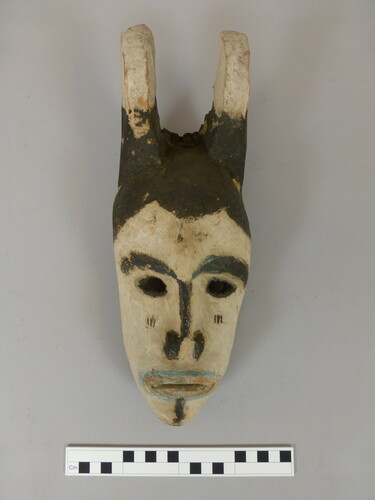 1938.15.18Face mask, human features with white face and two horns. [ZM 08/04/2013]1938.15.18
 1967.49.1.4Cane bound with strings along its length. For the associated objects see 1967.49 .2 - 1967.49.1 .4. [CW [OPS move] 14/10/2016]1967.49.1.4
 1884.114.591 of 51 padded fabric covers for Japanese Noh Masks [JN 3/12/2001]1884.114.59
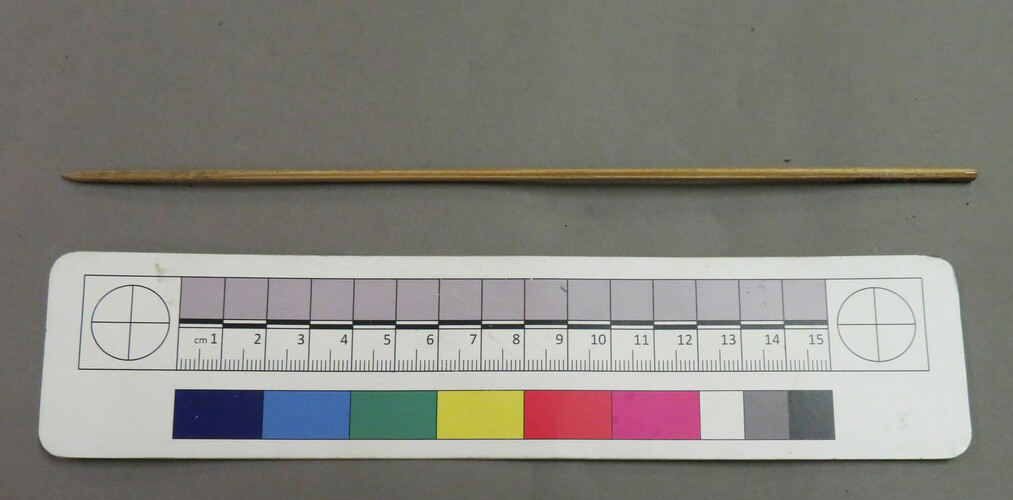 1884.17.4.45Bamboo arrow with pointed tip. For associated quiver, arrows and leaves for fletching see [1884.17.4 .1 - .85] [EH [OPS move] 3/10/2017]1884.17.4.45
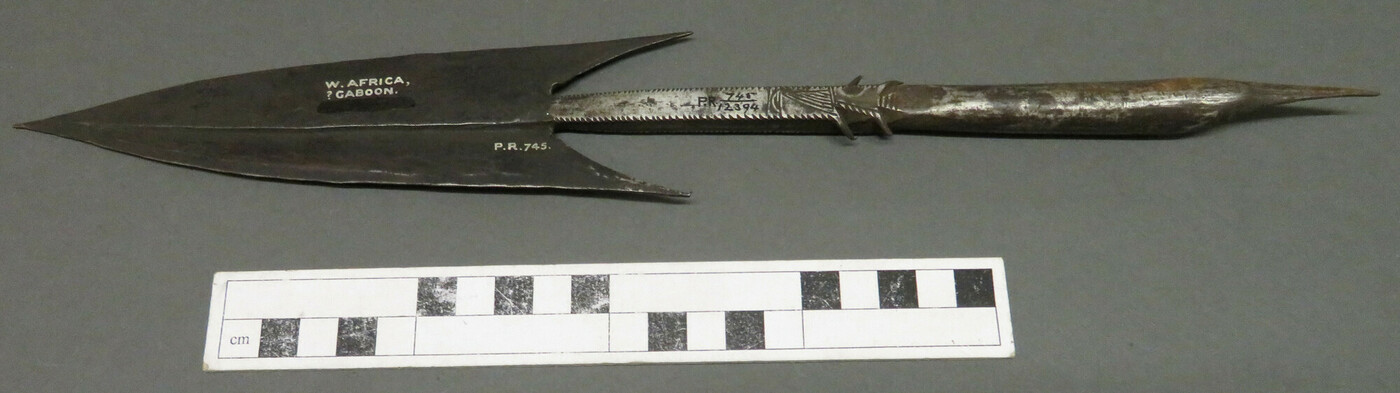 1884.19.119Spear. Made from iron with a pointed blade with two barbs. The handle of the spear is spiked at the end and is incised with decorative patterns and is barbed. [SB [OPS Move] 23/6/2017]1884.19.119
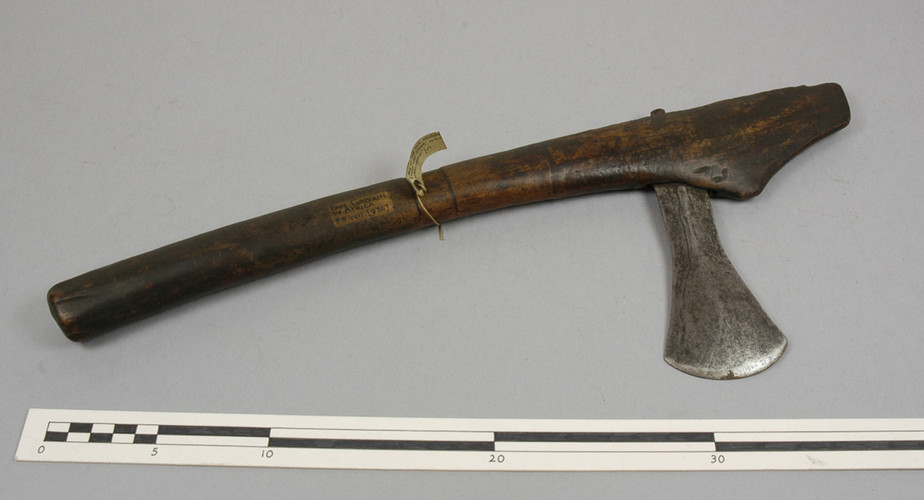 1884.21.8Axe with expanded and convex blade. The haft is wooden and shaped. It has several letters deeply incised into it on one surface. [SM 09/07/2007]1884.21.8
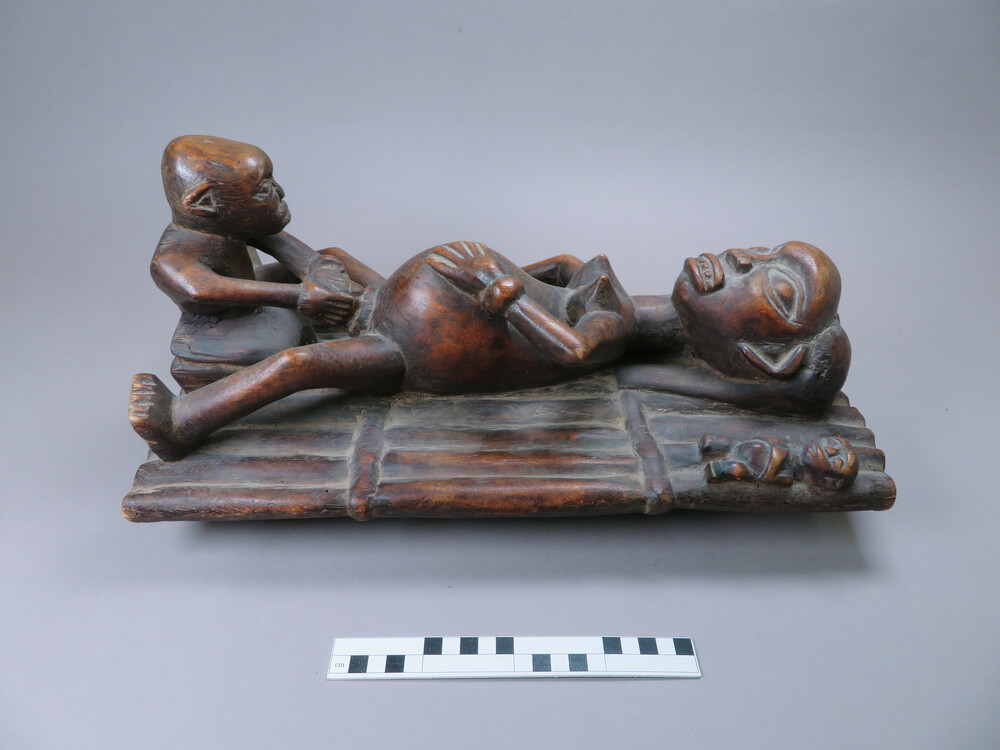 2024.21.4Carved wooden birth scene.2024.21.4