
- Collection type
- Object
- Description
- Noh mask of a thin old man.
- Long description
- Mask of an old man carved from a single piece of wood, with a gesso and paint surface finish on the front and black lacquer on the back. The proper right ear has been lost. There are three pieces of textile on the back, the largest being on the proper right side in dark blue. Grey animal hair has been used to represent head hair and a beard. Eyebrows and moustache have been painted on in black. There is a large amount of paint loss, particularly to the proper right cheek. [HR 24/10/2006]
- Cultural groups
- Japanese
- Person
- Maker Unknown Maker
- Field collector Unknown Collector
- PRM source Augustus Henry Lane Fox Pitt Rivers founding collection
- Date / Period
- Date made: Possibly before 1880 Archaeological period: Early Edo Period, uncertain
- Date collected
- ?Prior to 1880
- Acquisition information
- Donated: 1884
- Materials and processes
- Material Wood Plant, Material Pigment, Material Animal Hair, Material Textile, Process Painted, Process Carved, Process Lacquered Varnished
- Dimensions
- Depth 97 mm, Width: max 160 mm, Length: max 230 mm excluding beard, Weight 282 g
- Object numbers
- Accession number: 1884.114.24 PR no.: 318/ 11351
- Research and responses
Related Documents File - Typed transcription from the Bulletin of the Noh Research Institute No. 22, 1997, Hosei University Noh Research Institute, published 25 May 1998. By Nishino Haruo. Translated by Rachel Payne, Pembroke College, Oxford, October 1998: The text relating to this mask is as follows: '318. Kojo [Footnote 6: Kojo - a mask of a god incarnated as an old man.] * The mask's shape is that of a Koushi-jo [Footnote 26: Koushi - A mask carved by Koushi, a carver mentioned in the 15th century 'Sarugaku Dangi']. Right ear is damaged .' [JN 23/10/2001]
Typed report on the Noh masks [1884.114.7 - 58 and 116 and 117] drawn up by Jeremy Coote. In this listing the notes are listed under the heading A, B and C refer as follows:
A = as listed on a 19th century description possibly printed in Yokohama, B = on the list compiled by T.K. Penniman from information from Arthur Waley's 'The No Masks of Japan' Henry Joly's "Legend in Japanese Art' and V.F. Weber's 'Ko-ji Ho-ten'. C = from information provided 17 June 1993 by Professor Fukushima Kazuo, Director of Research Archives for Japanese Music, Ueno Gakuen College Tokyo following a visit to the PRM in 1984. 1884.114.24 Identified as: A 'A person in very humble circumstances, as a boatman 270 years old' B 'Sanko mask of old man'. No inscription.
One of a set of 52 Noh or No masks for which the Museum also holds 51 silk covers (1884.114.59 - 109). An old label, surviving only as a photograph (NEG A9.F27.32; see RDF), listing all the masks in this collection, reads as follows:
'Old Japanese Masks used in the No-dances and other Theatrical performances, both religious and secular.
'The following is a description of the Masks, printed in YOKOHAMA:-
'These Masks were recently on view at the Exhibition at KIYOTO, the former capital of Japan, to which they were loaned by the owner, who is proprietor of a theatre in TOKIO. There are said to be only two superior collections in Japan, both of which are in the possession of ex-DAIMIOS. These Masks have been used in the No-dances and other Theatrical performances, both religious & secular, for many years. They were made by Buddhist Priests during their leisure hours, & the ages of the Masks, as given below, shew their antiquity.'
'[The List follows; see RDF for this and other identifications.]
'Notwithstanding the high taste for Art displayed in Japanese works the entire absence of nobility and elevation of character in all representations of the human form cannot fail to strike the observer.'
The masks were also identified by T. K. Penniman, from information gleaned from Arthur Waley's 'The No Masks of Japan', Henri Joly's 'Legend in Japanese Art' and V. F. Weber's 'Ko-ji Ho-ten'. See RDF for this and other identifications. [JC]
Please note, the original list of these masks has been found and is in Solander Box 2. [MdeA 2/2/2001]
Further information from Rachel Payne, Queens College Oxford 2003. This mask is very important. Her research with noh mask makers in Japan suggests that this mask may date back to the 15th Century or possibly even 14th century (unconfirmed) as the carving of the wrinkles seems to be of a style that was discontinued in the very early evolution of noh masks. [JN 15/1/2003] [JN 13/9/2005]
Search terms: Mask, Theatre and Drama
Further items to explore
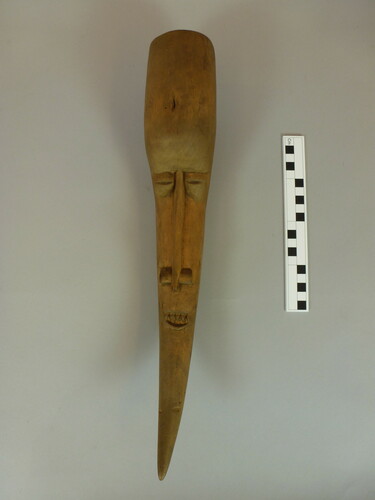 1938.15.29Head-dress mask of the water spirit Igbo [ZM 21/08/2013]1938.15.29
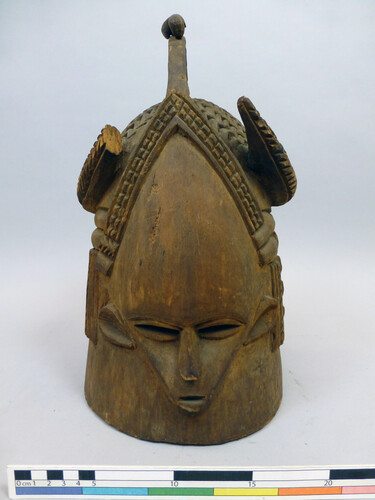 1908.23.4Helmet mask.1908.23.4
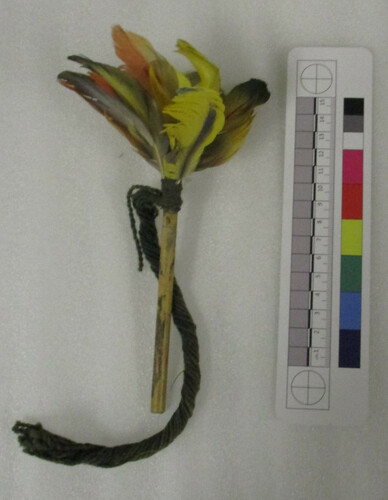 1967.49.1.3Detachable feather topped cane, part of a feathered mask. For the associated objects see 1967.49 .2 - 1967.49.1 .4. [CW [OPS move] 14/10/2016]1967.49.1.3
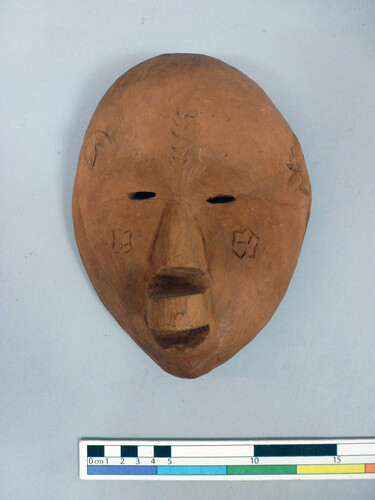 1921.23.15Wooden face mask representing a female with scarification, plus wearing a lip stud. [ZM 22/04/2013]1921.23.15
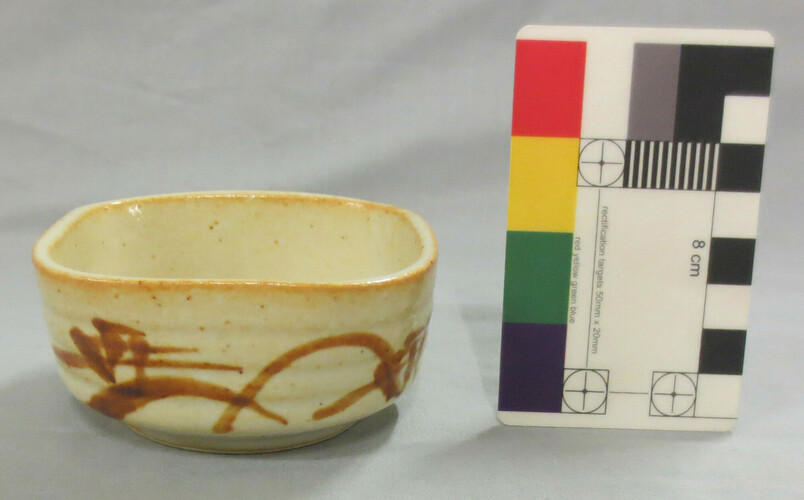 1996.17.252.1[1 of ] Set of four square bowls, slightly irregular and rustic in shape with a ridged exterior. [ASh [OPS move] 03/03/2016]1996.17.252.1
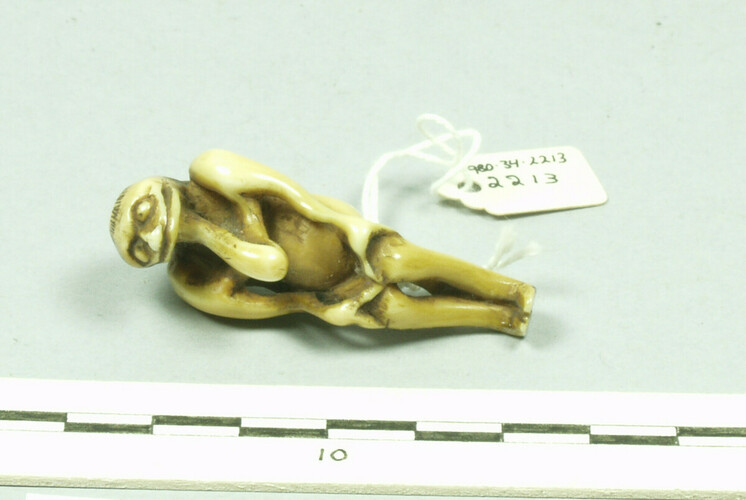 1980.34.2213An ivory toggle shaped like a creature with a birdlike head and prominent nose with a long neck, small feet and tail. [El.B 'DCF 2004-2006 What's Upstairs?' 5/5/2005]1980.34.2213
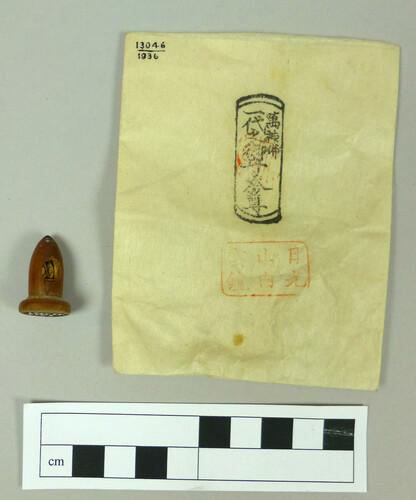 1985.53.894.1Amulet, folded paper printed with a cylinder with inscription and a red stamp. For figures contained inside the paper see [1985.53.894 .2] [EH [OPS Move] 27/6/2017]1985.53.894.1
 1980.34.2306.3A leather bag, framed and decorated with brass and steel. Attached to a brass netsuke toggle used as an ash tray [1980.34.2306 .1] with leather cord secured with a bead [1980.34.2306 .2]. [LB 'DCF 2004-2006 What's Upstairs?' 23/5/2005]1980.34.2306.3