
- Collection type
- Object
- Description
- End-blown trumpet/flute, putorino, carved from wood, which is of two pieces bound together with plant fibre.
- Long description
- End-blown trumpet/flute, putorino, carved from wood, which is of two pieces bound together with plant fibre. The flute has been carved with a stylised human figure at one end, a human face with protruding tongue at the other and in the centre with human figure with open mouth, the mouthpiece. All the figures have been inlaid with Haliotis shell eyes. The flute is bound in six places with neat rattan binding.
- Geographical reference
- Cultural groups
- Māori
- Person
- Maker Unknown Maker
- Field collector Unknown Collector
- PRM source Augustus Henry Lane Fox Pitt Rivers founding collection
- Date / Period
- Date made: 1700-1800, uncertain Archaeological period: Puawaitanga Period
- Date collected
- By 1874
- Acquisition information
- Donated: 1884
- Materials and processes
- Material Wood Plant, Material Haliotis Shell, Material Plant Root, Material String, Process Bound, Process Carved, Process Decorated, Process Inlaid
- Dimensions
- Diameter 170 mm mouth hole, Length: max 670 mm
- Object numbers
- Accession number: 1884.112.11 PR Cat other PR nos: 2173
- Research and responses
Studied by Alistair Fraser (http://www.maoriart.org.nz/al-fraser-p-567.html musician) on the 29 April 2015. He made the following observations: Putorino 667 mm long 42 mm deep by central wheku 56 x 59 mm either side of wheku (mask). Centre of centre mangai 329 mm from proximal. Mangai (centra) 34 mm x 14 mm x 8 mm. Kiekie root binding x 8 (1 missing with marking evident). 3 x wheku (face masks). Central wheku has body curving under the rear of flute. Femal Hine Roukatauri goddess of flute music. Proximal mangai interior 20.5 mm x 16 mm. Distal wenewene 3 mm - rounded (unusual). Uneven patina - more shine on rear/underneath and perhaps due to being played. Proximal wheku 89 mm long Central wheku 73 mm wide at "temple' outer 64 mm wide at check outer. Distal wheku 45 mm long approx. [FB 01/05/2015]
Examined by Professor Nghauia Te Awekotuku, of the University of Auckland, on 2 November 1994. Her notes (of which there is a copy in RDF) read: 'Putorino: "bugle flute". Made from two pieces of matai wood, sealed & bound together by aerial roots of the epiphyte kiekie (freycintia banskii). Probably Puawaitanga period - 18C[entury]: dominant central figure female form. Possibly renowned ancestress / composer / musician of instrument's maker &/or player. Tiny form at smaller end delightful comment - playing / biting right foot. Larger end form interesting - note double manaia pronounced to form large "ears" of raised head.' [unsigned, undated; JC 13 12 2007]
In Salisbury and South Wiltshire Museum Pitt Rivers ms collections there is a handwritten list [P141] headed 'A catalogue of M. General [sic - Major General] Pitt Rivers' Anthropological Collection Objects illustrating Animal Form conventionalised in Ornamentation from different countries' which seems to be a list of all items which were associated with the display entitled 'Illustrations of Human and Animal form Cases 92 - 93' in Bethnal Green and South Kensington Museums. A photocopy of this list is held by Alison Petch [AP 23/03/2005]
In 1978, David Simmons recorded the holdings of Māori material in a number of museums in Europe and North America including, in May 1978, the Pitt Rivers Museum. (For copies of his notes and related correspondence, see RDF: Researchers: Simmons.) In 1996, Simmons put together the ‘draft catalogues’ he had prepared, depositing copies in, at least, the National Library of New Zealand / Te Puna Mātauranga o Aotearoa and the British Museum. The ‘draft catalogue’ of the Māori material in the PRM, which includes photocopies of some of the relevant catalogue index cards and annotations supplied by PRM assistant curator Lynne Williamson in 1982, was included in ‘Draft Catalogues of Maori Material in English Museums II. Prepared by David Simmons from records made in 1978… Compiled in Auckland in 1996’. It is now widely accepted that Simmons’s assertions about the provenance and history of individual Māori objects are not to be trusted without further evidence and/or documentation. Nevertheless, as the entries in this document have been referred in the literature, in July 2016 I obtained from the British Museum scans of the pages devoted to the PRM’s collections (numbered by hand as pages 43 to 62), printing out a copy for the RDF. For the entry for this object, see page 52 (page 8 on Simmons's original list). [JC 28 7 2016]
Search terms: Music, Figure, Musical Instrument, Trumpet
Further items to explore
 1917.14.5.2Musical Instrument - Pair of sistra of wood and brass. For other related rattle, see 1917.14.5 .1 [LC 21/1/2020]1917.14.5.2
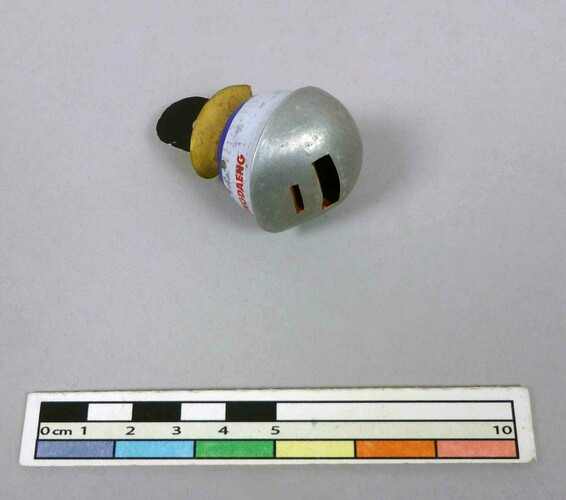 2014.44.2Pigeon whistle made from wood, metal and plastic. The cap of the whistle is painted silver with two slots, one bigger than the other. [FB 27/01/2015]2014.44.2
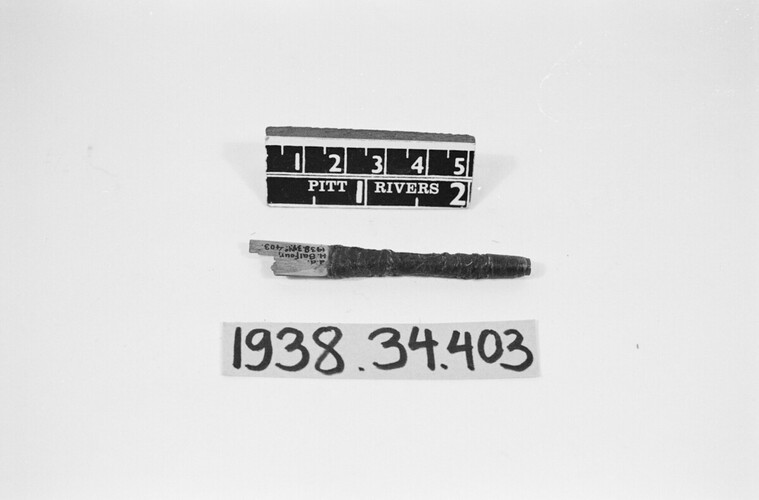 1938.34.403Double reed for Northumbrian bagpipe. Tied onto small brass cylindrical staple with waxed string.1938.34.403
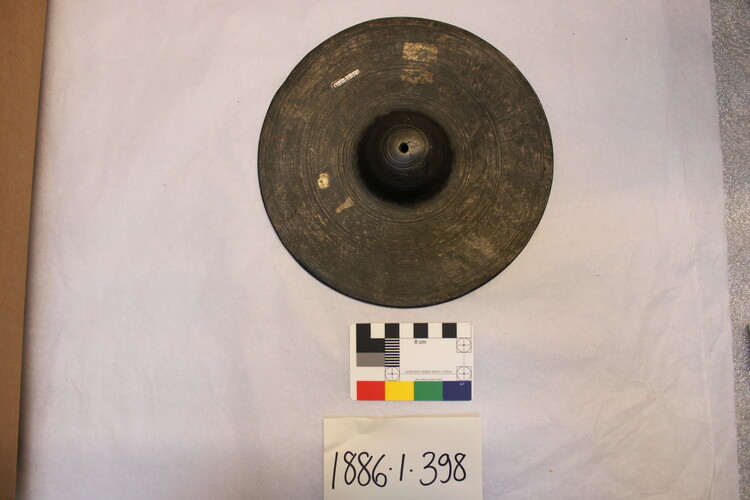 1886.1.398Gong or cymbal1886.1.398
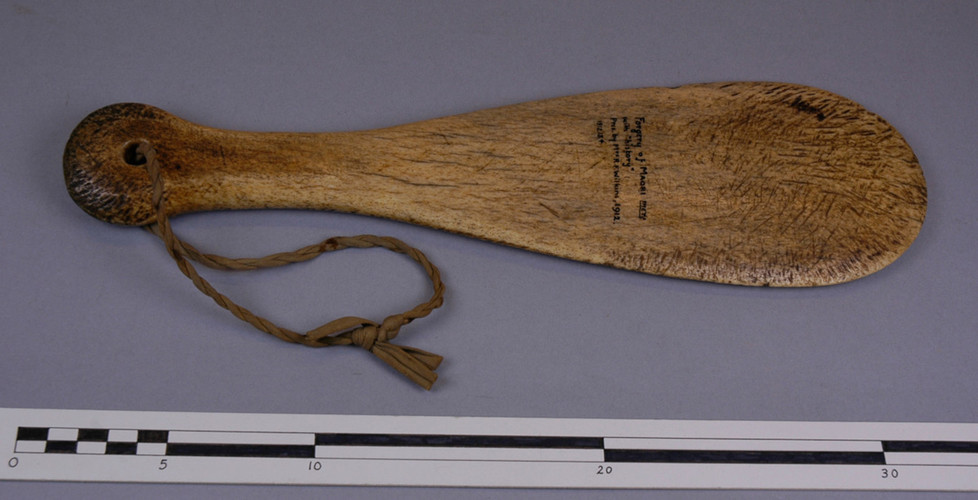 1912.13.4Reproduction bone club, with flat expanded head that is rounded at the end and rounded butt with a hole through the centre. [SM 14/02/2008]1912.13.4
 1930.82.28.2One cutting end of a very small chisel of nephrite.1930.82.28.2
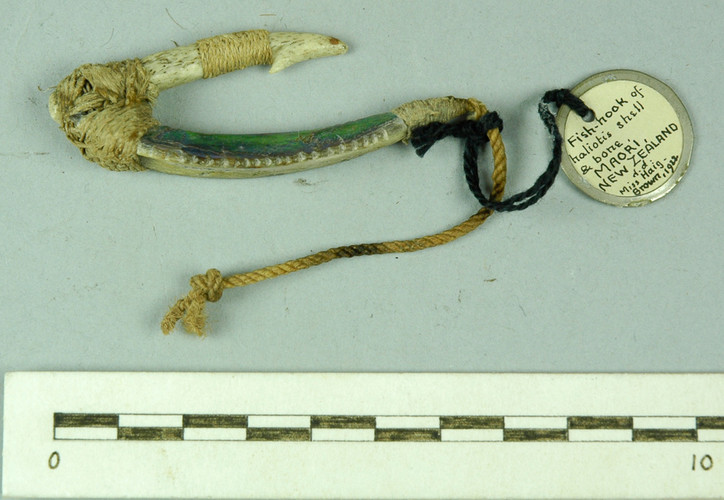 1922.9.2Fish hook of haliotis shell and bone hook. The barbed hook is bound to the shell shank with plant fibre. [MJD 11/03/2009]1922.9.2
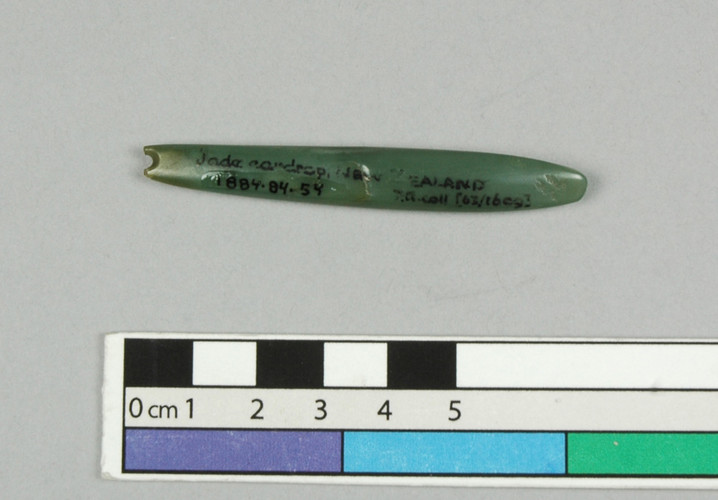 1884.84.54Ear drop of greenstone with broken perforation at the top. [El.B DDF Body Arts Project 2010/2011 17/11/2010]1884.84.54