
- Collection type
- Object
- Description
- Small penannular iron arm ornament with lozenge-shaped section [RTS 2/4/2004].
- Long description
- Penannular arm ornament made from an iron bar with angular, lozenge-shaped section, tapering to each flat-cut end, where the section becomes oval. The bar has been bent into a loop with open ends, 20 mm apart. The surface has been polished, and is currently a metallic gray colour (Pantone 421C). The object is complete and intact, with minor surface flaws. It measures 69 by 60.5 mm across the outside edges, and 51.5 mm across the inside edge, with a maximum thickness of 9.8 mm, a height of 13 mm, and a weight of 68.4 grams. The small diameter suggests that this was probably worn around the wrist [RTS 2/4/2004].
- Geographical reference
- Cultural groups
- Bongo
- Person
- Maker Unknown Maker
- Field collector John Petherick
- PRM source Augustus Henry Lane Fox Pitt Rivers founding collection
- Date / Period
- Date made: Possibly before 1858
- Date collected
- 1858
- Acquisition information
- Donated: 1884
- Materials and processes
- Material Iron Metal, Process Forged (Metal), Process Hammered, Process Polished
- Dimensions
- Length 69 mm, Width 60.5 mm, Thick 9.8 mm, Height 13 mm, Weight 68.4 g
- Object numbers
- Accession number: 1884.82.42 PR no.: 103/ 1621
- Research and responses
This object is said to have been collected in 1858; in that year Petherick led a trading expedition through Bongo territory, an account of which is given in his 1861 volume, Egypt, The Sudan and Central Africa; he refers to this group as the Dor. The expedition entered Bongo territory on January 25, 1858, visiting villages called Djau, Kurkur, Maeha, Mura, Umbura, Modocunga, Miha, Nearhe, Gutu, Mungela, Ombelambe and Lungo. Later in February they passed back through the Bongo villages of Djamaga and Lungo again. This material was shipped back to England in 1859 [RTS 20/1/2004].
In Egypt, The Sudan and Central Africa, 1861, p. 401, Petherick describes Bongo women as wearing numerous iron bracelets on their wrists. See also J.G. Wood, 1868, The Natural History of Man Vol. I, p. 499. “On their wrists they wear bracelets, made simply of iron bars cut to the proper length, and bent round the wrist.” [RTS 14/1/2004].
Search terms: Ornament, Arm Ornament
Further items to explore
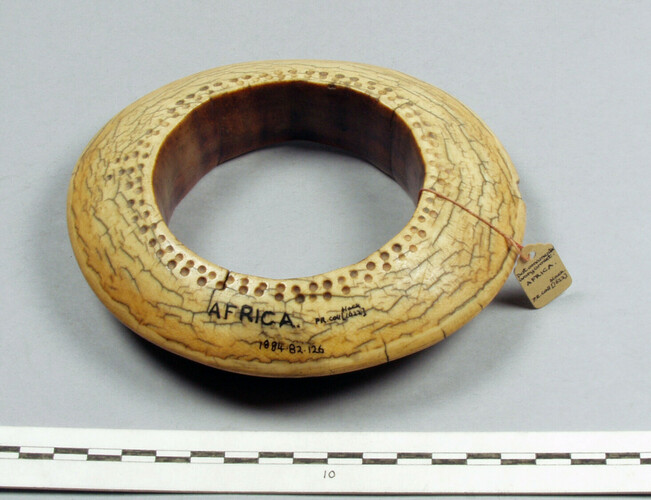 1884.82.126Oval ivory armlet with double dot ornament along the inner edge; flat hexagonal profile. [EC 'DCF 2004-2006 What's Upstairs?' 24/10/2005]1884.82.126
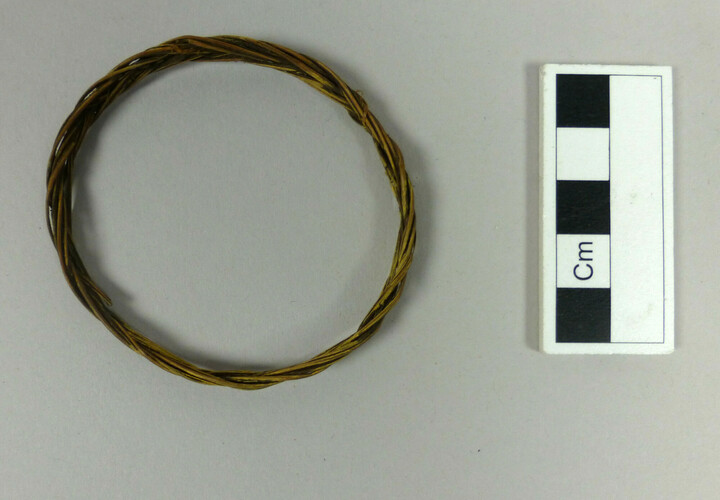 1917.6.24Arm ornament made of plaited cane and grass. [El.B 'DCF 2004-2006 What's Upstairs?' 24/11/2005]1917.6.24
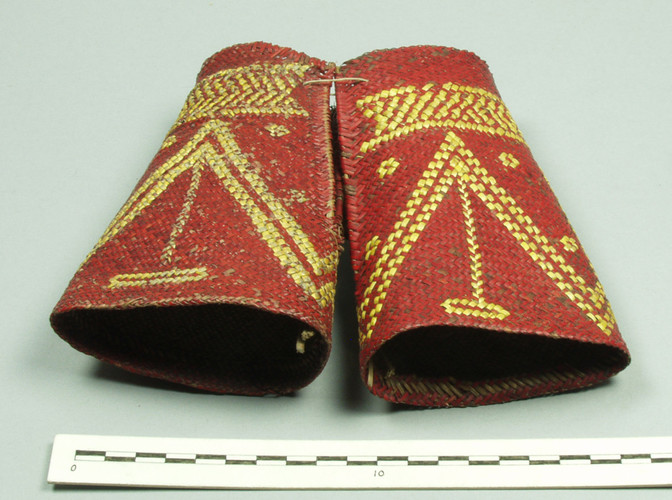 1923.84.319.1Pair of wristlets, twill plaited from red-dyed cane, with zigzag overlay designs in yellow orchid stem. Side openings with cane stiffeners. [LM 'DCF 2004-2006 What's Upstairs?' 11/11/2005]1923.84.319.1
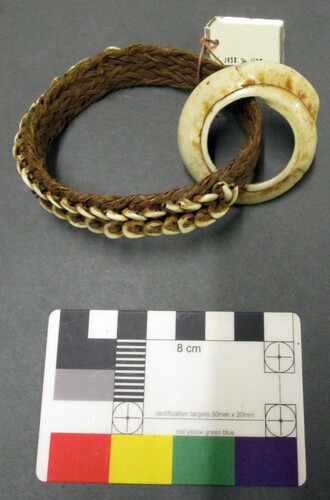 1938.36.1659Armlet of fibre with slightly ground conus shell ring. Bordered along the edge of the plaited fibre band with small white shells in an oval shaped loop. [ASh [OPS move] 11/11/2016]1938.36.1659
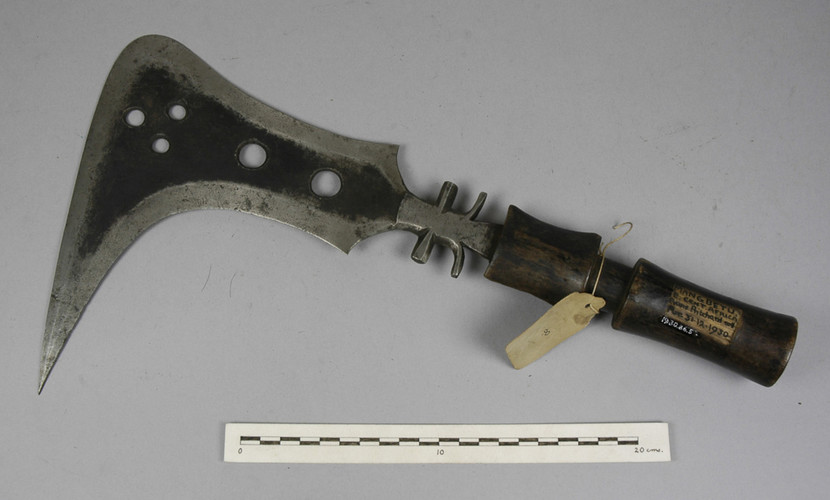 1930.86.5Knife with curved edged iron blade with long spiked tip and carved wooden handle. [SM 08/06/2007]1930.86.5
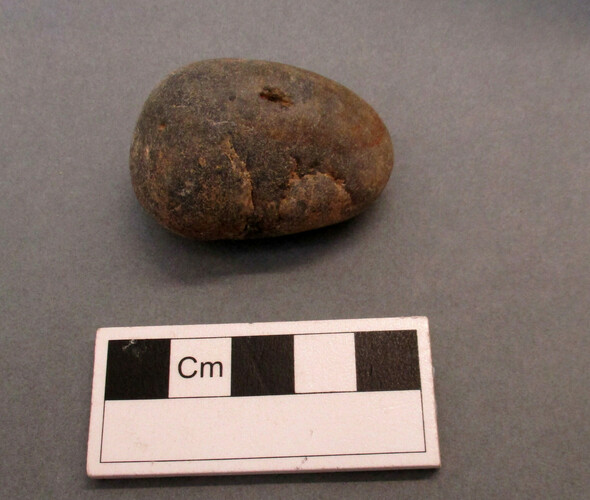 1985.54.809Amulet. Grey stone with orange stains, ovoid in shape. [PR [OPS] 09/03/2017]1985.54.809
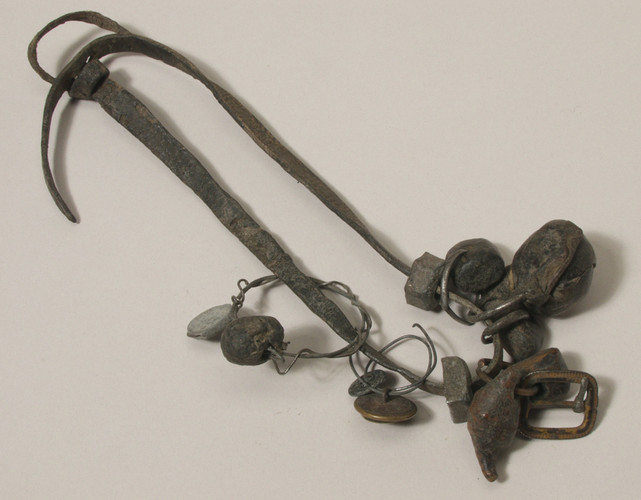 1903.16.128Hide necklet strung with iron and brass rings, wire, a lead seal, wooden beads, a nut or seed capsule, leather charm capsules, metal buttons, nuts and a buckle [RTS 2/8/2004].1903.16.128
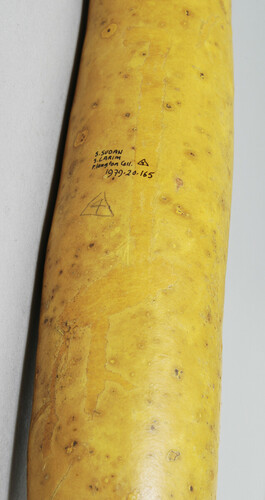 1979.20.165Long narrow gourd with hooked top, used for storing ostrich feathers and decorated with sgraffito ostrich design [RTS 16/8/2005]1979.20.165