
- Collection type
- Object
- Description
- Lenticular iron knife with punched decoration on one surface, used by women [SM 15/06/2007]
- Long description
- Iron knife, made in a single piece and consisting of a slightly convex disc handle, oval in plan view, with a short, round sectioned shaft below, hammered flat on two sides just before tapering out to form a lenticular blade with flat underside and slightly convex upper surface, of slightly irregular thickness, thinning to two cutting edges on either side. This blade tapers in again at the other end to form a slightly splayed, blunted point, thickened and hammered flat on either side, with the upper surface flattened and sloping down to the end. The upper surface of the blade is decorated with a series of incised motifs, made up of short straight or oval depressions that were probably created using a pointed metal punch with a hammer or hammerstone. These consist of two straight lines extending out from the handle end, parallel with the outer edge, with a zigzag filling the space between line and edge; on one side, this has degenerated into simple crosshatching. A running zigzag extends from the apex formed by these two lines, down along the centre of the length, where it meets an oxhide-shaped design with flat top and base lines and concave sides, filled with regular roughly parallel rows made up of short lines. The first three rows are curved, but the pattern then beomes less regular and more tightly spaced. A rectangular motif follows, comprising another zigzag that continues to follow the central line of the blade, framed by straight lines on either side, and then a series of rows made of short lines - twenty rows on one side, nineteen on the other, with a straight line framing the design on one side, parallel to the cutting edge of the blade. There was probably a similar line acting as a frame on the other side, but the design is worn on this part of the knife, probably as a result of use. The oxhide-shaped motif filled with incised lines is repeated on the other side of this rectangular panel, then the framed zigzags follow the edges of the blade to the other end, with a single row of short broken lines between them, running along the centre of the blade. Complete and intact; opaque silvery gray surface (approximately Pantone 423C). Total length 237 mm, diameter of handle 12 x 10.7 mm, diameter of shaft 5.5 mm, maximum width of blade 33.6 mm, minimum width of blade just above point 4 mm, maximum thickness of blade 2 mm, thickness at cutting edge 0.2 mm [RTS 15/3/2004].
- Geographical reference
- Cultural groups
- Bongo
- Person
- Maker Unknown Maker
- Field collector John Petherick
- PRM source Augustus Henry Lane Fox Pitt Rivers founding collection
- Date / Period
- Date made: Possibly before 1858
- Date collected
- 1858
- Acquisition information
- Donated: 1884
- Materials and processes
- Material Iron Metal, Process Hammered, Process Punched, Process Incised, Process Forged (Metal)
- Dimensions
- Length 237 mm, Width 33.6 mm, Thick 2 mm
- Object numbers
- Accession number: 1884.63.28
- Research and responses
This object is said to have been collected in 1858; in that year Petherick led a trading expedition through Bongo territory, an account of which is given in his 1861 volume, Egypt, The Sudan and Central Africa; he refers to this group as the Dor. The expedition entered Bongo territory on January 25, 1858, visiting villages called Djau, Kurkur, Maeha, Mura, Umbura, Modocunga, Miha, Nearhe, Gutu, Mungela, Ombelambe and Lungo. Later in February they passed back through the Bongo villages of Djamaga and Lungo again. This material was shipped back to England in 1859 [RTS 20/1/2004].
Similar knives are illustrated in J.G. Wood's, The Natural History of Man, 1868, p. 503 figures 3-4, where they are described as women's knives; these are attributed to the Jur of Sudan. These illustrated examples are almost identical to 1884.24.205 (said to be from Gaboon, West Africa) and 1884.24.206 (said to be from West Africa), and may even be the same pieces, badly drawn. Both knives are of similar style and design to 1884.63.28. Schweinfurth calls this type of knife a tibah, and states that Bongo women use them to peel vegetables and slice up gourds (G. Schweinfurth, 1975, Artes Africanae, pl. IV.7,8; In the Heart of Africa, 1873, p. 281). See also E. Castelli, 1984, Orazio Antinori in Africa Centrale 1859-1861, cat. no. 26-29, pp 49-50, all attributed to the Bongo (Museum of Perugia 49525-8). A further example in the British Museum was collected in 1867; their attribution to the Zande is probably incorrect (Accession number 4460, E. Schildkrout & C.A. Keim, 1990, African Reflections, fig. 5.10) [RTS 2/2/2005].
- Associated publications
- Illustrated in colour (PRM image PRM000007969) as '65c "Spear point"' on page 399 of The Fateful Journey: The Expedition of Alexine Tinne and Theodor von Heuglin in Sudan (1863–1864) – A Study of their Travel Account and Ethnographic Collections, by Robert Joost Willink (Amsterdam: Amsterdam University Press, 2019). Also listed on page 437: '65c "Spear point"' | Collection Petherick, Inv.nr. 1884.63.28 (registered as: "collected in 1858, Bongo?"), Pitt Rivers Museum, Oxford | Materials: iron | Dimensions: L. 23,7 x W. 3,36 cm'' [JC 8 10 2019]
Further items to explore
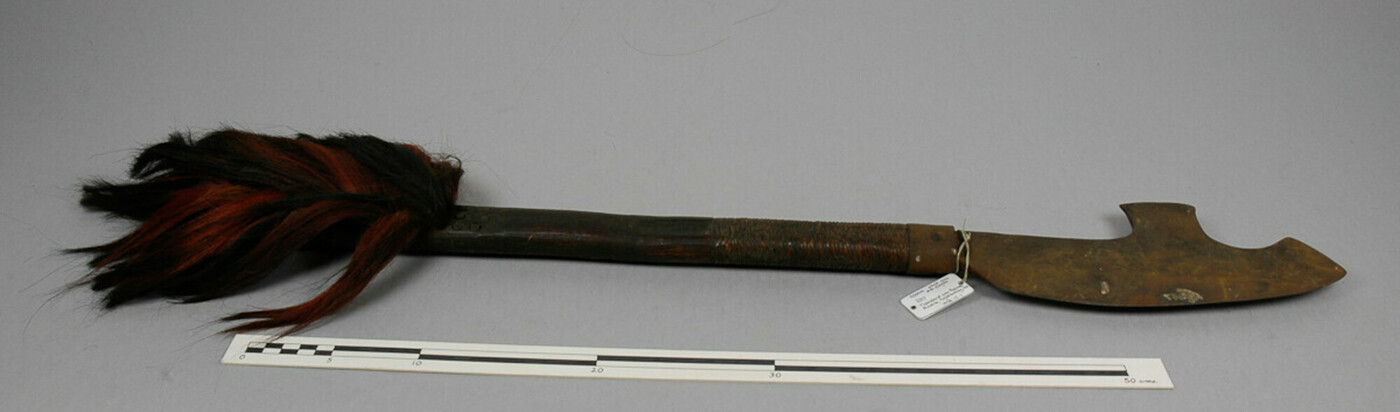 1978.15.1Dao with single-edged blade with two indentations at the back of the blade. With wooden handle bound with plaited cane. Red and black goat hair tassels inserted into the top of the handle. [El.B 05/07/2007]1978.15.1
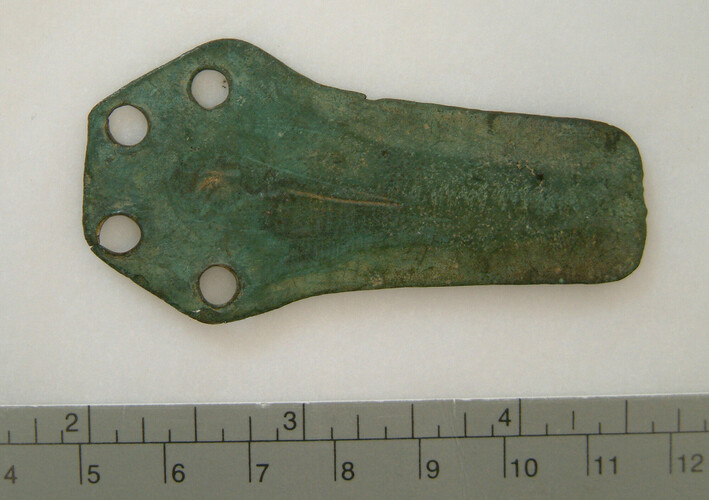 1884.119.277Base of knife balde.1884.119.277
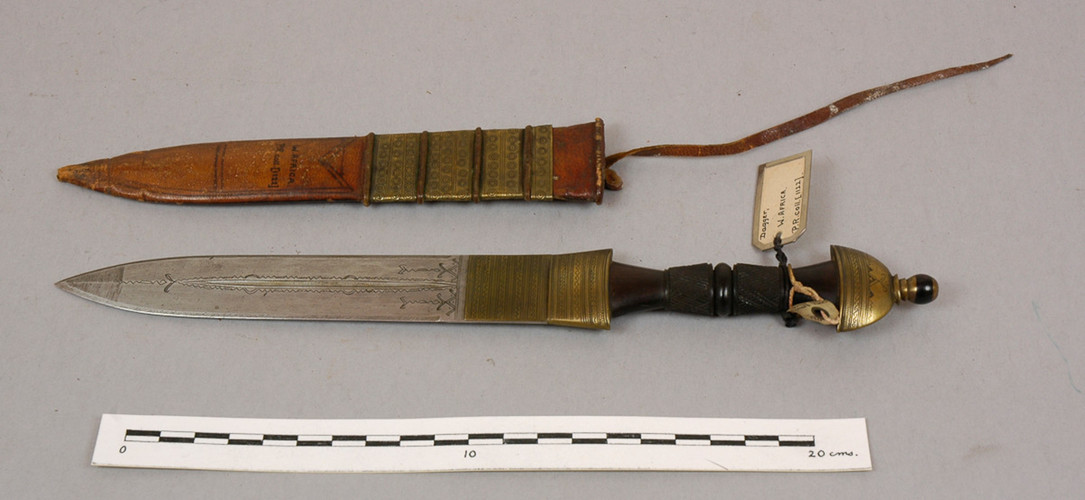 1884.24.256.1Finely-made brass-mounted dagger [.1] with ebony grip and brass pommel. Brass-mounted leather sheath [.2] [LM 03/07/2007]1884.24.256.1
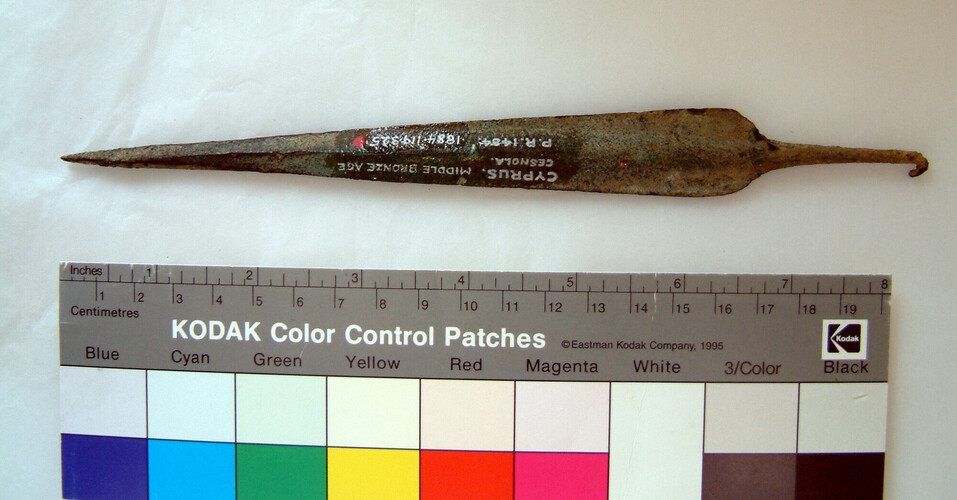 1884.119.325Copper hook-tanged dagger blade from Cyprus; probably Middle Bronze Age in date. [Dan Hicks 30/04/2012]1884.119.325
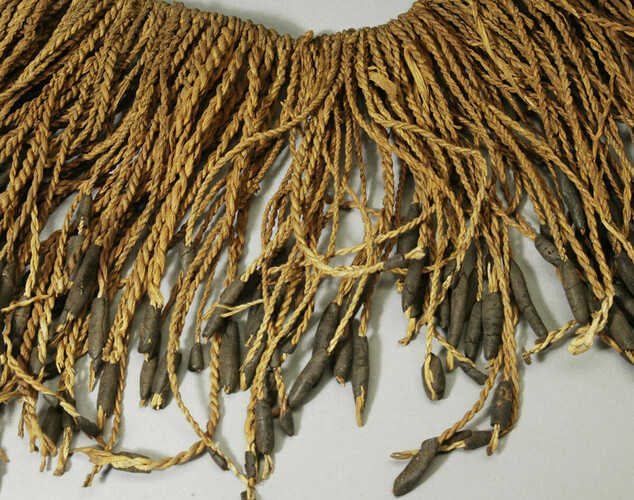 1936.10.64Fringed dance skirt made from twisted fibre cords weighted with barrel-shaped pellets of clay [RTS 16/9/2005].1936.10.64
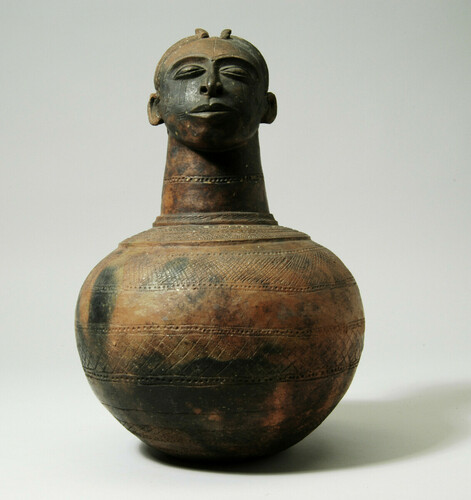 1950.12.117Human-headed pottery jar with narrow oval opening at back of head, on a globular body with incised, impressed and painted decoration [RTS 17/9/2004].1950.12.117
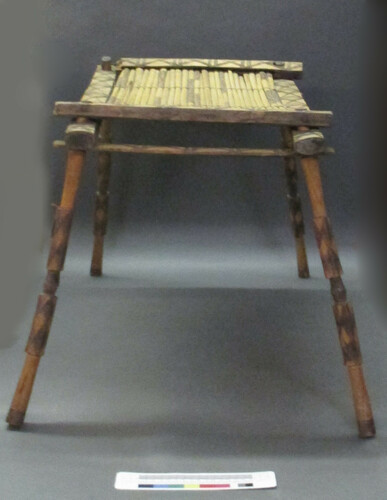 1952.5.62Wooden stool with split bamboo seat. It has four legs. The legs and frame are decorated with incised, blackened lozenge and criss-cross patterns. [PR [OPS move] 19/5/2017]1952.5.62
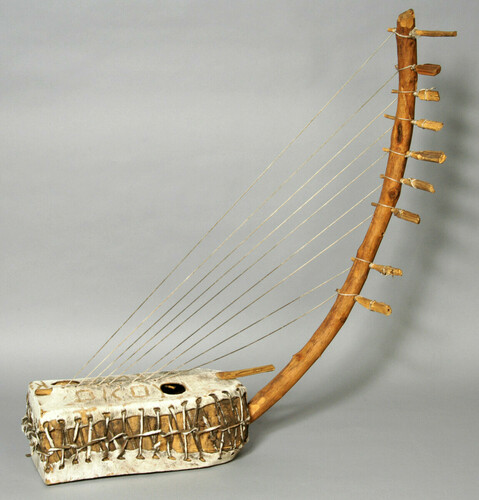 1994.60.1Bow harp with nine surviving strings and rectangular hide-covered resonator, with letters cut into surface.1994.60.1