
- Collection type
- Object
- Description
- Chilkat apron backed with caribou hide and decorated with bottom fringe strung with deer hooves and puffin beaks.
- Long description
- Chilkat apron backed with leather and decorated with bottom fringe strung with deer hooves and puffin beaks. The woven decoration on the front of the apron is widest at the top and then curves to form a narrower area in the centre and toward the bottom of the apron. The leather backing has been made from segments of hide stitched together. There are long leather thongs sewn onto each top corner of the apron to allow the wearer to tie it around the waist. There are two layers of leather fringe along the bottom. One layer set forward is decorated with upper mandibles of puffins tied to the bottom of the fringe. The other layer is set back and is decorated with deer hooves tied to the bottom of the fringe. The woven pattern is done in black, yellow, blue and white yarn spun from mountain goat wool. The face of the central animal figure is in the centre of the apron. There are ears visible and set over two large eyes which contain face designs within them. There is a wide, slim nose and a mouth visible. There are paw or claw designs at the bottom of the apron, pointing outward in opposite directions. [CAK 25/05/2010]
- Geographical reference
- Person
- Maker Unknown Maker
- Field collector Unknown Collector
- PRM source Augustus Henry Lane Fox Pitt Rivers founding collection
- Date / Period
- Date made: Before 1877, uncertain
- Date collected
- ?Prior to 1877
- Acquisition information
- Donated: 1884
- Materials and processes
- Material Caribou Skin Deer Animal, Material Goat Hair Yarn Animal, Material Deer Hoof Animal, Material Puffin Beak Bird, Material Cedar Wood Plant, Process Twined Woven, Process Embroidered, Process Strung, Process Dyed
- Dimensions
- Length: max 1030 mm across top, Width: max 710 mm at centre, including fringe
- Object numbers
- Accession number: 1884.56.82
- Research and responses
According to a recent NW Coast First Nations Visitor [Dolores Churchill] this piece is probably Tsimshian rather than Chilkat because the colouration is blue/green rather than the blue colour used by the Chilkat. There is a possibility that the blue was derived from boiling ? Royal Naval uniforms. [JN Sept 2000]
Changed provenance from original computer entry before PR Leverhulme project began.
The following information comes from Haida delegates who worked with the museum’s collection in September 2009 as part of the project “Haida Material Culture in British Museums: Generating New Forms of Knowledge”:
This object was viewed in its case, though with the case open, on Tuesday Sept 15, 2009. It was not prepared for the visit as its provenance was listed as Tsimshian or Tlingit, however Haida delegates were very taken with it and wanted to see it. Nika Collison and Kwiaahwah Jones described the techniques used to make the apron as an S-twist in black, yellow and blue threads with yellow cedar Z-twist warp. Natalie Fournier explained that by using pounded cedar, the finished cloth was stiffer. They explained that Chilkat is a cross-over of basket and textile weaving. The yarns would have been mostly hand spun and rolled on the thigh. They thought the bottom, fine circle was very delicate with three rings.
The style and technique of this apron was made by both Tlingit and Haida, though Nika Collison and Natalie Fournier thought this apron was Haida. The Haida word for Chilkat weaving was given as Naaxem. The materials were confirmed as mountain goat hide with yellow cedar, deer hide on the top part of the apron. The softness of the hide was remarked upon and Nika Collison offered that the reverse of the weave is quite rough, so a soft backing was desirable. The apron is lined with leather and attached to the bottom are puffin beaks at the front and deer hooves at the back. It was explained that puffins are native to Haida Gwaii and shed their beaks once a year. These can be collected from Marble Island and Flat Rock. Deer hooves are easier to find than puffin beaks and make the same kind of noise and so were also used. The hooves on this apron were thought to be small, much like the small deer found on Haida Gwaii. It was thought that the apron was probably made post-contact because of the deer hooves, an introduced species on Haida Gwaii. Natalie Fournier explained that Haidas weave from the left to the right only. Nika Collison admired the formline woven into the apron and thought it was very advanced and the best eyes she has seen. The bird on the front of the apron was thought to be an eagle. It is interesting that two different shades of blue thread have been used. Extra fringing has been added onto the bottom of the apron. Nika found a red line drawn on one of the tassels, which may have been used to show the length of where the tassel should be cut. Different weights of thread have been used; perhaps a mixture of commercial and home spun thread. In two areas in particular the weaver has consciously used a heavier blue and green thread. Delegates were uncertain why this was as the weaver was clearly skilled and would have had ample light weight wool at their disposal. One delegate commented that the weaving is so well executed that it looks like the image has been painted onto the apron. The wefts are well hidden like they have been woven back into the weave. Nika thought the yarn to be home spun. The weaving is very fine, with the thread count being 16 ends per inch; the average nowadays is 12 counts per inch. The weave is a strong weave from the age of the apron, to have kept so well. The hue of the blue dye could be analysed to pinpoint where on Haida Gwaii this apron was made.
In historic times, Haidas explained that men painted formline patterns for the weaving on boards, and the women wove the pattern from that template. Lucille Bell clarified that the pattern board would be full size, and just off to the side, for the weaver to work from.
One delegate explained that both men and women wore Chilkat aprons for dancing, however Natalie Fournier thought that only males would have worn Chilkat historically -- either the male chief, or a male dancing on the chief's behalf. Nika Collison thought the shape of this particular apron indicated it was a man's apron.
Delegates distinguished Chilkat from Raven's tail weaving. Chilkat or Naaxem is worked in sections and the weaver is able to create curves and circles. Raven's tail weavings, in contrast to this apron, uses black, yellow and white yarn and is executed using skipstitch, twining and the Haida spider web pattern and is done in strips. Natalie Fournier characterised Raven's tail weaving as more flexible than Chilkat. The same designs seen on baskets can be taken and used in Raven's tail weaving. Today, most weavers work on baskets or Raven's tail weaving. There are only eleven historic examples of Raven's tail weaving known in the world. Both Chilkat and Raven's tail use yellow cedar.
Nika requested high-resolution images of both the front and back of this apron. [CAK 21/05/2010]
During the 2010 trip to Haida Gwaii by KJ and LP, a request was made by Evelyn Vanderhoop daughter of weaver Dolores Churchill for images of this apron. Dolores made a replica of this piece which is part of the exhibition 'Time Warp: Contemporary Textiles of the Northwest Coast' Bill Reid Gallery 2010 [KJ 25/08/2010].
During a visit of Yukon First Nations tribal leaders in June 2024 the apron was identified as being made from caribou hide. There are numerous holes on the back of the hide left by an infestation of Warble fly larvae, a common parasite in caribou.
- Associated publications
- Used in Body Arts trail March 2005 [MdeA 13/5/2005] Referenced on page 28 of Time Warp: Contemporary Textiles of the Northwest Coast [catalogue published to accompany the exhibition of the same title held at the the Bill Reid Gallery of Northwest Coast Art from 16 July 2010 to 16 January 2011], edited by Martine J. Reid (Vancouver: Bill Reid Gallery of Northwest Coast Art, 2010): 'I started weaving this apron while in Victoria during my apprenticeship with Cheryl Samuel. I wanted this early apron displayed in the Time Warp exhibition because I want to acknowledge Cheryl as an influential teacher amongst the Northwest Coast textile weavers... Ernestine Glessing, a Tlingit weaver from Hoonah, and I had come to Cheryl with different designs that we had hoped to execute during our apprenticeship with her. But Cheryl wanted us on the same page, so to speak, and requested as our teacher, for us to weave the pattern of the apron at the Pitt Rivers Museum (Oxford, England).' [FC 18/08/2010; JC 9 10 2019]
Search terms: Clothing, Status, Dance, Ritual and Ceremonial, Figure, Apron, Status Object, Dance Accessory, Ceremonial Object
Further items to explore
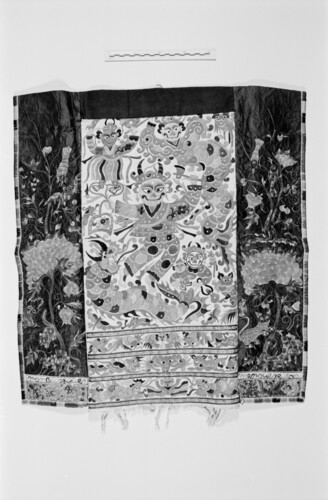 1995.36.1Woman's embroidered apron1995.36.1
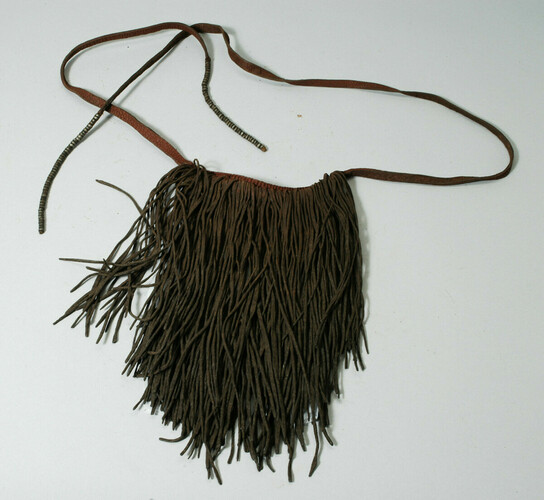 1940.7.095Apron with a fringe of narrow leather strips sewn onto a narrow waist band with 2 leather ties decorated with iron beads, worn by women [RTS 9/3/2005].1940.7.095
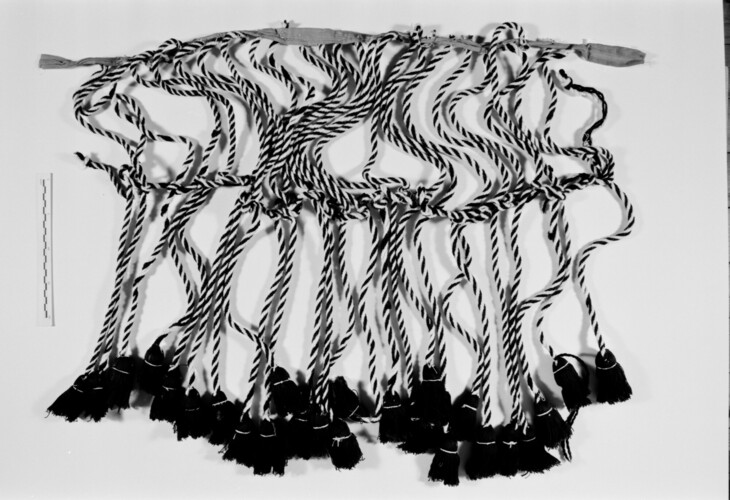 1995.4.2Apron from Ache Lhamo dance costume (male).1995.4.2
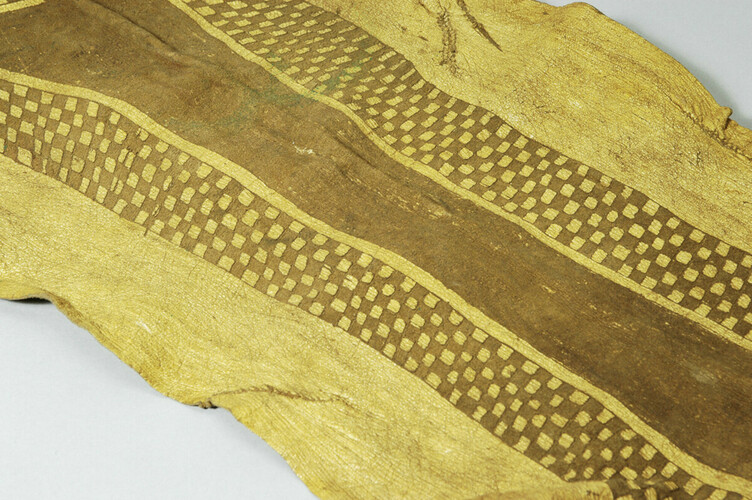 1940.7.096Apron made from a piece of yellowish hide with a brown pattern of plain and chequered bands cut into the surface, worn by women [RTS 9/3/2005].1940.7.096
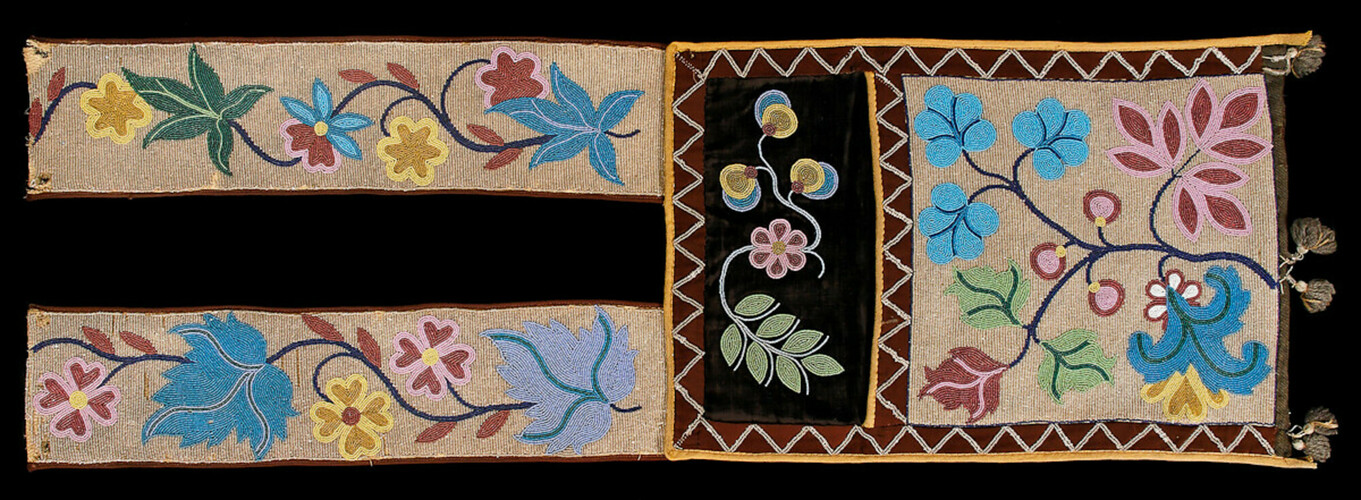 1948.12.21'Medicine' bag. Front completely covered with beadwork, floral, on translucent white bead ground. Bag lined with trade cotton material. Above bag a panel of black velvet with floral pattern in beads, and two straps covered with beadwork like that on front. Brown cloth border with zigzags of translucent white beads.1948.12.21
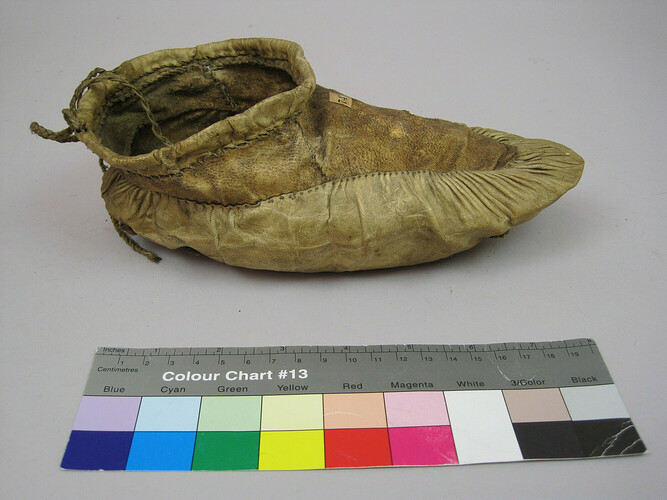 1886.1.747Sealskin shoe with a gathered upper and sinew drawstring around the ankle. [SM (Verve) 25/03/2014]1886.1.747
 1884.118.57Bone object, long and narrow with a hole at the top and grooved projecting piece at the other end. [El.B 30/04/2012]1884.118.57
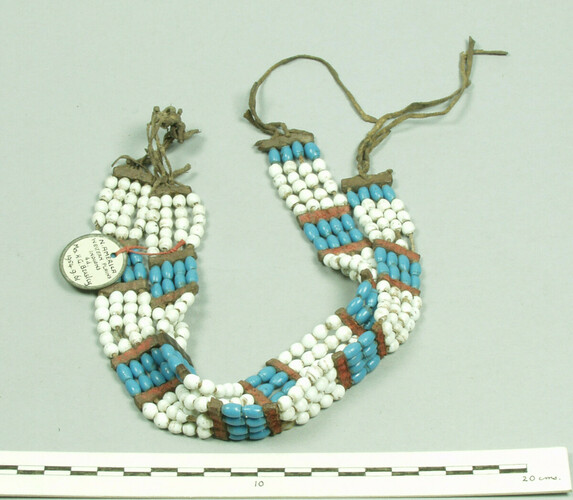 1954.9.61.1Two bands of coloured trade beads, with hide strip spacers separating white and blue sections; one band [.1] is slightly shorter than the other [.2]; the two are tied together with skin thongs. [N.B. 'DCF 2004-2006 What's Upstairs?' 25/7/2005]1954.9.61.1