
- Collection type
- Object
- Description
- Headdress of white cylindrical beads, elaborately mounted on end, on net-work, with neck-guard.
- Long description
- Headdress made from a series of cylindrical beads knotted onto a stringwork body, shaped to form a simple hemispherical cap with an extended rectangular tail piece that widens to the base, and which serves to protect the back of the neck. The lower edge of this neck guard has a straight edge. The body was constructed first from a series of light brown twisted cords, with a woolly consistency (Pantone 7509C). These have been arranged in horizontal rows, 5 mm apart, crossed at right angles by a series of more widely spaced vertical cords that are between 15 to 18 mm apart at the base, with the gap narrowing towards the upper part of the cap. Each vertical element is composed of two twisted strands, that open to pass on either side of each horizontal cord, effectively tying the warp and weft together. The stringwork is strengthened down either long edge of the neck guard with four thicker cords, tied onto the weft by smaller pieces of string that also help attach the beads at this point. These continue up to the centre of the top. The outer face of the headdress has been completely covered with horizontal rows of beads, strung so they stand with one flat end resting against the body netting, and the other visible on the surface. This is a flexible arrangement that allows each bead to move slightly; when worn, the beads seem to radiate out from a central point at the apex of the cap. Each bead has been tied on individually, using a short section of string that loops over the weft cords, with the two ends then passing through the string hole before being secured with a thick knot at the other end, these knots becoming a decorative feature [of] the exterior surface. The edge of the headdress has been given a slightly different finish, and consists of a single row of the same type of bead, strung to lie at right angles to the others and providing a flat border that runs across the front of the cap, down either long side and across the base of the neck guard, where it splits into a double border. This has been secured around the outer edge by an additional line of knotted string. The beads are all of roughly of the same size and colour, and are made from an opaque white glass (slightly whiter than Pantone 7499C). Some examples appear to have a thick core of this colour, coated with a thin outer layer of colourless glass that is visible in section. They have no mould lines and have probably been drawn and cut to similar lengths, varying from circular to slightly oval in section. They measure from 8 to 9 mm in length, between 5 to 6 mm in diameter, and have a string hole diameter of 2 mm. The object is essentially complete, but there is some damage to the string body that has been bound round with modern thread by [PRM] conservation, particularly at the centre of the neck guard; one bead has become detached and is stored in a separate bag with the object; other beads have damaged ends, and a few have lost their top knots. It has a weight in excess of 1000 grams. When lying flat (ie: not being worn), it has a total length of 440 mm, with a width across the front of the cap of 255 mm, and across the base of the neck guard of 325 mm, while it is around 11 mm thick. [RTS 26/9/2005].
- Geographical reference
- Person
- Maker Unknown Maker
- Field collector John Petherick
- PRM source Augustus Henry Lane Fox Pitt Rivers founding collection
- Date / Period
- Date made: Before 1859
- Date collected
- [1853 - 1859]
- Acquisition information
- Donated: 1884
- Materials and processes
- Material String, Material Glass, Material Bead, Material Plant Fibre, Process Netted, Process Twisted, Process Knotted, Process Strung, Process Beadwork, Process Drawn
- Dimensions
- Height: max 440 mm, Width: max 325 mm base, Width: max 255 mm cap, Weight 1770 g
- Object numbers
- Accession number: 1884.32.3 PR Cat other PR nos: 129
- Research and responses
In 1977/1978, PRM conservation technician R. S. (Sue) Walker analysed and conserved the headdress as part of the work she submited to the Museums Association for her Conservation Certificate. A copy of the relevant pages of her report is in the RDF. [JC 17 10 2019]
Schweinfurth also observed this type of headdress: 'Since the Dinka cannot do much with his ... hair, he turns his attention to caps and perukes ... Whilst I was with Kudy I often saw these strange specimens of head-gear which in the shape of a Circassian chain-helmet, are formed exclusively of large white bugle-beads, which in Khartoum are called 'muria'. This decoration is especially common amongst the Nuer' (G. Schweinfurth, 1873, The Heart of Africa Volume 1, pp 153-154). This would seem to confirm that the type was found amongst both Dinka and Nuer.
This headdress was published by J.G. Wood in his Natural History of Man Volume I, with an illustration and detail of the beadwork on p. 522. Wood commentated that the headdress " … is white, in imitation of the clay with which the head is usually decorated, and is made of cylindrical beads shaped as if they were pieces of tobacco-pipe ... The singular point in this head-dress is the exact resemblance to the soldier's casque of ancient Egypt, and to the helmets now in use in India and other parts of the world". It is also discussed in a talk given by Pitt Rivers to the Royal United Services Institution, with the comment: "A headdress of nearly the same form as Figs 20 and 21, belonging to the Nouaer tribe of Negroes, inhabiting both sides of the Nile from 8 to 10˚ N latitude, brought to England by Mr Petherick and now in Col. Fox's collection.It resembles the Egyptian very closely and is composed of cylindrical white beads, fastened together with a kind of string. The beads are of European manufacture" (Lane Fox, 1867, "Primitive Warfare Part I", Journal of the Royal United Services Institution 11, p. 32, pl. III, figure 22; the image was published again in Pitt Rivers, 1906, The Evolution of Culture, p. 61 and pl. VIII no. 22 (erroneously called 'Ethiopian'). Much of his description seems to be based on Petherick's and Wood's publications. The headdress is also mentioned briefly in A. A. Blackman, 1956, The Material Culture of the Nilotic Tribes of East Africa (Unpublished B.Litt. thesis, University of Oxford), p. 250; and discussed by M. Carey in Beads and Beadwork of East and South Africa (Shire Ethnography 1986, p. 21 and fig. 7).
There are two similar headdresses in the Museum für Völkerkunde, Berlin. Accession number III.A.321 was collected by Schweinfurth in 1872, and accession number III.A.2273 was collected by Johannes Duemichen during an expedition to Egypt, Nubia and the Sudan in the late 1850s/early 1860s. A third headdress of this type is now in the Museum of World Ethnography 'Franz Binder' in Sibiu, Romania, where it is currently exhibited as part of the 'Art and Culture of the Peoples of the World', accession number E57 (old number 136). It was discussed in Verhandlungen und Mitteilungen des siebenburg. Vereins für naturwissenschaften zu hermannstadt, I. Wissenshaftlicher Teil, 1935 (no author given), pp 50-51, where the comment was made that this type of headdress, which was very impratical in a hot climate like the Sudan, was worn only by people of high status (based on research by Alison Petch - see RDF).
The style of these items is also comparable to a headdress decorated with cypraea shells illustrated in E. Castelli, 1984, Orazio Antinori in Africa Centrale 1859-1861, p. 22 figure 2, in a reproduction from a plate published by A. Castelbolognesi, 1862, Voyage au fleuve des Gazelles in Le Tour du Monde [RTS 26/9/2005].
The beads used in this headdress are probably of European manufacture; several similar examples are found in the Arkell bead collection, such as 1971.15.196 and 1971.15.1128 [AP Leverhulme project on founding collection 1995-1998].
Linda Mowat believed that the construction could have started from the upper fringe part and then worked down to the neck end. The fringe is made in a semi-circle but appears not to be sewn to the back piece but actually worked into it. The whole string network could have been made like a basket by twining from the top and then lengthening the neck section on one side. In this case the string bits to which the beads are attached would be the weft and the vertical thread the warp. [LM].
RDF 1884.32.3 contains a letter dated 19th June 1992, from Dr Roma Mildner-Spindler of the Museum für Völkerkunde, Berlin, to Alison Petch [PRM], confirming that their collection holds two helmets similar to this one (IIIA 321, collected by Georg Schweinfurth in 1872, and IIIA 2273, collected by Johannes Duemichen in late 1850's and early 1860's; they are called Nuer or Dinka). The former is mentioned in The Heart of Africa I, 1873, 153 ff 'Since the Dinka cannot do much with his ... hair, he turns his attention to caps and perukes ... Whilst I was with Kudy I often saw these strange specimens of head-gear which in the shape of a Circassian chain-helmet, are formed exclusively of large white bugle-beads, which in Khartoum are called 'muria'. This decoration is especially common amongst the Nuer', with a footnote referencing an illustration in J.G. Wood's Natural History of Man, p. 522. 2 black and white photographs are enclosed, stamped: FOTO: DIETRICH GRAF, and marked: IIIA 321 and IIIA 2273 respectively. Another letter, dated 11th November 1993, from Adina Vargatu of the Museum of Traditional Folk Culture in Romania, to Alison Petch, includes enclosed information on the history of this museum and the Museum of World Ethnography "Franz Binder", and a black and white photograph of a similar headdress, marked in green biro: 'INV. NO. E57 old inv. no. 136. Presently exhibited in 'Art and Culture of the Peoples of the World' within the Museum of World Ethnography "F[ranz] Binder" '. A photocopy is included of a passage, from Verhandlungen und Mitteilungen des siebenburg. Vereins für naturwissenschaften zu hermannstadt, I. Wissenshaftlicher Teil, 1935 (no author given), with a discussion of this type of headdress; a translation is included by Alison Petch. Also included is a printout of a former object description, written by Alison Petch prior to 2005. [RTS 7/1/2004]
- Associated publications
- Pieces of a Nation: South Sudanese Heritage and Museum Collections, Editor: Zoe Cormack; Editor: Cherry Leonardi, 2021
- Illustrated in colour as Figure 2.1 on page 48 of ‘“A very singular helmet…”’, by Alison Petch and Jeremy Coote, in Pieces of a Nation: South Sudanese Heritage and Museum Collections, edited by Zoe Cormack and Cherry Leonardi (Leiden: Sidestone Press, 2021), pp. 48–54, 194–196. Caption: ‘Headdress of cylindrical glass beads on a network of string; 490 mm long; acquired by John Petherick in the 1850s; part of the founding collection of the University of Oxford’s Pitt Rivers Museeum.’ Coote and Petch provide a detailed account of the history of the headdress and information about similar objects in other museum collections Referred to and illustrated (fig. 22) on page 173 of ‘On the Arms of the Arab and Negro Tribes of Central Africa, Bordering on the White Nile [talk given to the Royal United Service Institution at its Evening Meeting on Monday 7 May 1860]', by John Petherick, in Journal of the Royal United Service Institution, Vol. 4 (no. 13, 1860), pp. 171–77: ‘The Nouaer on both sides of the Nile from 8 to 10 degrees north latitude, wear a helmet of cylindrical white beads.’ [JC 1 10 2019] Listed as lot 102 on page 8 of Catalogue of the Very Interesting Collection of Arms and Implements of War, Husbandry, and the Chase, and Articles of Costume & Domestic Use, Procured during Several Expeditions up the White Nile, Bahr-il-Gazal, and among the Various Tribes of the Country, to the Cannibal Neam Nam Territory on the Equator, by John Petherick, Esq., H.M. Consul, Kharthoum, Soudan: Which Will be Sold by Auction, by Mr. Bullock, at his Great Rooms, 211, High Holborn, W.C. on Friday, June 27th, 1862, at Twelve for One O’Clock [catalogue of a sale held by Bullock in London on 27 June 1862] (London.1862): '102. A very singular helmet of cylindrical white beads (Nouaer)'. [unsigned, undated; JC 27 9 2019] Illustrated in a line drawing as figure 22 in Plate L in ‘Primitive Warfare: Illustrated by Specimens from the Museum of the Institution [lecture given on Friday 28 June 1867]’, by A. Lane Fox, in the Journal of the Royal United Services Institution, Vol. 11, pp. 612–43; see also p. 624 and the entry in the 'Description of the Plates' on page 642. [JC 27 9 2019] Illustrated in two line drawings (whole object and detail) on page 522 of Africa, by J. G. Wood, Volume 1 of his The Natural History of Man: Being an Account of the Manners and Customs of the Uncivilized Races of Men (London: George Routledge and Sons, 1868); and described as follows (same page): A head-dress of remarkable beauty was brought from this tribe by Mr Petherick and is now in the collection of Colonel Lane Fox. It is white, in imitation of the white clay with which the head is usually decorated, and is made of cylindrical beads shaped as if they were pieces of tobacco-pipe. These beads, or bugles, as they ought perhaps to be called, are threaded on string, and fastened together in a very ingenious manner. The singular point in this head-dress is the exact resemblance to the soldier's casque of ancient Egypt, and to the helmets now in use in India and other parts of the world. Printout of relevant page in RDF. [unsigned, undated; JC 27 9 2019] Referred to on page 250 of 'The Material Culture of the Nilotic Tribes of East Africa' by Alan A. Blackman (Oxford: University of Oxford B.Litt. thesis, 1956): 'Some of the more conspicuous articles of Nilotic wear are observable today only as museum specimens. Of prime interest are the bead headdresses of the Nuer and Dinka, of the type on display in the Pitt-Rivers Museum, in the Binder collection (from the Gok Dinka...) and mentioned in Schweinfurth’s writings....'. [JC 7 10 2019] Illustrated in black and white as figure 7 on page 16 of Beads and Beadwork of East and South Africa (Shire Ethnography 3), by Margret Carey (Aylesbury: Shire Publications, 1986). Caption (same page): 'Man's headdress ascribed to the Nuer of the Nilotic Sudan. The style, a skullcap with integral neck covering, is most unusual for the area and may perhaps reflect external inspiration'. Also discussed on page 21: 'The headress in fig. 7 is made of off-white tubular glass beads attached to a string foundation twined into an open rectangular mesh. It was collected bwteen 1850 and 1865 by John Petherick and is ascribed to the Nuer, who live north-east of the Dinka in the southern Sudan.' [AP Leverhulme project on founding collection 1995-1998; JC 8 5 2008, 2 10 2019] Discussed in detail and illustrated in black and white (full view, figure 1; detail, figure 2) in 'Two Puzzles in African Beadwork', by Margret Carey, in International Bead & Beadwork Conference, 22-25 November 2007, Istanbul, edited by Jamey D. Allen and Valerie Hector, (no place [Istanbul]: Kadir Has University, no date [2007]), unpaginated. Photocopy in RDF. [JC 8 5 2008, 15 5 2008, 28 8 2008] Illustrated in colour as figure a on page 26 of A Shared Struggle: The People & Cultures of South Sudan, edited by Tim McKulka (no place [Juba]: Ministry of Culture, Youth and Sports, Government of the Republic of South Sudan and the United Nations Mission in South Sudan, 2013). Caption (same page): 'Nuer beaded headdress'. [JC 28 2 2014] Illustrated in colour (PRM image PRM0001567035165) as Figure 3 on page 113 of ‘Beaded Coiffures of the Acholi, Dodinga, Latuka, and Related Groups’, by Michael Oehrl, in Tribal Art Magazine, Vol. 20, no. 3 (no. 80; Summer 2016), pp. 112–121. Caption (same page): 'Beaded headdress with neck guard. Nuer, South Sudan. Mid 19th century. Vegetal fiber, string, glass beads. | H: 49 cm. | Collected by John Petherick between 1853 and 1859/ | Ex Augustus Henry Lane Fox Pitt Rivers. | Pitt Rivers Museum, inv. 1884.32.3.' Also discussed (same page): 'Ivory merchant and late British consul to the Sudan John Petherick collected a combination head and neck cover among the Nuer between 1853 and 1859, which is now in the collection of the Pitt Rivers Museum. It is made of large tubular white beads attached to a plant fiber netting, undoubtedly cotton.... Save for the addition of the neck cover, the form and color of this object are reminiscent of the tropical military helmets worj by European-outfitted soldiers with whom the Nuer may have been in contact, even if only during conflicts. It has also been described as reminiscent of a Circassian chain mail coif, but the resemblance here is purely one of outward appearance. Generally, such external infuences can only be assumed or guessed at, and they are often controversial.' (Offpirnt in RDF.) [JC 2 10 2019]
Search terms: Clothing Headgear, Cordage, Bead, Ritual and Ceremonial, Armour Weapon, Status, Headdress, Helmet, Armour, Ceremonial Object
Further items to explore
 1938.36.1496Basketry headdress.1938.36.1496
 1964.2.74Head ornament of a ring with a fringe of feathers all round and a bird skin pendant. [El.B 04/12/2008]1964.2.74
 1893.11.8Headdress of feathers of a bird of paradise. [El.B 30/05/2008]1893.11.8
 1923.45.5Openwork leather headdress [.1] covered with cowrie shells and a fringe of black bast [.2] which has become separated from the headdress. [JP 5/12/2001]1923.45.5
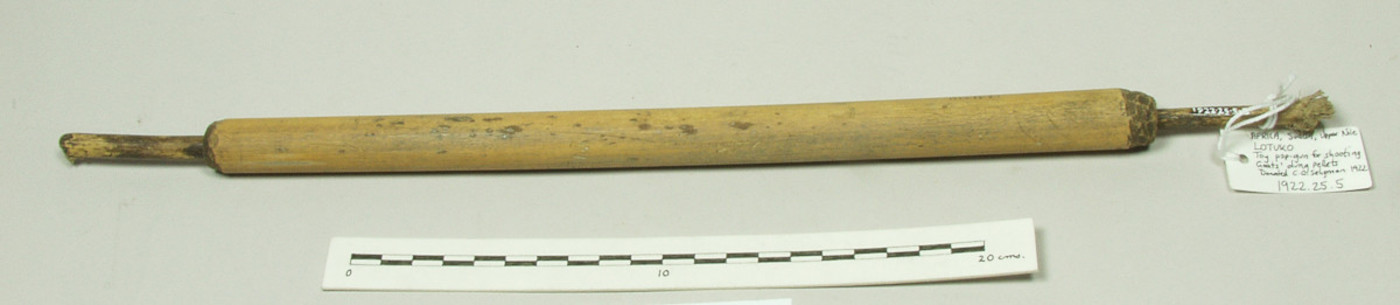 1922.25.5.1Wooden toy pop-gun for shooting goats' dung pellets consisting of a stick [.2] inside a cylinder [.1] [El.B 'DCF 2004-2006 What's Upstairs?' 8/3/2005]1922.25.5.1
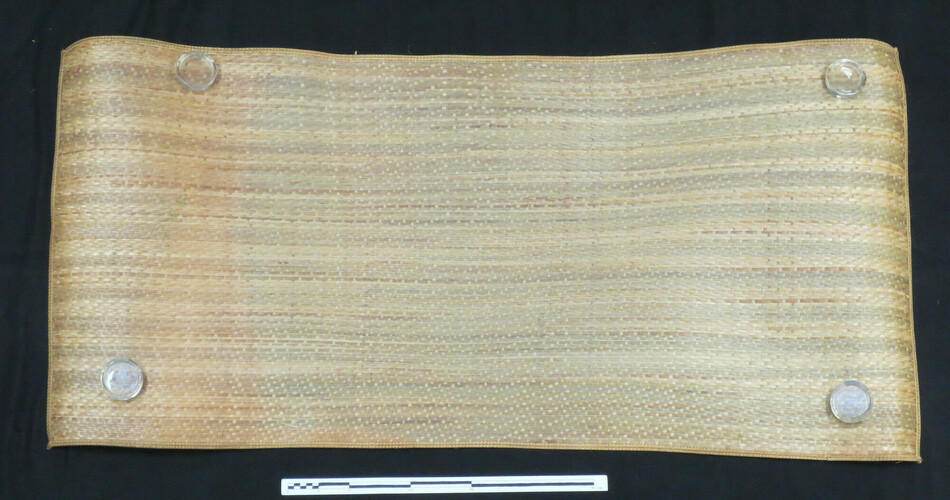 1948.2.159.13Rectangular mat made of chequerwoven strips of yellow palm fibre with fringed inner edges [RTS 9/8/2005].1948.2.159.13
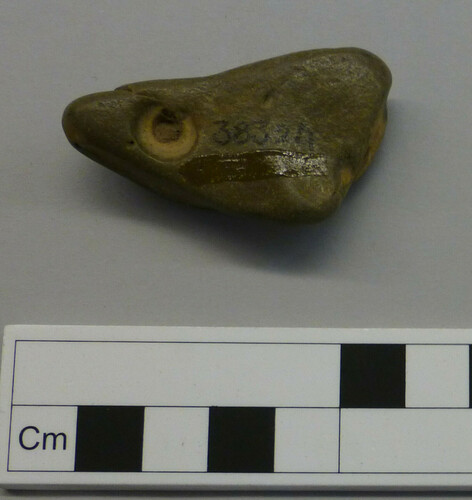 1985.54.404Amulet, roughly triangular dark brown stone with patches of lighter brown. For 'warram' (swellings, tumours) in men and women. [JC [OPS] 03/03/2017]1985.54.404
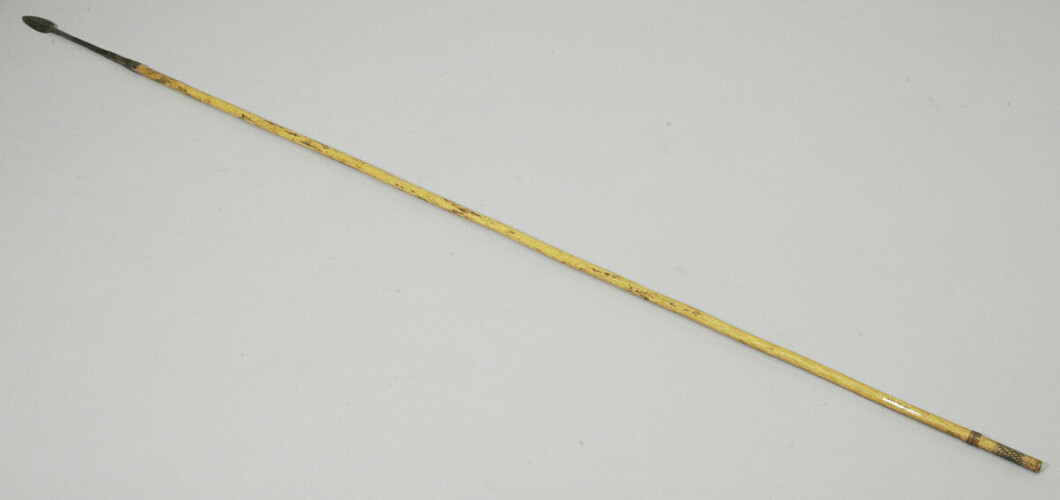 1979.20.184Socketed iron arrowhead with short leaf-shaped blade on a wooden shaft with decorated, bound and nocked end [RTS 6/6/2005].1979.20.184