
- Collection type
- Object
- Description
- Back section of brigandine jacket (jazerine). [BH [OPS move] 31/8/2017]
- Long description
- Back section of brigandine jacket (jazerine). Consisting of overlapping iron plates affixed to textile jacket with metal rivets. For the front please refer to [1884.31.44]. [BH [OPS move] 31/8/2017]
- Geographical reference
- England
- Cultural groups
- English
- Person
- Maker Unknown Maker
- Field collector Unknown Collector
- PRM source Augustus Henry Lane Fox Pitt Rivers founding collection
- Date / Period
- Date made: 1400-1500
- Date collected
- ?By 1862
- Acquisition information
- Donated: 1884
- Materials and processes
- Material Metal, Material Iron Metal, Material Canvas Textile, Material Velvet Textile, Material Gilt Metal, Process Riveted, Process Gilded, Process Woven, Process Stitched
- Dimensions
- Length: max 631 mm, Width: max 565 mm
- Object numbers
- Accession number: 1884.31.43 PR Cat other PR nos: 108
- Research and responses
Brigandine is an English term denoting armour made from small plates – usually rectangular and iron, as here – either linked together into a continuous flexible surface by rings linking each plate edge to the next, or overlapping and riveted into a thick coat of some kind. Brigandine armours vary widely in the quality of their internal plates. The simplest and cheapest brigandines were constructed from hardened leather, and functioned a little better than leather cuirasses. Higher quality brigandines were of bronze or iron, but the lack of elasticity in cheaper metals meant that the plates could shatter on impact, and themselves wound the wearer. The highest quality brigandines contain plates of tempered low-carbon steel, which are both strong and flexible. Northern Italy (particularly Milan) and southern Germany were the great late-medieval/early modern armoury centres of Europe, largely due to the advanced blacksmithing being practiced there at the time. English smelting and metalworking skills were relatively poor throughout the medieval period compared to the continental mainland, and even by the time Henry VIII acceded to the throne in 1509, English armourers were still importing iron and medium carbon steel from Germany and Spain. The English were also importing almost all high quality armour from Germany and Italy, which cost the crown considerably. For Henry, his desire to radically strengthen England’s military force, the souring political relations with Spain, and the expense of importation on a vast scale led him to set up a royal armoury at Southwark in 1515, where a predominantly German workforce worked under the Flemish master armourer, Martin Van Royne, and English boys were apprenticed to learn their skills. Armour and helmets of both English metal and manufacture, dating to this period were not bullet-proof, due to the fact that the English did not possess the technique of quenching. This process, the heating of steel (of a certain carbon content) to red heat, and then carefully-timed plunging into cold water, changed the crystalline structure of the steel (Austenite becoming Martensite), radically hardening the artefact. Van Royne’s English successors John Kelte and Jacob Halder perfected the technique of quenching some time around 1560, long after Henry’s death – but the workshop produced high-quality bullet-proof armour thereafter. By 1590, late in the reign of Elizabeth I, however, experiments showed that the quality of English iron was still too poor to resist bullets, nomatter how it was forged. Relevant Reading: Gardner, J.S. (1897) Armour in England: From the Earliest Times to the Reign of James I. London: Seeley & Co. Ltd. Lacombe, P. (1907) Arms & Armour in Antinquity & the Middle Ages. London: Reeves & Turner. Ffoulkes, C. (1912) The Armourer & His Craft. London: Methuen & Co. Norman, V. (1971) The Medieval Soldier. London: Arthur Baker Ltd. Nicolle, D. (ed.) (2002) Companion to Medieval Arms & Armour. Woodbridge: Boydell. Research Conducted for DCF Cutting Edge Project 2006/2007 [AM]
- Associated publications
- C ffoulkes. 1912. 'European Arms and Armour in the University of Oxford' Clarendon Press, Oxford. p60 '178 Brigandine of the XV cent. The plates are riveted overlapping upwards on a foundation of coarse canvas with an outside covering of dark green or blue velvet. The rivet heads which show on the outside have been gilded Pitt Rivers coll' [illustration]. This object is mentioned in 'Primitive Warfare' page 33 'Plate IV fig 45 The inner side of a Breast-piece of Jazerine armour of iron scales, of the fifteenth or sixteenth century - Colonel Fox's collection. See also Grose's Treatise on Ancient Armour pl 30 Critical Inquiry into Ancient Armour Meyrick vol vii pl lvi'. [AP Leverhulme project on founding collection 1995-1998]
Search terms: Armour Weapon, Armour
Further items to explore
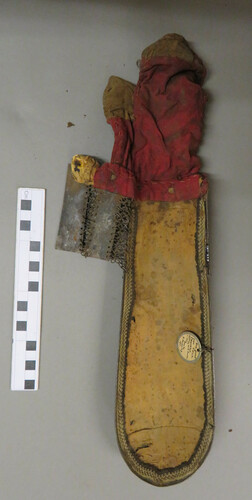 1911.29.3Arm guard with incised decoration. Chain main hand guard. Padded with textile.1911.29.3
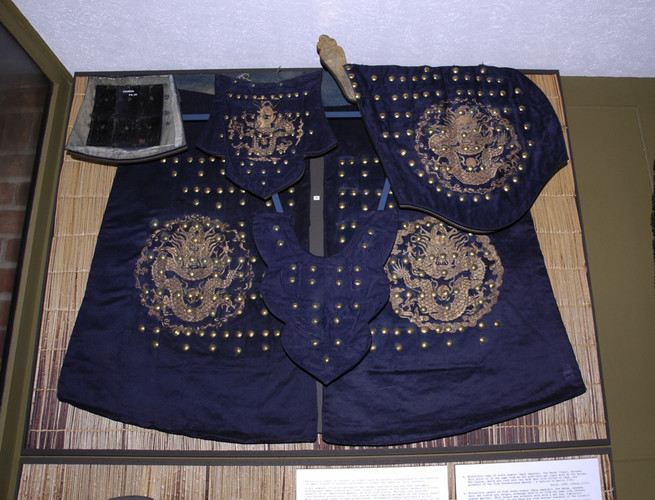 1884.31.27.1Scale armour, composed of oblong iron plates covered with dark blue satin embroidered with gold and lined with canvas, to which plates are fixed through the satin with brass studs. Includes an apron [.1], left shoulder guard [.2], under-arm gusset [.3], flap for the genitals [.4] and piece from the back of a helmet [.5]. [El.B 29/3/2007]1884.31.27.1
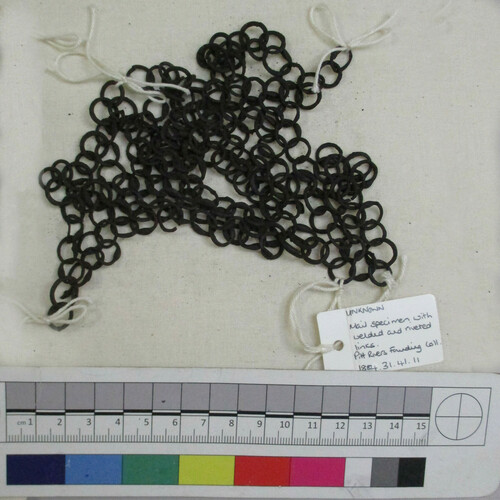 1884.31.41.11Specimen of mail with welded and riveted links. [SM (Verve) 23/10/2014]1884.31.41.11
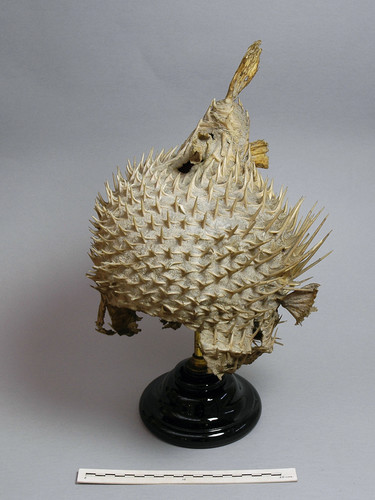 1884.32.31Helmet of porcupine fish-skin. [El.B 22/3/2007]1884.32.31
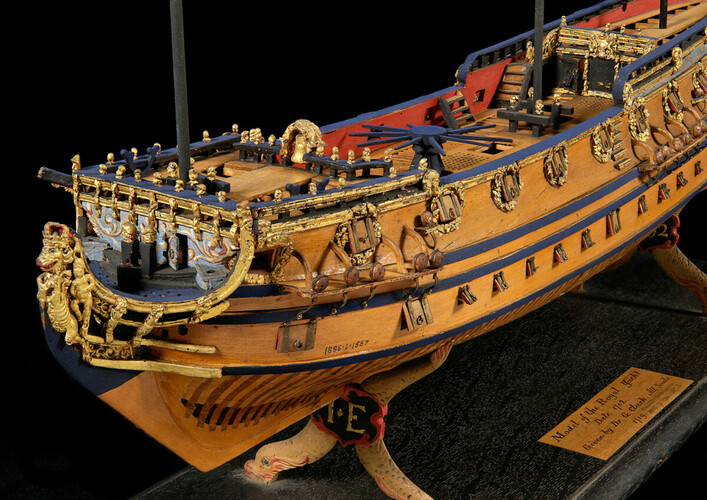 1886.1.1667Model of a Fourth Rate 44 gun Royal Navy warship of 1702, made late 17th or early 18th century. [ZM 7/4/2017]1886.1.1667
 1884.137.23.19Ceramic sherd1884.137.23.19
 1988.3.1Lead quality control seal.1988.3.1
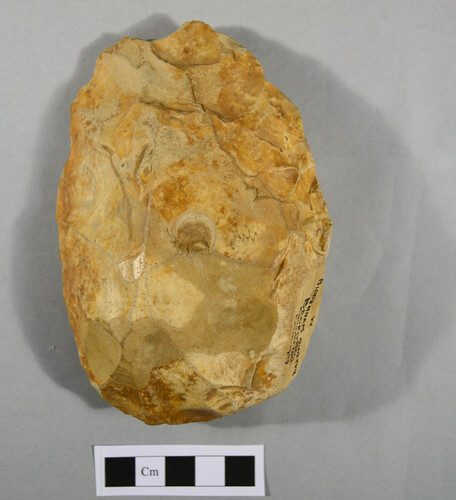 1909.66.22Stone tool, hand-axe. [MJD 22/05/2013]1909.66.22