
- Collection type
- Object
- Description
- Model of a Fourth Rate 44 gun Royal Navy warship of 1702, made late 17th or early 18th century. [ZM 7/4/2017]
- Geographical reference
- England
- Cultural groups
- European
- Person
- Maker Unknown Maker
- Field collector Unknown Collector
- PRM source Ashmolean Museum, University of Oxford
- Date / Period
- Date made: On or before 1719
- Date collected
- ?On or before 1719
- Acquisition information
- Transferred: 07/09/1886
- Materials and processes
- Material Wood Plant, Material Pigment, Material String, Material Paper Plant, Process Carved, Process Painted, Process Stitched
- Dimensions
- Height: max 365 mm, Length: max 810 mm, Width: max 200 mm
- Object numbers
- Accession number: 1886.1.1667 Other numbers: 3
- Research and responses
In July 1987 Richard Toporoski from the University of Toronto, Canada, noted about 1886.1.1667: 'Boat model dated 1702 - marked as displaying the standard of Prince George of Denmark, consort of Queen Anne. But the standard actually on the ship is clearly the royal banner of King William III (note the lion in escutcheon - the arms today of the Queen of the Netherlands).' (see related documents file for a copy of the notes supplied by Toporoski) [ZM 7/4/2017]
See RDF for a photocopy of a letter from a curator at the Ashmolean to T.K. Penniman stating that there is no entry for this object in the Register of Benefactors held at that museum. [MOB 4/9/2001] [RDF file not found in April 2017 [ZM 7/4/2017]]
This was one of the ship models Phil Johnson examined and worked on in November 1939. In the typed 'Report on the Ship Models of the Pitt Rivers Museum, University of Oxford, and their Restoration' Johnson notes the following about this particular model: '(2) Described as Royal Yacht, dated 1702...Number (2) described as Royal Yacht, 1702, has been identified as describing certain alterations contemplated on the "Royal Charles" galley fourth-rate of that date. It is fairly preserved. The following restorations were necessary: three gun port lids n the starboard side, one amidships on the upper deck, and one amidships, and one forward on the main deck, the stern lamp on the port side, two capstan bars, and the rail repainted with matt paint. The model cleaned and oiled.' (See the related documents file for 1884.54.44 for the full report Phil Johnson sent to the Museum's Curator T.K. Penniman and his estimate dated 13 January 1940 for the cost of further restoration work.) [ZM 7/4/2017]
Phil Johnson contacted Sir Geoffrey Callender, Director of the National Maritime Museum in Greenwich, London, to help identify ship models 1886.1.1666 and 1886.1.1667. In a typed letter to Johnson dated 29 November 1939 Callendar notes: 'I have your letter of the 27th and the photographs of the ship models. Both these are wrongly described as Royal Yachts'. He identifies 1886.1.1667 as follows: '(A) This ship is a Fourth Rate of 44 guns. She would probably be about 130 feet long. She is flying the standard of Prince George of Denmark, who was created Lord High Admiral on the accession of Queen Anne. This ship must have been one of the first to be laid down. It should be noticed that a large part of the space on her lower gun deck is devoted to row-ports, of which twelve could be mounted aside. The main idea of this ship was speed. When other ships were becalmed, or found the wind contrary, this ship could push out 24 long "sweeps", and pull round until she felt the breeze. These same sweeps were useful in leaving harbour, like the auxiliary engines of the early Victorian ships. I am at present puzzled by the initials I.E. I should have expected I.B. for Isaac Betts. It is possible that I.E. may stand for John Ernle one of the Commissioners of the Navy. I may perhaps be able to identify this shipwright later on.' At the start of the letter Callendar explains ships of the period in question were divided into two main groups (a) ships of the line and (b) those insufficiently strong to take their place in the line. 'The "line" refers to the line-of-battle, the invariable formation adopted by H.M. ships before engaging the enemy. The ships strong enough to take their place in the line were subdivided into 6 classes, or (more properly) "rates".' See Ship Models file for the original letter. [ZM 15/4/2016]
Model A. ... cannot be anything save a proposal. Her proportions are roughly those of the 'Charles Galley' of 1693, but the scale would have to be 1/66, which is most improbable, and the model has a very definite A.R. on it besides the date on the stand. It is too long and narrow for any other known ship of the period. I imagine the scale is 1/64 (3/16 in. to 1') and on that the dimensions would be 126 1/2 ' x 28-4. The 'Charles Galley' was rebuilt again in 1710, but then was made much wider for her length. Probably the model was made with a view to an earlier rebuilding or another ship of the same kind. You might describe her as 'Ship of 30-36 guns of 1702' with a note that is probably only an unrealised design.' (From a letter from R. C. Anderson of the Society for Nautical Research (to Philip Johnson?) 4/12/39. See 'SHIP-MODELS' file). [unsigned, undated]
'This could be a model of a ship that was actually built, the 'Charles Galley', as she was in 1702. The standards from this model and from the 'Lizard' (1886.1.1666) have been reversed at some time.' Information from John Franklin, June/July 1985. (See research file 'FRANKLIN' for further notes. See also details of his publication below.) [unsigned, undated]
'Boat model dated 1702 - marked as displaying the standard of Prince George of Denmark, consort of Queen Anne. But the standard actually on the ship is clearly the royal banner of King William III (note the lion in escutcheon - the arms to day of the Queen of the Netherlands)'. Information from Richard Toporoski, St Michael's College, University of Toronto, Toronto, Ontario, Canada M5S 1J4. [unsigned, undated]
- Associated publications
- Published in detail with five black and white photographs (plates 85-89) as '15. Galley-frigate of 32-40 guns 1702' on pages 132-5 of Navy Board Ship Models, 1650-1750, by John Franklin (London: Conway Maritime Press, 1989) (photocopy of relevant pages in RDF). [JC 10 12 2010]
Search terms: Model, Navigation, Boat
Further items to explore
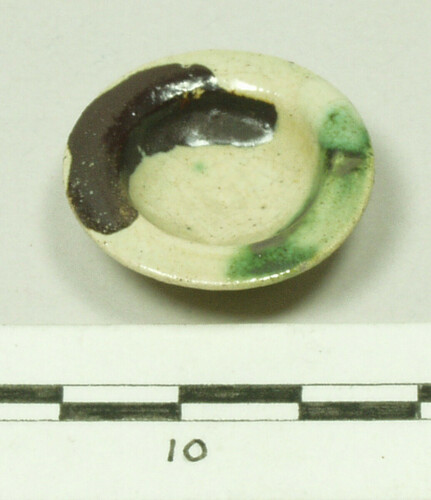 1951.11.180.75Miniature pottery vessel, white dish with brown and green decoration [N.B. 'DCF 2004-2006 What's Upstairs?' 9/3/2005]1951.11.180.75
 1978.9.9.3Paddle for a model boat, made from a single piece of wood that has been carved with a wide section, making the blade, at one end. Pale in colour. Associated with this object is a canoe [1978.9.9 .1], another paddle [1978.9.9 .3] and a water bailer [1978.9.9 .4]. [ASh [OPS move] 12/09/2016]1978.9.9.3
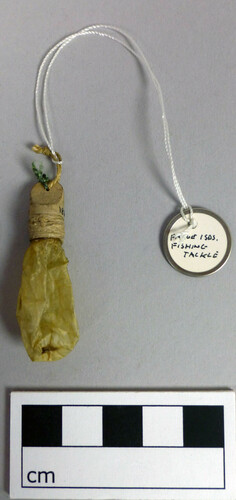 1884.54.34.10One of two skin floats, part of boat model 1884.54.34. [ZM 11/3/2016]1884.54.34.10
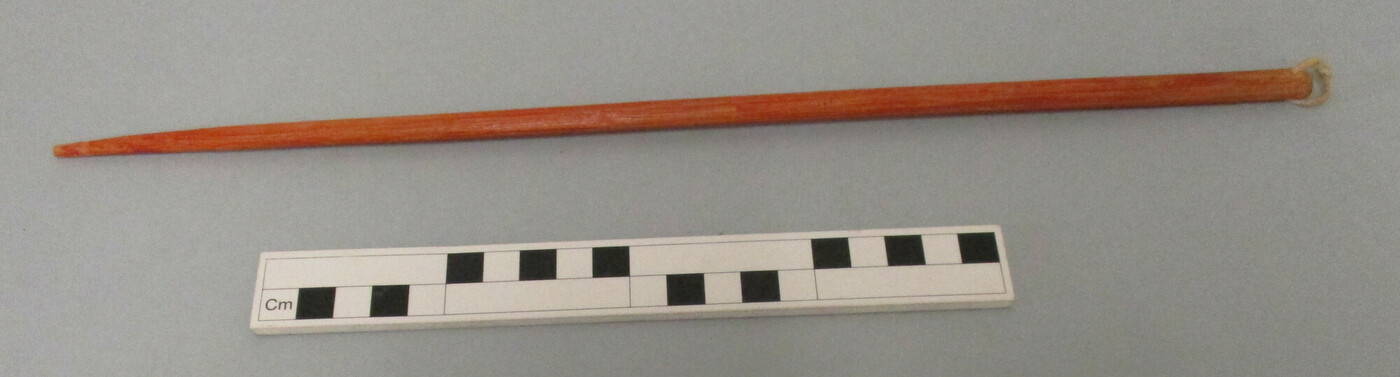 2009.150.9.12Wooden roof strut for model nomadic tent. For the other wooden roof struts see [2009.150.9 .1 - 11] and [2009.150.9 .13 - 45] and for the other constituent parts of the tent see [2009.150 .1 - 31]. [CW [OPS Move] 26/6/2017]2009.150.9.12
 1884.137.11.33Ceramic sherd1884.137.11.33
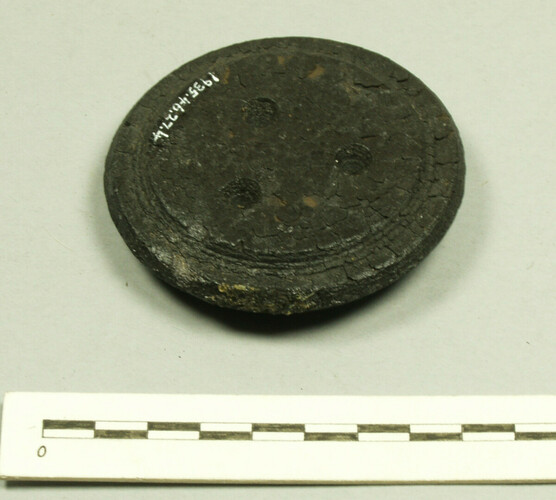 1935.46.27.4Turned disc of Kimmeridge shale: waste from an armlet factory. With three round perforations where it was held by the lathe. [LM 'DCF 2004-2006 What's Upstairs?' 11/10/2005]1935.46.27.4
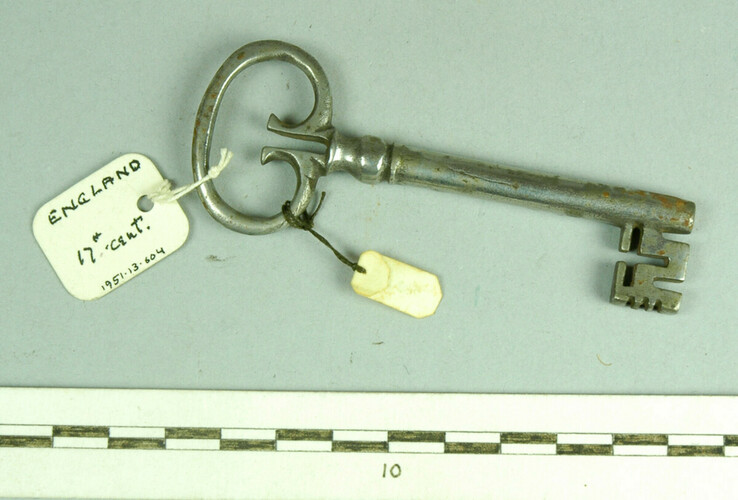 1951.13.604Key, silver plated, oval bow with two small horns, solid stem and bit with T-shaped cut, simple cut and comb. [El.B 02/04/2009]1951.13.604
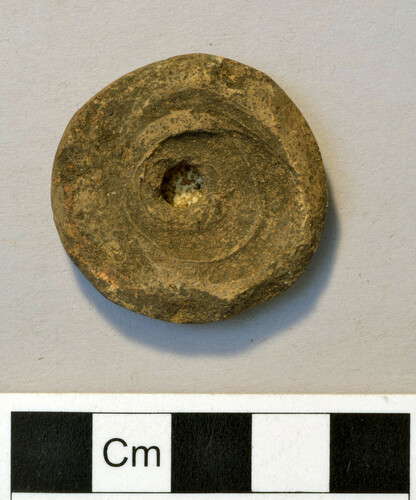 1884.140.1511.2Disk of fine grained ceramic with a hole piercing through the centre, ?spindle ?whorl. [VS [OPS move] 14/8/2018]1884.140.1511.2