
- Collection type
- Object
- Description
- Convex circular shield of coloured cotton work, decorated with a copper cross and four brass bosses. [LM 14/3/2007]
- Long description
- Convex circular shield of coloured cotton work, decorated with a copper cross and four brass bosses. Technique resembles twining. Bosses have serrated edges and punched dot and circle motif. Shield is edged with a strip of iron. On the back is a skin pad stuffed with cotton [this has been conserved] with two padded cloth grips attached with iron links. [LM 14/3/2007]
- Geographical reference
- Person
- Maker Unknown Maker
- Field collector Unknown Collector
- PRM source Augustus Henry Lane Fox Pitt Rivers founding collection
- Date / Period
- Date made: Before 1862
- Date collected
- By 1862
- Acquisition information
- Donated: 1884
- Materials and processes
- Material Animal Hide Skin, Material Cotton Seed Fibre Textile Plant, Material Copper Metal, Material Brass Metal, Material Iron Metal, Process Dyed, Process Punched, Process Twined Woven
- Dimensions
- Diameter: max 400 mm
- Object numbers
- Accession number: 1884.30.48 PR Cat other PR nos: 93 PR Cat other PR nos: 44
- Research and responses
Despite the original Accession Book entry I am not convinced that the main part of the shield is made of hide. [LM 14/3/2007]. Dhal were most commonly made of Indian Rhinoceros (Rhinoceros unicornus) rawhide, which was dried and lacquered, but not tanned. Rhinoceros hide was valued for shield-making because it could take on a striking translucent quality, and was harder and more durable than buffalo leather. The Asian rhinoceros was much more widely available for hunting prior to 1600 AD. The skin of the freshwater porpoise was occasionally also used for making shields in India, as were steel, wood, and papier maché. Four brass bosses are typical of Indian shields, which both protect and conceal the fixings that support the two handles inside. These straps were held in the hand during fighting. They had a third leather strap, or silk scarf, tied between them when not in use, so that the shield could be slung over the back when riding. This style of convex circular shield was used throughout western and southern Asia – particularly Persia – from the early 7th century AD onwards – although the characteristic four-bossed shape is distinctive to the Indian subcontinent. Relevant Reading: Robinson, H.R. (1967) Oriental Armour. London: Herbert Jenkins. Egerton of Tatton, Lord (1968) Indian & Oriental Armour. London: Arms & Armour Press. Welch, S.C. (1985) India: Art & Culture, 1300-1900. New York: Metropolitan Museum of Art. Research Conducted for DCF Cutting Edge 2006/2007 [AM].
Further items to explore
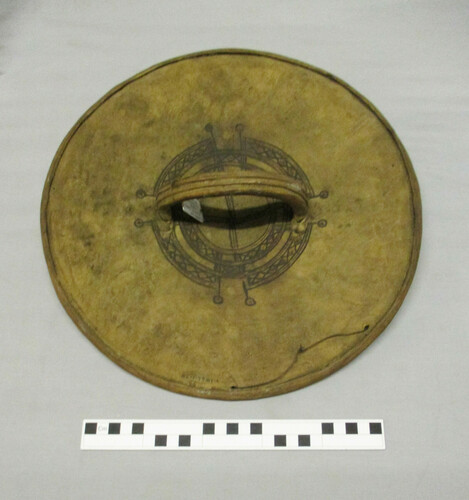 1966.1.38Shield of ?hippopotamus hide, with domed central boss and inclined rim. [CW [OPS move] 10/8/2016]1966.1.38
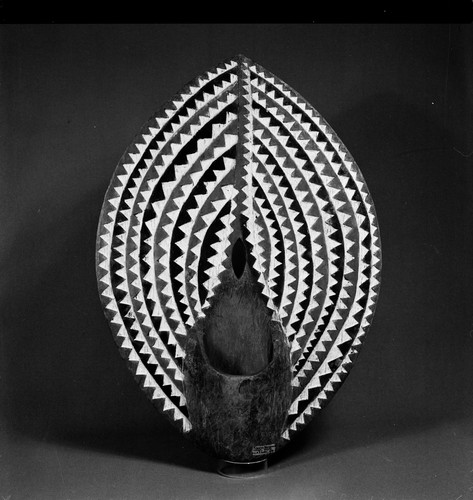 1910.28.1Shield worn on the arms by boys at initiation ceremony1910.28.1
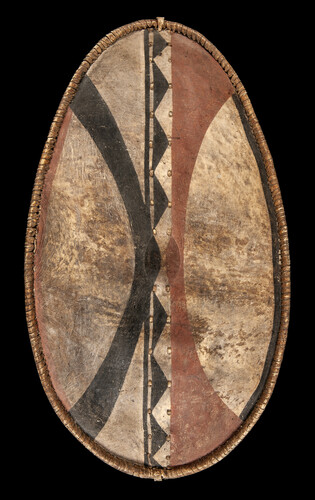 1966.1.8Hide shield with slightly raised central boss and bound around the edge with hide strip. [MJD 05/08/2010]1966.1.8
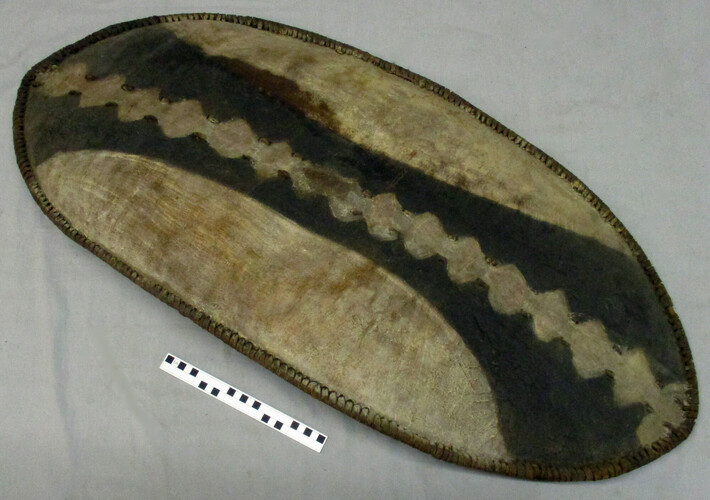 1949.5.13Oval shaped hide shield with pointed ends and domed central boss. The front of the shield is decorated with two curved sections and a central band of triangular designs in black and white pigments. The rim is perforated along the entirety of the rim through which strips of hide are woven. On the reverse in the centre there is a disc of hide with notches cut away from the edge. There is a carved handle which also serves as a central supporting rib which is bound to the shield with strips of hide threaded through perforations in the surface. There is a twisted plant fibre loop tied to the handle. [CW [OPS move] 17/8/2016]1949.5.13
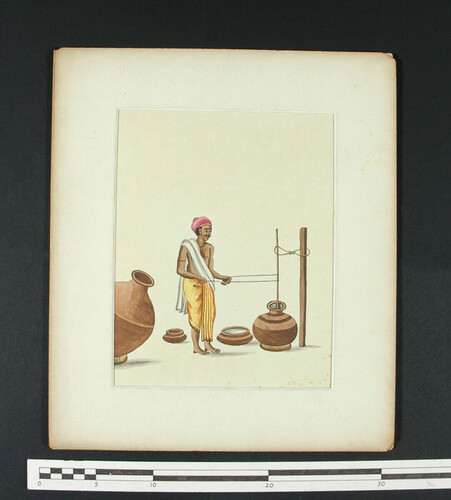 1950.11.9BPainting of a man making a large pot. He wears a red turban, yellow trousers and a white shawl/sash. [LKG 16/11/2009]1950.11.9B
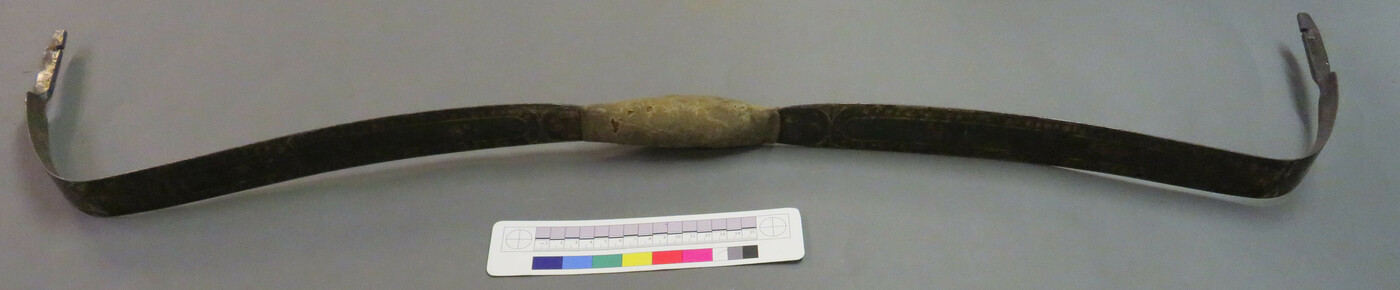 1884.15.19Metal bow. The bow is curved in shape with two pointed and notched tips. The bow is painted on each side with a floral design. The grip in the centre of the bow is covered with leather. [SB [OPS Move] 4/7/2017]1884.15.19
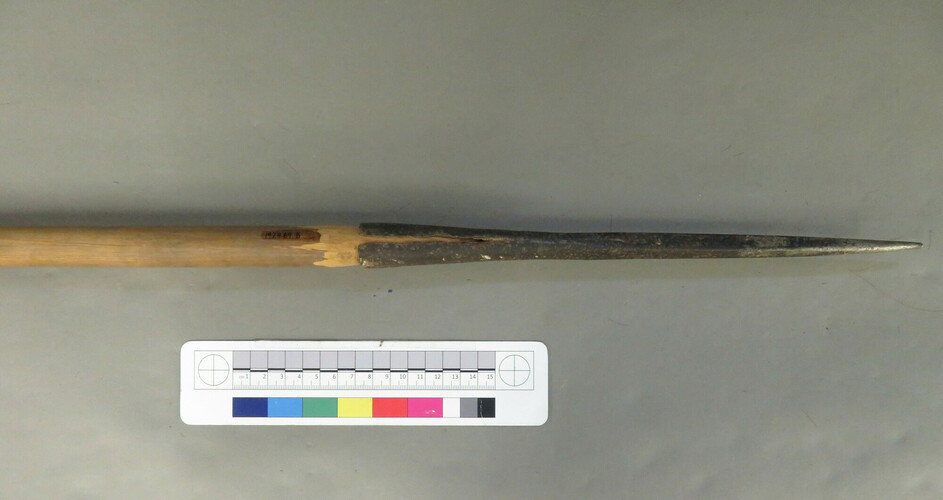 1928.69.6Spear with a wooden shaft with two bands of red coloured hair and socketed metal blade and butt spike. [AB [OPS move] 1/8/2018]1928.69.6
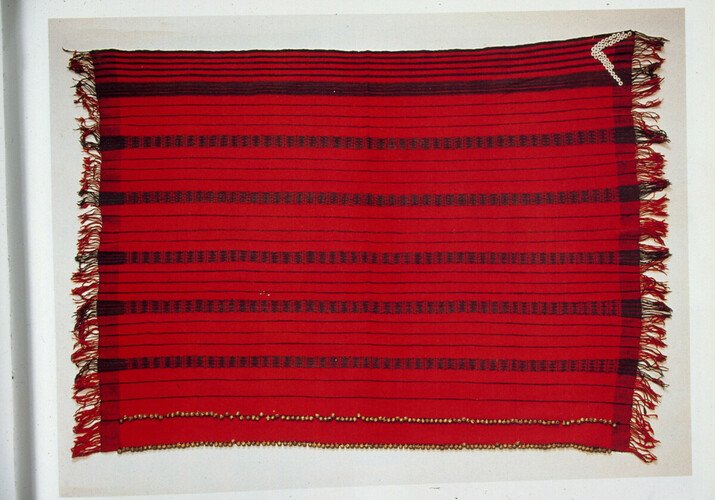 1923.85.293Body cloth for a rich man. Red with blue bands and narrow blue lines. With two rows of brass bells along the lower edge. 1923.85.293