
- Collection type
- Object
- Description
- Sword with broad, curved, single-edged blade in red-lacquered wooden hilt with leaf-shaped pommel. [LM 03/10/2007]
- Cultural groups
- Kodava
- Person
- Maker Unknown Maker
- Field collector Unknown Collector
- PRM source Augustus Henry Lane Fox Pitt Rivers founding collection
- Date / Period
- Date made: Before 1862
- Date collected
- By 1862
- Acquisition information
- Donated: 1884
- Materials and processes
- Material Wood Plant, Material Iron Metal, Material Lac Insect Lacquer Varnish, Material Steel Metal, Process Carved, Process Forged (Metal), Process Lacquered Varnished
- Dimensions
- Length: max 520 mm
- Object numbers
- Accession number: 1884.24.8 PR Cat other PR nos: 1107 PR Cat other PR nos: 171 PR Cat other PR nos: 966
- Research and responses
Stone, 1934: 84 'Ayda Katti. The national sword of the Coorgs of Coorg (Malabar). It has a very broad, heavy, curved, single-edged blade very much wider at the end than at the hilt, and sharp on the concave side. The hilt has no guard but has a large kite-shaped pommel. It is carried, unsheathed, on the back passed through a flattened brass ring with a spike projecting from the centre (called the todunga) which is fastened to the belt which is fastened in front by massive silver chains Fig 104'[AP Leverhulme project on founding collection 1995-1998]
During the mid-16th century, the Vijayanagara Empire waned and collapsed into several fragmented states. The previous regional governors of the empire (known as Nayaks) became independent rulers of large kingdoms, with whom the British and French first negotiated to establish their 17th-century trading posts on the Coromandel Coast of the subcontinent. The Nayaks of Madurai and Tirunelveli – states within what is present-day Tamil Nadu – subdivided their lands into 72 administrative regions, known as Palayams. Each palayam had a combined military governor/civil administrator, known as a Palayakarrar. The British, along with so many other Indian terms and place-names, Anglicised this into Polygar. By the late 18th century, the British had established control over much of southern India, administering it through the Madras Presidency. In 1801, many of the palayakarrar in the far south rose in rebellion against the dominance of the Presidency, which prompted the Polygar War of 1801-1802. This was an intense and bloody war, taking the British army eight months to put down the rebellion, and exposing them to one of their earliest experiences of jungle warfare. The documentation is unclear whether this is actually the sword of such a local governor, or was taken during the Polygar War. Relevant Reading: Egerton of Tatton, Lord (1896) Indian & Oriental Armour. London: Arms & Armour Press. Robinson, H.R. (1967) Oriental Armour. London: Herbert & Jenkins. Wenner, M.W. (1980) The Arab/Muslim Presence in Medieval Central Europe. In: International Journal of Middle East Studies, Vol.12, No.1, pp.59-79. Alexander, D.G. (1983) Two Aspects of Islamic Arms & Armour. In: Metropolitan Museum Journal, Vol.18, pp.97-109. Grancsay, S.V. (1986) Arms & Armour. New York: The Metropolitan Museum of Art. Tirri, A.C. (2003) Islamic Weapons: Maghrib to Moghul. Fort Lauderdale, FL: Indigo Publishing. Schimmel, A. (2004) The Empire of the Great Mughals: History, Art & Culture. London: Reaktion Books Ltd. Research Conducted for DCF Cutting Edge Project 2006/2007 [AM]
Adya/Ayudha comes from the Sanskrit word for 'weapon' and katti/kathi in all Dravidian languages refers to 'knife' or 'dagger'. [HH 16/12/2010]
Further items to explore
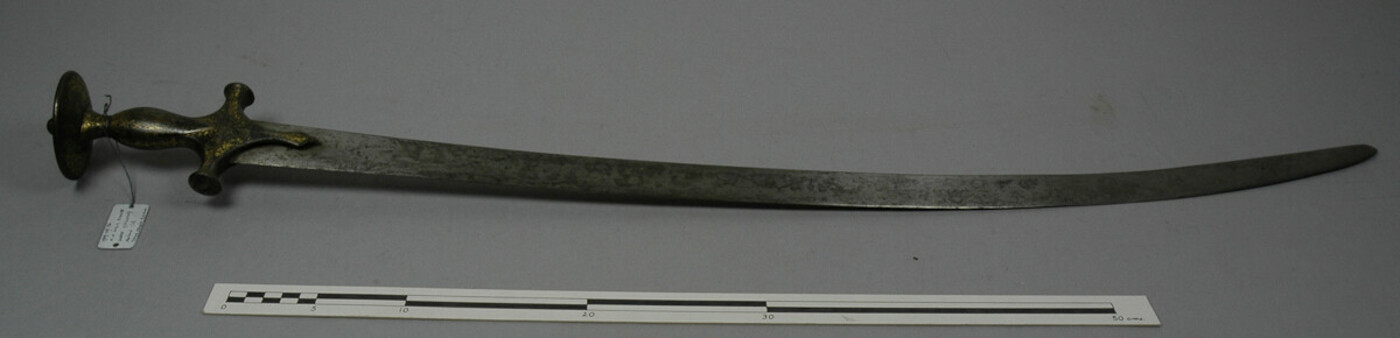 1969.29.26Sword with curved blade, handle with short quillons, langets and disc pommel all in black steel damascened with gold floral pattern. [El.B 14/11/2007]1969.29.26
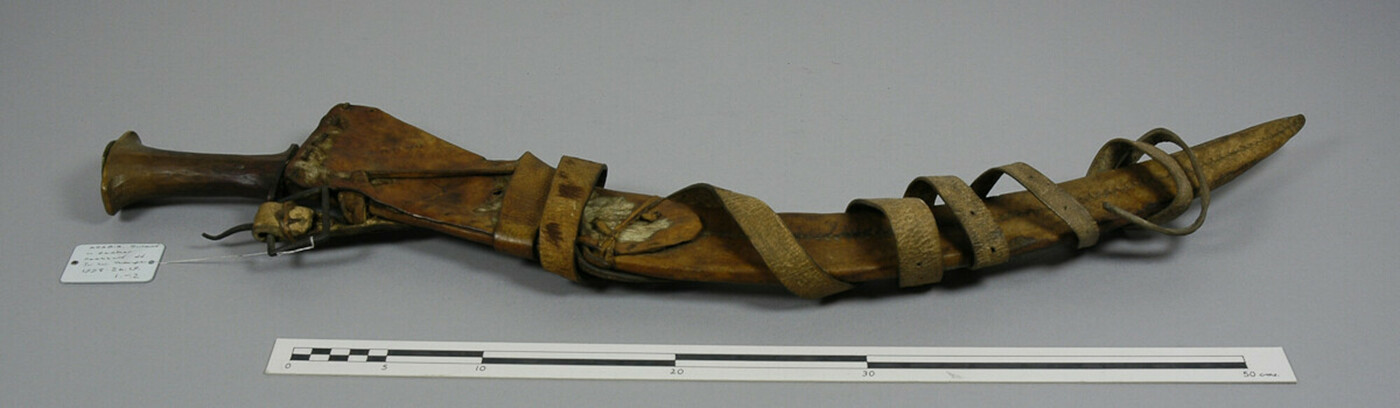 1998.26.19.1Curved sword [.1] with wooden hilt and leather sheath [.2] [SM 13/03/2007]1998.26.19.1
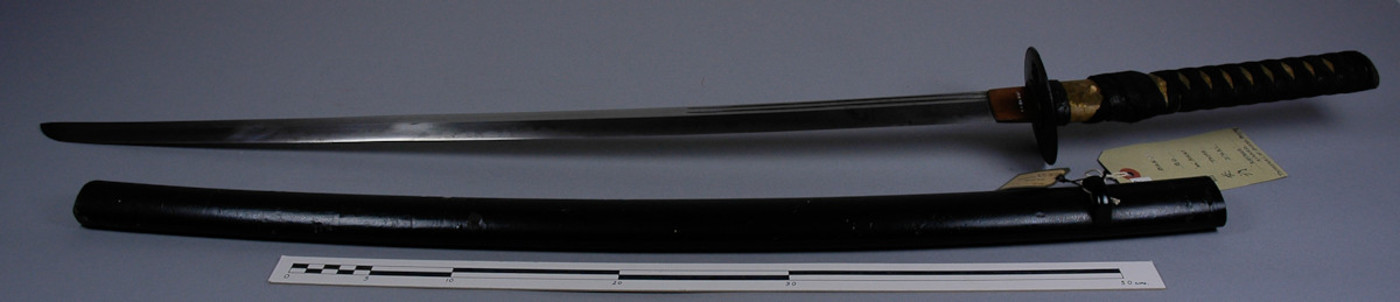 1913.48.1.1Sword [.1] and sheath [.2]. [El.B 26/02/2008]1913.48.1.1
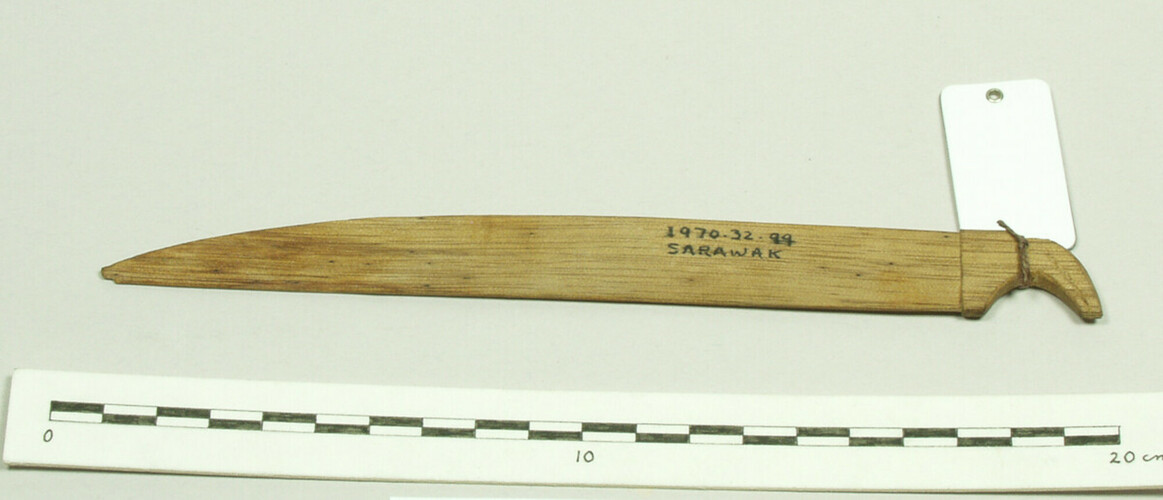 1970.32.99Carved wooden miniature sword. [El.B 'DCF 2004-2006 What's Upstairs?' 30/3/2005]1970.32.99