
- Collection type
- Object
- Description
- Perana, tunic with green bodice and a full skirt of vertically pieced green and purple brocaded silk panels. Worn by Iranian Zoroastrian women.
- Long description
- Women’s perana (dress/tunic) constructed from multiple panels of silk to form a full skirt reaching approximately mid-calf length when worn. The bodice is cut using rectilinear pattern pieces, with straight-cut sleeves integrated into the body panels, creating a T-shaped silhouette. The garment is predominantly hand-sewn using running stitch. The neckline comprises vertical slit openings at centre front and centre back. These openings are finished with applied woven trim and edged with narrow black binding. The front lower section is constructed from vertical panels of silk brocade with supplementary weft floral patterning, arranged in alternating pink-purple and green design. The back lower section consists of vertical panels of plain-weave silk in green and red. All lower panels are joined with straight vertical seams and attached to the upper bodice by a horizontal waist seam. The vertical seams between the skirt panels are decorated and partially obscured with hand embroidery in multicoloured silk thread. The hem is finished with narrow applied appliqué bands in blue, yellow, and green fabric, alternating with bands of black and white embroidery. The hem edge and one sleeve cuff are finished with applied black braiding. Neck and hem facings are constructed of printed cotton. The remainder of the garment is unlined, with no interlining or internal structural supports. The dress was made from textile remnants because there were restrictions on Zoroastrians buying full widths of fabric. The Perana forms part of a traditional outfit worn by Iranian Zoroastrian women, together with garments 1985.6.1–5. It is worn over the Šarvār (1985.6.5) and is visible only from the waist downwards as the upper part is hidden by the draped maklū (1985.6.1).
- Date / Period
- Date made: 1900-1930?, uncertain
- Date collected
- By 1985
- Acquisition information
- Purchased: 1985
- Materials and processes
- Material Silk Textile Animal, Material Cotton Seed Fibre Textile Plant, Material Pigment, Process Brocaded Woven, Process Embroidered, Process Braided, Process Printed
- Dimensions
- Length 1110 mm, Width 1040 mm
- Object numbers
- Accession number: 1985.6.4
- Research and responses
This textile was viewed by Azadeh Pashootanizadeh, Associate Professor, Cultural Heritage and Tourism Research Center, Department of Traditional Arts of Iran and Marie Skłodowska Curie Postdoctoral Researcher, Centre for Textile Research, University of Copenhagen, Denmark. Organised as part of the Clothworkers’ Textile Project, 27/11/2025.
In response Azadeh helped us to write the object descriptions, provided local names and the following information;
“Women's Clothing of Iranian Zoroastrians
The clothing of Zoroastrians is considered their second soul, whereas in most countries around the world, clothing is regarded as a second body.
Colors in the color palette of Zoroastrian women's silk clothing carry specific meanings. Green is regarded as a symbol of the Zoroastrian goddess of the earth and thus represents motherhood in the Zoroastrian faith; Zoroastrian brides wear green dresses at their wedding ceremonies. White symbolizes virginity and the water goddess, and Zoroastrian girls wear white clothing during engagement ceremonies. Zoroastrian women's silk garments are worn during religious festivals as well as private celebrations, such as weddings.
Pink or red, when combined with green in the skirts of Zoroastrian women's dresses, is one of the most popular dress codes for Zoroastrian women attending weddings.
Pink is a color obtained by boiling silk threads in a mixture of red pigments and yogurt. The combination of pink and green in skirts was worn by Zoroastrian women under the age of 40, while the red and green combination was reserved for women over 40.
Widows used golden trimmings on the cuffs of their sleeves, but the trimmings were not applied symmetrically to both sleeves. Divorced women, on the other hand, would embroider one sleeve of their garment while leaving the other plain, signaling to observers that they were currently without a spouse and, if interested, could be formally courted.
In traditional Zoroastrian marriage customs, each of the five types of marriage—practiced since the Sasanian era and continuing until approximately a century ago—was associated with a specific colour of the silk Maknā worn by women as part of a codified dress code. The Maknā for Pātaxšāyih marriages was green (Sāvz in the Dari Behdini language); for Ayōk-zan, yellow (Zārd); for Satar(o)r-zan, red (Sowr); for Čākar-zan, blue (Owvi); and for Rāy-zan, purple (Benāfš). Additionally, the colour orange (Nowrenji) was designated for unmarried girls, symbolizing their transitional social status before marriage.
The spoken language of Zoroastrians, Dari Behdini, has two main dialects: Yazdi and Kermani."
Azadeh Pashootanizadeh, 2025 [EW 19/01/2026]
Search terms: Clothing, Religion, Ritual and Ceremonial, Status, Tunic
Further items to explore
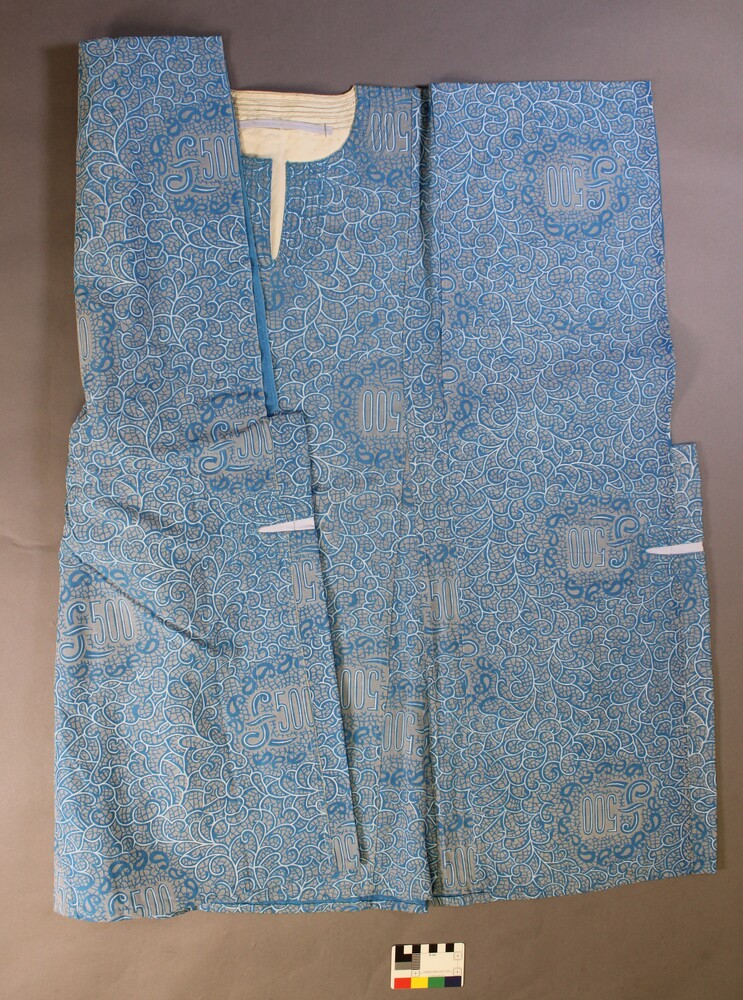 2004.76.1Blue sleevless tunic printed with a pattern which includes a '£500' symbol. Part of a complete outfit. [JP 20/10/2004]2004.76.1
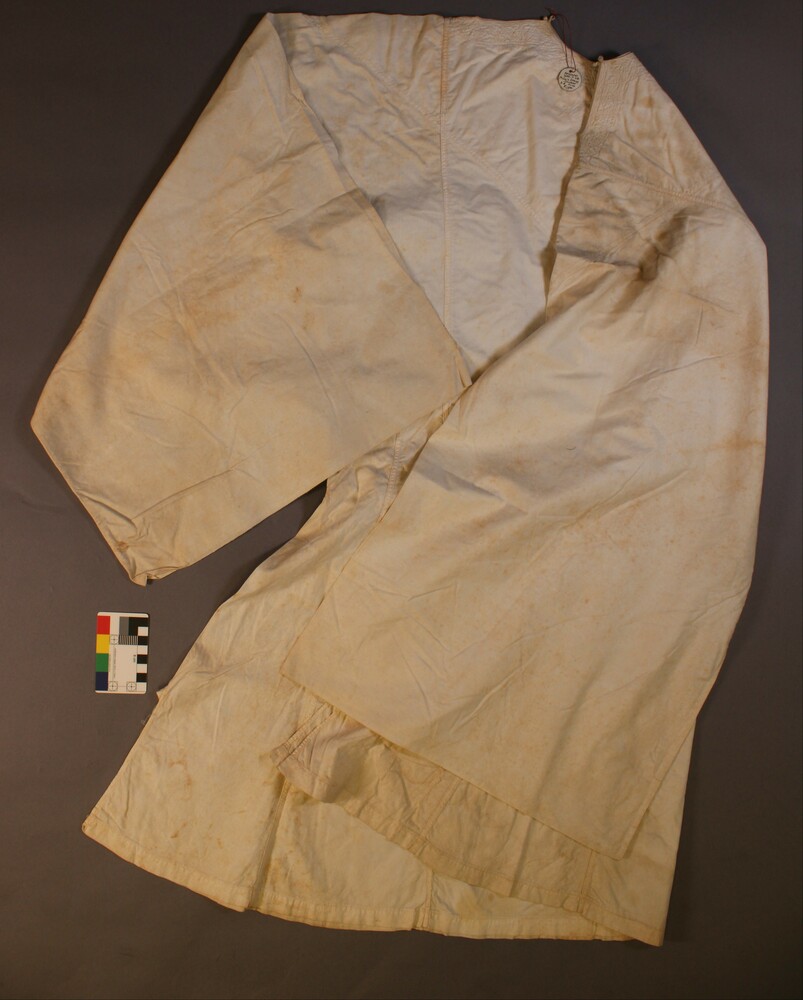 1950.11.28White cotton tunic embroidered at neck.1950.11.28
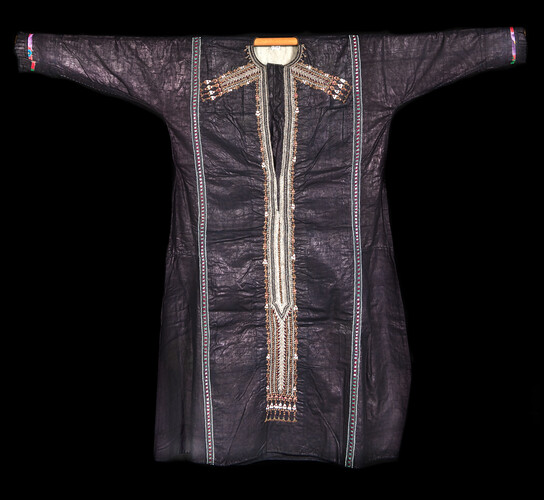 2018.37.81Indigo dyed qamis heavily embroidered with silver thread, and decorated with appliquéd textile shapes, brass paillette and chains, and mother of pearl shell. [AFS [OPS move] 5/8/2019]2018.37.81