
- Collection type
- Object
- Description
- Aluminium or tin ear stud with three-pronged base, part of a pair [RTS 12/5/2004].
- Long description
- White metal ear stud consisting of a flat upper surface, cut into a distinctive narrow shape with convex sides that become concave at its centre; these finish in two points at either end. A raised, rounded ridge runs down the length of this section. The shape is reminiscent of Lotuko shields; Langton suggested similarities to the form of some types of Larim headrests. The underside of this surface is flat, with thickening around the bases of three rectangular prongs that are attached at right angles to it, in a row running down the centre. The prongs splay out towards their ends, which look to have been compressed slightly through hammering. The metal from which this stud has been made is very light and soft, and currently a light gray colour (Pantone 420C), suggesting that it is probably either aluminium or tin. The object is complete and intact, with a series of shallow scratches on the upper surface exposing the original colour of the metal. It has a length of 35 mm, a maximum width of 11 mm and a thickness of 1 mm. The prongs are 4 mm wide at their ends. The stud weighs 2.3 grams [RTS 12/5/2004].
- Cultural groups
- Northern Laarim
- Date / Period
- Date made: Before 1979
- Date collected
- 24 March 1979
- Acquisition information
- Purchased: 1979
- Materials and processes
- Material Aluminium Metal, Material Tin Metal, Process Hammered
- Dimensions
- Length 35 mm, Width 11 mm, Thick 1 mm top plate, Width 4 mm end of prongs, Weight 2.3 g
- Object numbers
- Accession number: 1979.20.158.1 Other numbers: Langton Collection PL 42
- Research and responses
Purchased by Patti Langton at Napongayit, in the Kerenge Clan area, for 50 piastres on the 24th March 1979, during the British Institute in East Africa's expedition to the Southern Sudan. This is one of a pair, known as kachikinu; for the other, see 1979.20.158.2. Despite this, the earrings are not identical, with one being notably longer than the other, while weighing less.
These earrings were made by specialist men, and worn by both men and women. Langton commented that all Larim children have their ears pierced with three holes, a pierced lip, and get their two lower incisors removed when they are around seven years old. For a different type of Larim earring, see 1979.20.190.
Is it possible that the shape is reminiscent of a type of shield? [RTS 12/5/2004].
Search terms: Ornament, Ear Ornament
Further items to explore
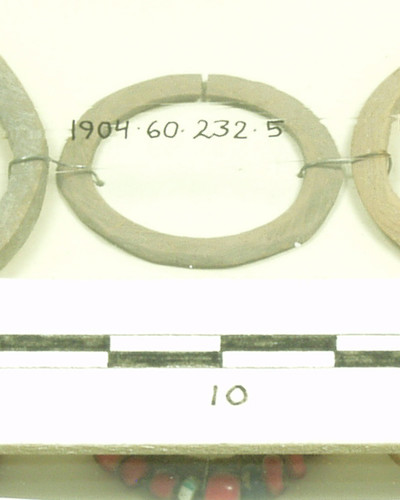 1904.60.232.5Ear ornament of coconut shell, consisting of plain split rings. [N.B. 'DCF 2004-2006 What's Upstairs?' 17/6/2005]1904.60.232.5
 1956.12.83.4BMan’s bead ear ornament with red string. [El.B DDF Body Arts Project 2010/2011 26/11/2010]1956.12.83.4B
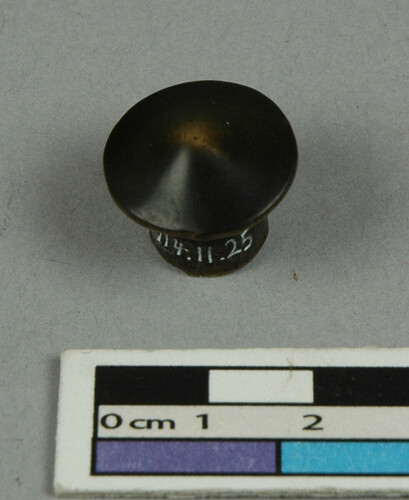 1914.11.25Dark brown horn ear plug. [MJD DDF Body Arts Project 2010/2011 09/11/2010]1914.11.25
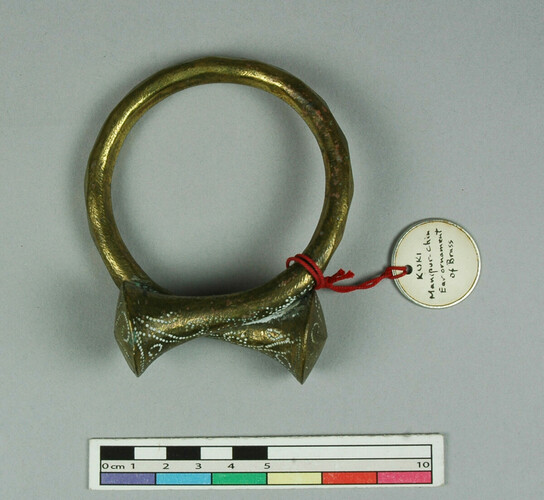 1962.7.36Hair or ear ornament of brass, bent into a circle, with flared ends impressed with dots. [El.B DDF Body Arts Project 2010/2011 01/11/2010]1962.7.36
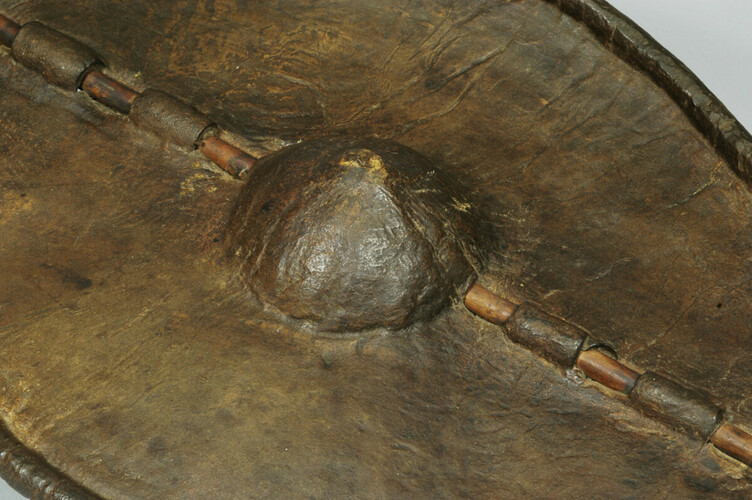 1946.8.96Oval shield of bullock hide with raised boss at centre and rolled outer edge, on a short wooden support stick bound with iron strips [RTS 17/1/2005].1946.8.96
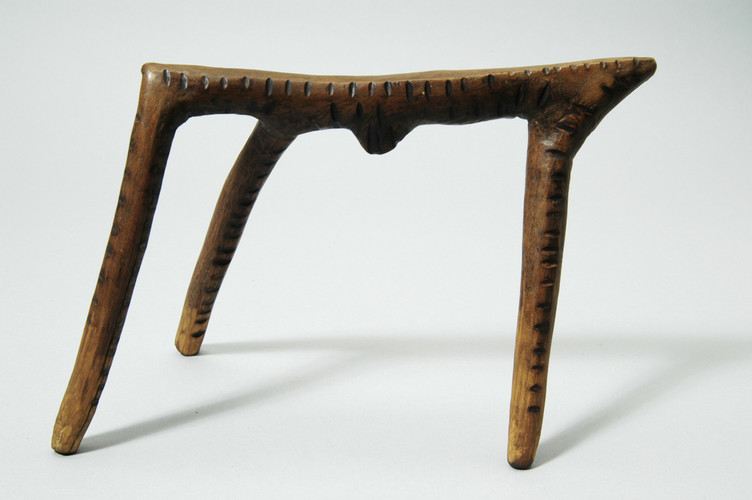 1931.66.17Wooden headrest with three angled legs, cut in one piece from a tree branch and decorated with linear pokerwork designs [RTS 20/10/2004].1931.66.17
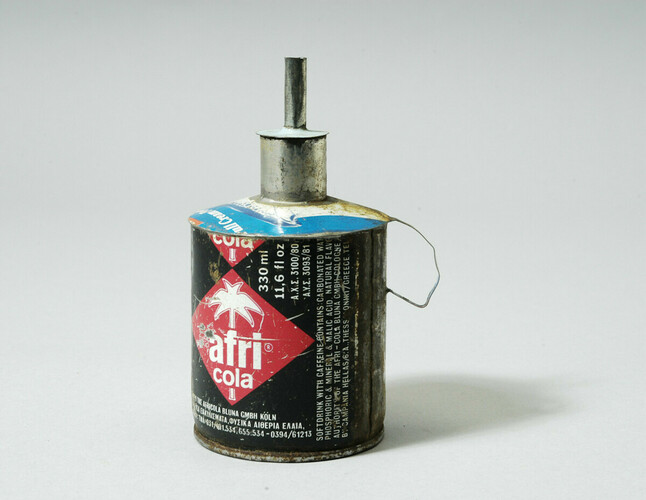 1985.24.14Oil lamp with cylindrical body and strap handle, made from recycled powdered milk and Afri Cola cans [RTS 14/7/2005].1985.24.14
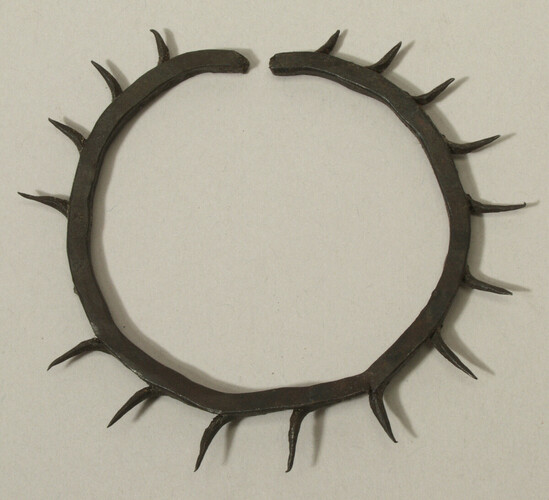 1936.10.19Iron armlet with long spikes around the edge, worn by boys during wrestling fights [RTS 4/3/2004].1936.10.19