
- Collection type
- Object
- Description
- Oval shield of bullock hide with raised boss at centre and rolled outer edge, on a short wooden support stick bound with iron strips [RTS 17/1/2005].
- Long description
- Shield made from a piece of bullock's hide, shaped when wet. This consists of an oval body with a raised conical boss at the centre, and a slightly irreguar surface recessed from the outer edge which has been cut straight and rolled over itself to form a raised, rounded border. The hide is a dark brown colour (Pantone 439C), with some tufts of orangey to reddish brown hair over the surface; the underside has not been well cleaned and numerous hair tufts remain here also. A series of cuts have been made in a line down the centre of the shield, to creat a series of six loops through which a round sectioned wooden stick has been threaded to act as a back support. Where the stick passes behind the central boss this also serves as a handle grip. The stick has been cut flat at either end and the reddish brown surface polished (Pantone 7517C). It extends above the top and bottom edges of the shield; the upper exposed area has a broad groove partially cut just below the top, while the body below is decorated with an iron strip with raised ridge down its centre, wound in a spiral around the wood. A second, shorter iron band is wrapped around the opposite end of the stick, just above its base. The shield has also been provided with some hide loops for carrying and suspension. One small loop has been tied around the central handle area; a seond loop is tied around the stick and shield body near its lower edge, while a third, much larger hide strip is fastened to the back strut on either side of the handle area. This has been formed from at least 2 separate pieces sewn together using hide thongs. The object is complete, but the surface of the iron has begun to corrode and is now a dull gray colour (Pantone 412C), while the hide carrying strap is damaged in areas. The wooden stick is 885 mm long and measures 13.5 mm in diameter; the longer iron band is 6.5 mm wide. The shield body is 605 mm long, 455 mm wide, and 17 mm thick at the edges, and the carrying strap is 31.2 mm wide and 1.2 mm thick [RTS 17/1/2005].
- Cultural groups
- Nuer
- Person
- Field collector W. Sherlock Lennon
- PRM source Kathleen Constance Averina Knowles
- PRM source Mrs Cameron
- Date / Period
- Date made: Before 11/1923
- Date collected
- 17 February 1923
- Acquisition information
- Donated: 1946
- Materials and processes
- Material Cattle Skin Animal, Material Animal Hide Skin, Material Wood Plant, Material Iron Metal, Process Carved, Process Polished, Process Moulded, Process Perforated, Process Forged (Metal), Process Stitched, Process Tied
- Dimensions
- Length: max 885 mm, Length 605 mm shield, Width 455 mm shield, Diameter 13.5 mm stick, Weight 1000 g
- Object numbers
- Accession number: 1946.8.96
- Research and responses
The term 'White Nile' is now used to denote an administrative district immediately south of Khartoum, bordered by the districts of Northern and Southern Kordofan to the west, El Gezira and Sennar to the East, and Upper Nile to the south. However this term has been used more loosely in the past to refer to the Bahr el Abiad and Bahr el Jebel rivers or the areas around them. Lake No lies within the modern administrative district of Wahda.
Note that there seems to be some confusion about the collection date of Lennon's lake No material; some items give it as 17th February 1923, and others as 17th November 1923, and some objects have both dates associated with them (e.g.: 1946.8.88). One Lennon object was accessioned in 1925, and bears the 17th February collection date in the accession book entry; the rest were done as a group in 1946, and are all associated with the November date in their accession entry. As the objects themselves, where marked, bear the February reference, that was probably the correct date. JC has suggested that the error came from misreading February written in the roman numerals 'II' as '11' for November.
Dinka shields are somewhat similar in design, with an oval body with raised boss at the centre, threaded down the length with a wooden pole. For a series of photographs showing that type and its manufacture, by soaking the hide in water, pegging it out to stiffen and dry with the central pole in place, then trimming the edges to shape, see J. Ryle, 1982, Warriors of the White Nile, the Dinka, p. 49 [RTS 17/1/2005].
Further items to explore
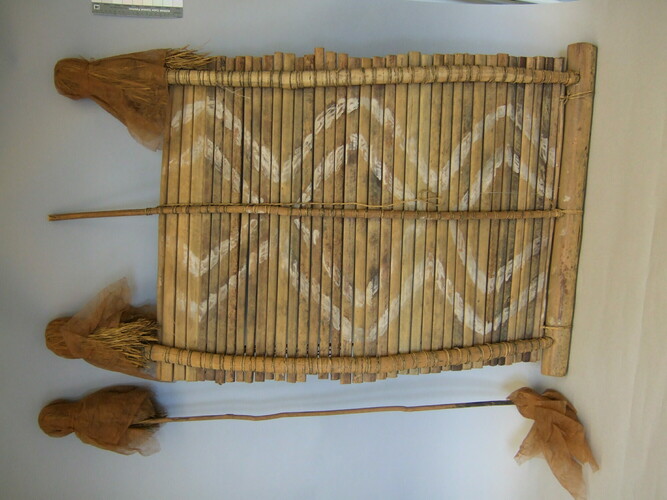 1893.6.1Wrestling shield comprising horizontal bars of aeta palm pith bound together by three vertical sticks, the ends of which are ornamented with palm fibre tassels. The central stick is very long, protruding above the shield. [LM 26/03/2007]1893.6.1
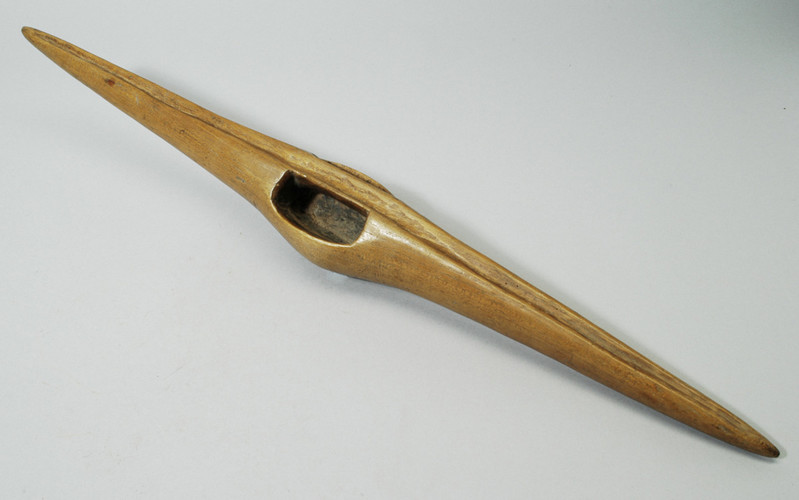 1931.66.10Short wooden parrying shield with tapering ends and groove running along length [RTS 10/1/2005].1931.66.10
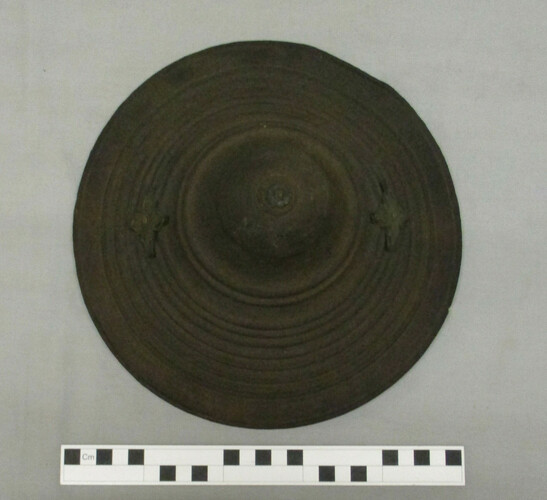 1884.30.59Conical shield of ?rhinoceros hide decorated with concentric incised and raised bands.1884.30.59
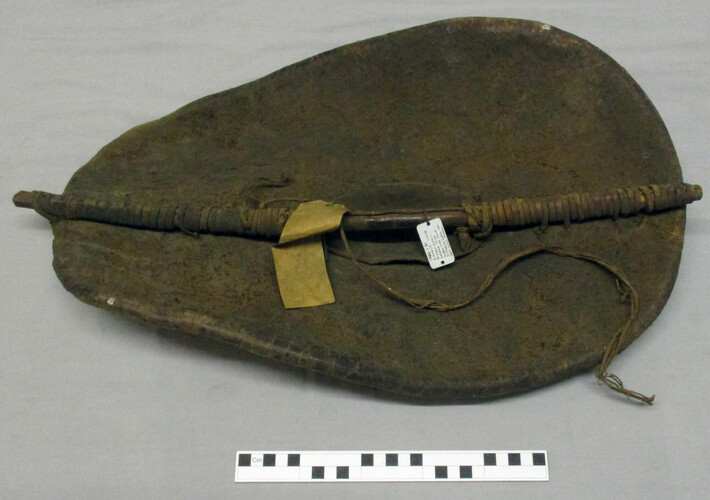 1966.1.31Hide shield with raised central boss and raised edge. On the reverse there is a wooden rod bound with strips of hide through perforations in the surface of the shield to form central rib and handle. [CW [OPS move] 16/8/2016]1966.1.31
 1884.15.103Wooden bow with tapering ends and grooved inside face, strung with twisted sinew cord [RTS 27/9/2005].1884.15.103
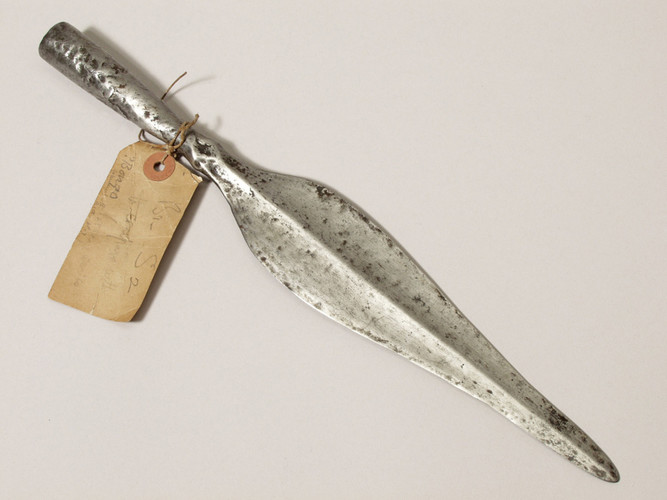 1884.120.63Iron spear-head with split socket and leaf shaped blade [RTS 16/2/2004].1884.120.63
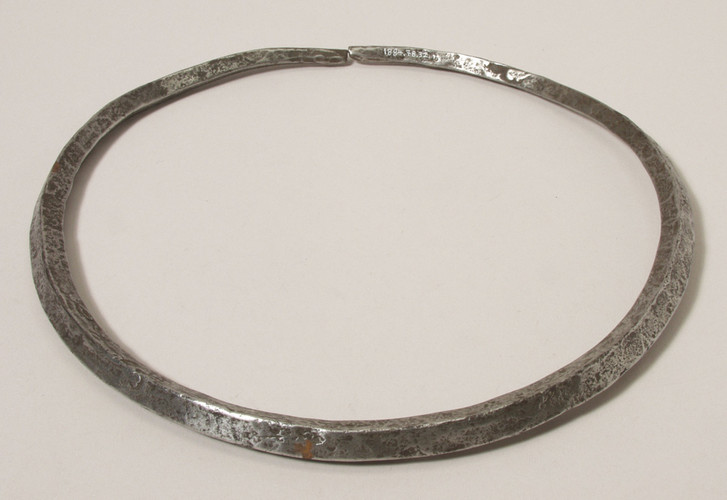 1884.78.32Heavy penannular iron torque with lozenge-shaped section, ends just touching, and notched decoration [RTS 28/4/2004].1884.78.32
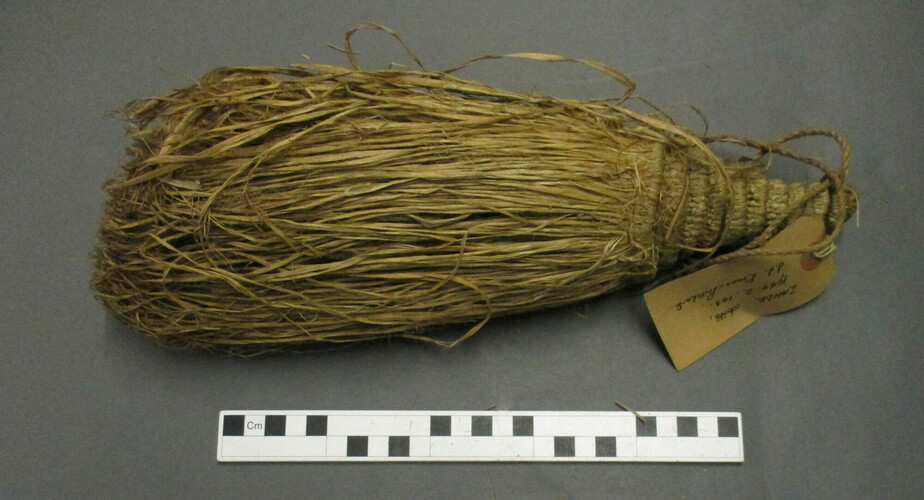 1948.2.143Fringed skirt made from split plant fibre. [FB 26/02/2015]1948.2.143