
- Collection type
- Object
- Description
- Gourd jar [.1] with detachable neck [.2], decorated with pyroengraved designs and used as an ashtray by men [RTS 30/3/2005].
- Long description
- Squat jar made from a gourd plant with the upper part of the neck cut off, the pulpy interior removed and then the remaining shell dried. It has a narrow rim, cut flat across the top, then turning out to a short, narrow concave neck that flares into a convex shoulder and broad body with convex base; this is slightly concave underneath where the plant stem was originally attached to the centre. It is round in plan view. The vessel has been jaggedly cut into two pieces across the top of the shoulder, to create a detachable neck [.2] and separate bowl below [.1]. Two small holes were then bored into the edges of each piece, and a short length of European string passed through to tie them together. Although the two pieces should fit snugly together, the cuts have not been aligned correctly in relation to these holes. The flat upper rim, base edge of the neck piece, and top edge of the jar body below have all been burnt black. Decoration has also been added to both parts. The neck piece has been decorated with a series of vertical lines, burnt down the sides to make blackened 7 groups, with a single line incised around the lower edge of the circumference. The body piece has been decorated with a broad band around its upper part, made of a series of triangles pendant from a top line, meeting a second row of triangles pointing upwards. The triangle bodies are filled with hatching; the smooth surface of the gourd appears as a reserved lozenge-shaped pattern running across the centre of this band. The gourd interior is a matt yellow colour (Pantone 7508C), while the exterior is a smooth orange (Pantone 7510C); the burnt decoration is a dark brownish black (Pantone black 7C). This object was originally used as a drinking gourd for young children; it is difficult to see how this could be the case with a detachable neck that does not fit snugly and has not been given any secure means of tying it in place, and it is possible that the neck was removed at a later stage in this object's life, when it began to function as an ashtray for men. This latter use could explain the scorching seen around the interior of the mouth on one side, which would be where cigarettes were extinguished; there is no burning on the base which was apparently filled with sand. The object is complete and intact, with some discolouration on the exterior surface, possible residues on the interior and slight insect damage. It has a weight of 51 grams, and a total height of 130 mm. The rim has an external diameter of 35 mm and is 4 mm wide. The neck piece, [.2] has a base diameter of 98 by 101 mm and is 4 mm thick and 40 mm high. The body piece, [.1] has a rim diameter of 101 by 105 mm, a maximum diameter of 140 mm, is 94 mm high and 4 mm thick [RTS 30/3/2005].
- Geographical reference
- Northern Bahr el Ghazal Dhangrial Wun Rog Mayen
- Cultural groups
- Dinka Tuich
- Date / Period
- Date made: Before 1979
- Date collected
- 19 February 1979
- Acquisition information
- Purchased: 1979
- Materials and processes
- Material Gourd Plant, Material String, Process Hollowed, Process Dried, Process Decorated, Process Pyroengraved Pokerwork, Process Perforated
- Dimensions
- Height: max 130 mm, Diameter: max 140 mm, Diameter: max 101 mm neck piece, Weight 51 g
- Object numbers
- Accession number: 1979.20.70.1 Accession number: 1979.20.70.2 Other numbers: Langton Collection 151
- Research and responses
At the time this object was collected, the Bahr el Ghazal province was bordered by the Upper Nile Province to the east and Western Equatoria to the south; this area is now divided into the districts of Western Bahr el Ghazal, Northern Bahr el Ghazal, and parts of Warab and El Buheyrat. Dhangrial, Wun Rog and Mayen lie within Northern Bahr el Ghazal. For a map showing the distribution of Dinka Tuich groups, see J. Ryle, 1982, Warriors of the White Nile: The Dinka, p. 25.
Langton describes this method of decorating Dinka gourds in her entry for accession number 1979.20.91, with the pattern being marked out in charcoal, and then with a type of needle called a with (for this tool, which is made of iron, see 1979.20.59), which is then scored over using a heated spear or knife blade [RTS 3/12/2004].
Search terms: Vessel, Food and Drink, Children and Childcare, Narcotic, Food Accessory, Lid, Tobacco Accessory
Further items to explore
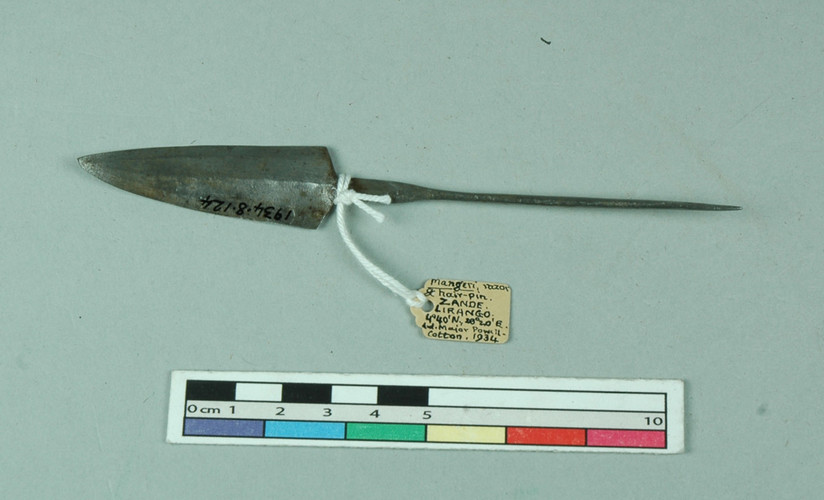 1934.8.124Iron object with a triangular, two edged blade, used as a razor, and a long narrow handle ending in a point, used as a hair pin [RTS 7/6/2004].1934.8.124
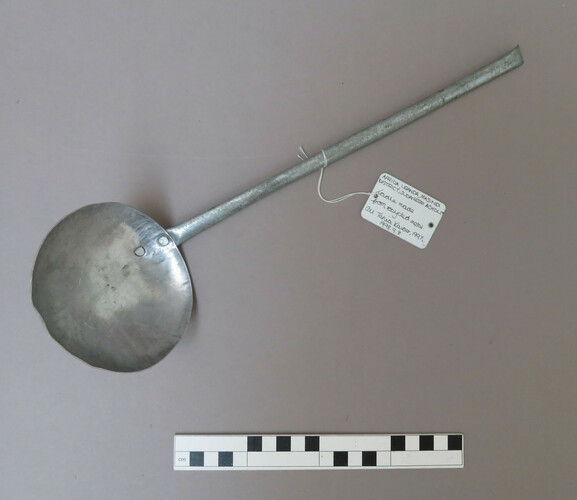 1998.9.8Long handled ladle made from recycled aluminium [RTS 18/6/2004].1998.9.8
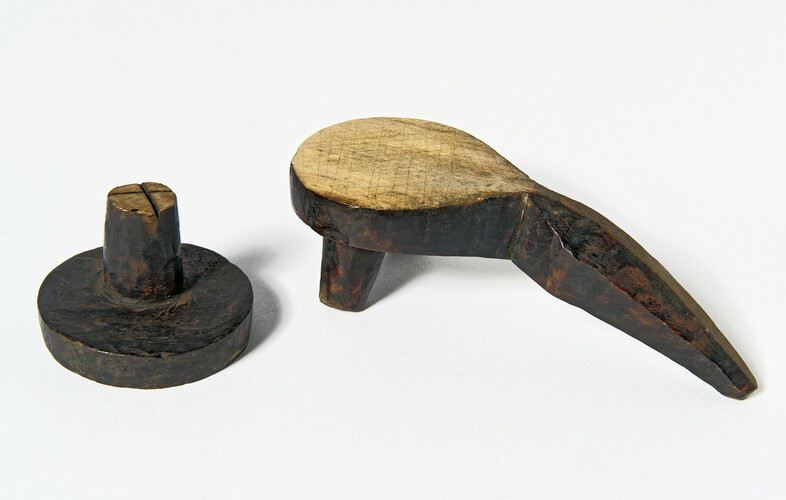 1940.12.608.1Rubbing-board oracle, consisting of a miniature wooden table [.1] with separate circular upper part that slides across the surface [.2].1940.12.608.1
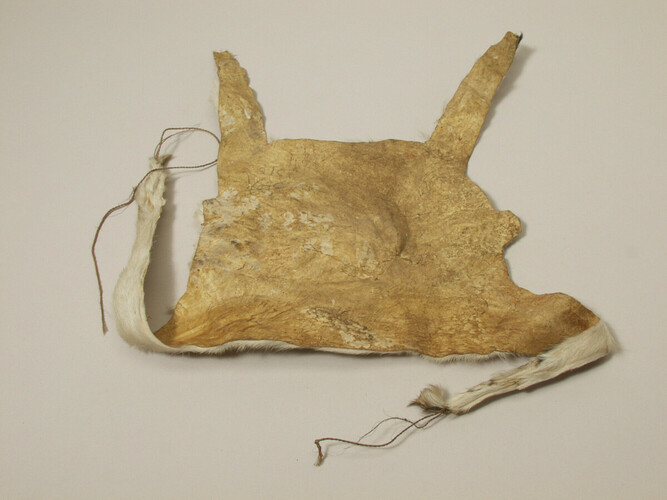 1934.8.90Sheep skin back apron, worn by men for dancing [RTS 22/6/2004].1934.8.90