
- Collection type
- Object
- Description
- Ornament from helmet 1940.7.092.1, consisting of a ball of black ostrich feathers with a red wool ball at its centre, suspended on a fibre cord [RTS 10/3/2005].
- Long description
- Twisted yellowish brown plant fibre cord used to suspend an ornament for helmet 1940.7.092.1 (Pantone 728C). The cord has 4 component strands twisted together; this is knotted before dividing into 2 sections to form a loop, then knotted again before becoming a single, thicker cord below. Several fibre rings were then threaded onto the lower part of this cord. Each ring is made from a core bound round with flat strips and with short black bird feathers fixed into their sides, splaying out and curving downwards (Pantone black C). The clustering of these rings has created a thick ball of feathers. At the centre of its base is a second ball, of solid, bright red wool that has been tied to the end of the cord (Pantone 1797C). This ornament would have been attached to the crown of the helmet, to hang down one side. It is nearly complete, but the cord is fraying while the feathers are quite fragile and have broken in a number of places. The object has a weight of 31.7 grams. The cord has a diameter of 1.5 mm; the feathered ball measures 123 by 105 mm across, and is 80.5 mm thick, while the wool ball has a diameter of 33 by 31 mm [RTS 10/3/2005].
- Geographical reference
- [Equatoria] Bahr el Jebel Eastern Equatoria
- Date / Period
- Date made: Before 1940
- Date collected
- By 1940
- Acquisition information
- Loaned: 1940
- Materials and processes
- Material Ostrich Feather Bird, Material Wool Yarn Animal, Material Plant Fibre, Process Twisted, Process Tied, Process Wound, Process Bound, Process Strung
- Dimensions
- Diameter: max 33 mm wool ball, Height 80.5 mm feather ball, Length 123 mm feather ball, Width 105 mm feather ball, Weight 31.7 g
- Object numbers
- Accession number: 1940.7.092.3
- Research and responses
A province known as 'Equatoria' or 'Al Istiwa'iyah' was in existance from some time in the 1940's to 1981, after which point it was divided into the districts of Eastern and Western Equatoria; in the 1990's these were subdivided further into the modern administrative districts of Western Equatoria, Bahr el Jebel, and Eastern Equatoria. The Lotuko appear to be associated with the area around Torit, suggesting a provenance for this object in either Bahr el Jebel or Eastern Equatoria.
An early prototype for the type of helmet that this decoration comes from is described by Samuel White Baker in his account of the Lotuko: " The Latookas wear most exquisite helmets, all of which are formed of their own hair … The thick, crisp wool is woven with fine twine, formed from the bark of a tree, until it presents a thick network of felt. As the hair grows through this matted substance it is subjected to the same process, until, in the course of years, a compact substance is formed like a strong felt, about an inch and a half thick, that has been trained into the shape of a helmet. A strong rim about two inches deep is formed by sewing it together with thread, and the front part of the helmet is protected by a piece of polished copper, while a piece of the same metal, shaped like the half of a bishop's mitre and about a foot in length, forms the crest. The framework of the helmet being at length completed, it must be perfected by an arrangement of beads, should the owner of the bead be sufficiently rich to indulge in the coveted distinction. The beads most in fashion are the red and the blue porcelain, about the size of small peas. These are sewn on the surface of the felt, and so beautifully arranged in sections of blue and red that the entire helmet appears to be formed of beads; and the handsome crest of polished copper surmounted by ostrich plumes gives a most dignified and martial appearance to this elaborate head-dress. No helmet is supposed to be complete without a row of cowrie-shells stitched around the rim so as to form a solid edge." (S.W. Baker, 1866, In the Heart of Africa, p. 212; a shorter version of this also appears in J.G. Wood, The Natural History of Man Volume I, 1868, p. 505). The Lotuko helmet in most recent form began to be made in late 19th century, and was conferred on Lotuko warriors who had distinguished themselves in war (C. Spring 1993, African Arms and Armour, 119). Among the changes were the practice of cutting these helmets away from the head and used independently - which led to a new style of closely shaven hair, to allow these helmets to be fit better. The glass and cowrie bead elements were also abandoned, in favour of more brass plating (J. Mack, 1982, "Material Culture and Ethnic Identity in Southeastern Sudan, in J. Mack & P. Robertshaw (eds), Culture History in the Southern Sudan, 118, fig. 4, pl. II). Powell-Cotton illustrated a helmet of this type in 1933, which included a black ball of feathers like this one, worn on one side of the crown (Spring 1993, fig. 115).
Search terms: Clothing Headgear, Ritual and Ceremonial, Status, Dance, Headdress, Ceremonial Object, Status Object, Dance Accessory
Further items to explore
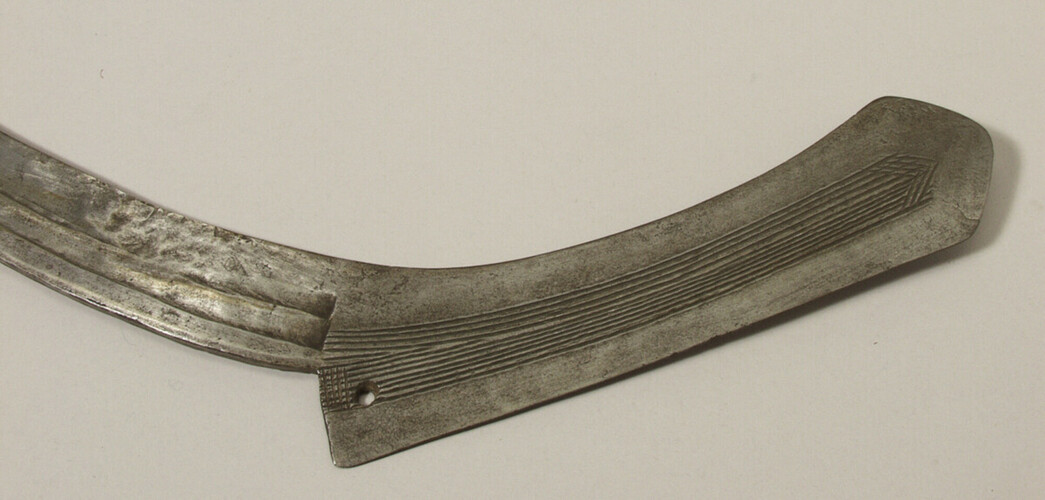 1905.68.10Long curved throwing knife/sword with wooden hilt and expanded butt. The blade has a concave edge. [SM 26/04/2007]1905.68.10
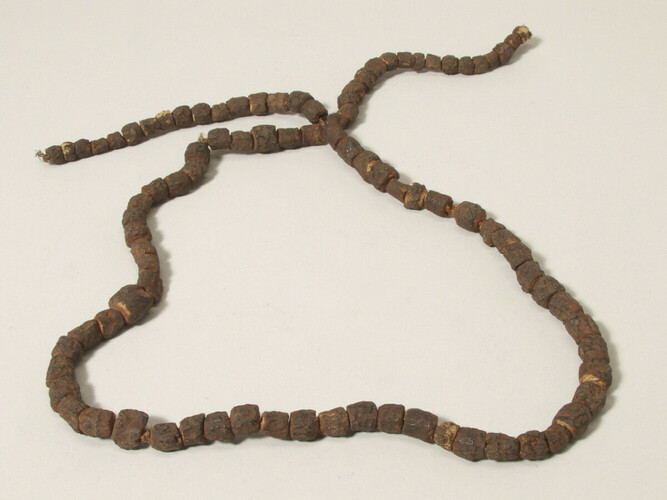 1942.1.447Scented wooden beads strung on a plaited grass string, worn around the neck [RTS 13/5/2004].1942.1.447
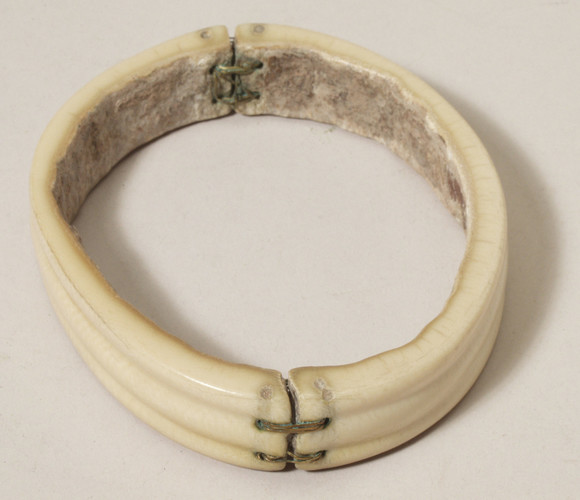 1934.8.26Ivory armlet, oval in plan view, made of two pieces, joined by metal wire [RTS 2/6/2004].1934.8.26
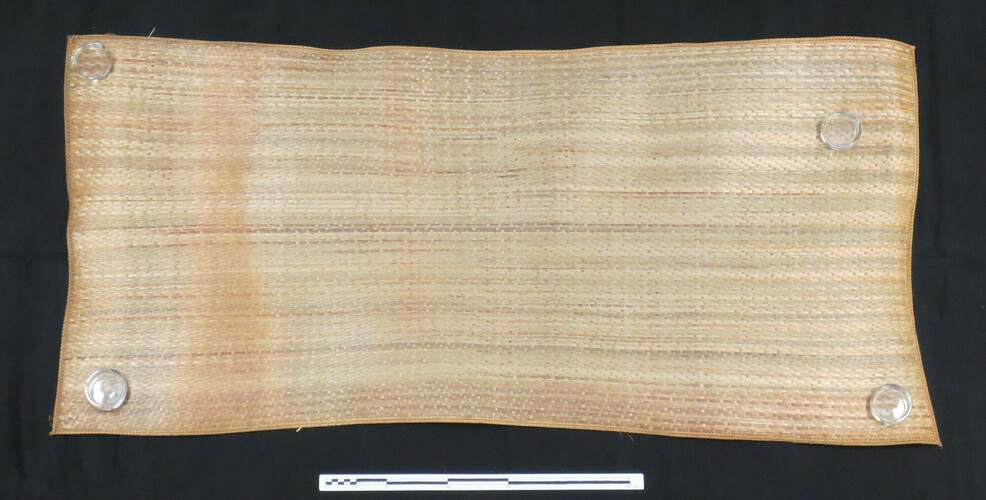 1948.2.159.12Rectangular mat made of chequerwoven strips of yellow palm fibre with fringed inner edges [RTS 9/8/2005].1948.2.159.12