
- Collection type
- Object
- Description
- Ivory armlet, oval in plan view, made of two pieces, joined by metal wire [RTS 2/6/2004].
- Long description
- Arm ornament made from two pieces of ivory. This was probably carved originally as a single piece, and then either deliberately or accidentally broken. It has a flat inner face that is currently covered with a layer of white uncalcified dentine, from the core of the tusk. This surface seems irregular, and the thickness of the armlet varies. The upper and lower surfaces are flat and narrow; the outer face was probably cut to be slightly convex, and then further worked by the addition of two shallow parallel grooves around the circumference. The two parts of the armlet are of equal size, and the joining ends have been cut flat. Each end has been pierced by two holes, seated in the bases of the decorative grooves. Through these have been threaded pieces of round sectioned brass wire (Pantone 871C). These are visible on the outer face as two groups of horizontal bindings going across each pair of holes. On the inside face, the wires have also been passed vertically and obliquely between the holes. In addition to these functional holes, small circular depressions have been bored into the narrow flat upper and lower surfaces at each end; on one end, there are two such depressions bored so that they touch very slightly. The object is complete, with the ivory currently a pale cream colour (Pantone 7401C). It measures 104.5 by 90.3 mm across its outside edges, and 87 by 78 mm across its inside edges, with a height of 21.3 mm and a thickness that varies from 6 to 8.7 mm. The weight is 71.2 grams [RTS 2/6/2004].
- Cultural groups
- Dinka
- Person
- Field collector Percy Horace Gordon Powell-Cotton
- Field collector Hannah Powell-Cotton
- PRM source Percy Horace Gordon Powell-Cotton
- Date / Period
- Date made: Before 1933
- Date collected
- 3rd May 1933
- Acquisition information
- Donated: 1934
- Materials and processes
- Material Animal Ivory Tooth, Material Brass Metal, Material Copper Alloy Metal, Process Carved, Process Perforated, Process Bound
- Dimensions
- Width: max 90 mm, Length: max 87 mm internal, Depth: max 21 mm, Width: max 78 mm internal, Length: max 104.5 mm, Thick: max 9 mm, Weight 71.2 g
- Object numbers
- Accession number: 1934.8.26 Other numbers: 2049
- Research and responses
According to the Encyclopedia Britannica Online, the White Nile is the section of the Nile between Malakal and Khartoum, Sudan [CW 23/3/2000]. However the way in which this term has been used seems to have changed since this object was collected, aand Fanamweir appears to be located in the administrative district of Warab in the Southern Sudan. Powell-Cotton made ethnographic films during his 1932-3 shooting expedition to southern Sudan; footage included a Dinka hunter setting a trap, a staged fight between a Dinka and Jur and a female Dinka potter at work (see the description in Mrs Powell Cotton, "Village Handicrafts in the Sudan", Man 34 (112), pp 90-91).
Domville Fife suggested that ivory bangles were worn by Dinka men who had speared an elephant (C.W. Domville Fife, 1927, Savage Life in the Black Sudan, p. 129); he does not give any specifics as to the actual form of the armlet, but gives it the name afjok. This is probably the term that appears in Nebel as apiok, meaning an ivory armlet. An alternative term is given as atum (ivory, round) (Nebel 1979, Dinka-English Dictionary, p. 106). He does not mention the word pioque [RTS 9/11/2004].
Search terms: Ornament, Arm Ornament
Further items to explore
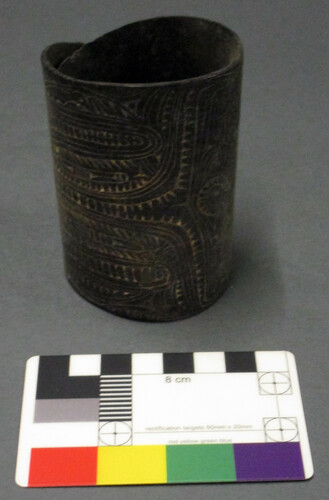 1938.36.1000Turtleshell wristlet. [ASh [OPS move] 23/11/2016]1938.36.1000
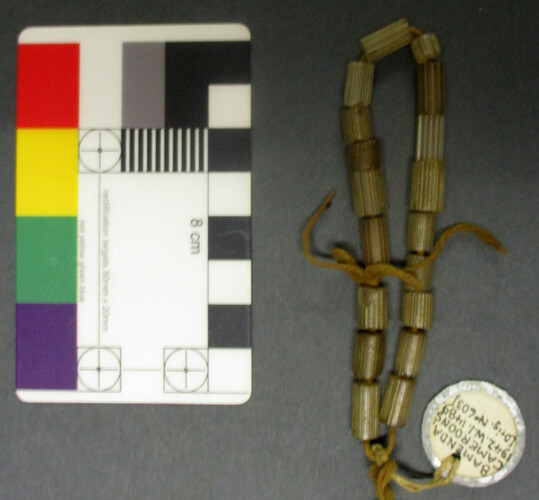 1942.13.1489.2Bracelet of cylindrical yellowish translucent beads with white horizontal stripes. Strung onto buff coloured twisted cord. Attached to 1942.13.1489 .1 [ASh [OPS move] 18/11/2016]1942.13.1489.2
 1945.8.13.10Green glass bangle. [El.B 'DCF 2004-2006 What's Upstairs?' 11/11/2005]1945.8.13.10
 1978.9.16Adjustable bracelet; thick elephant hairs with 2 knotwork sliders. [EC 'DCF 2004-2006 What's Upstairs?' 21/10/2005]1978.9.16
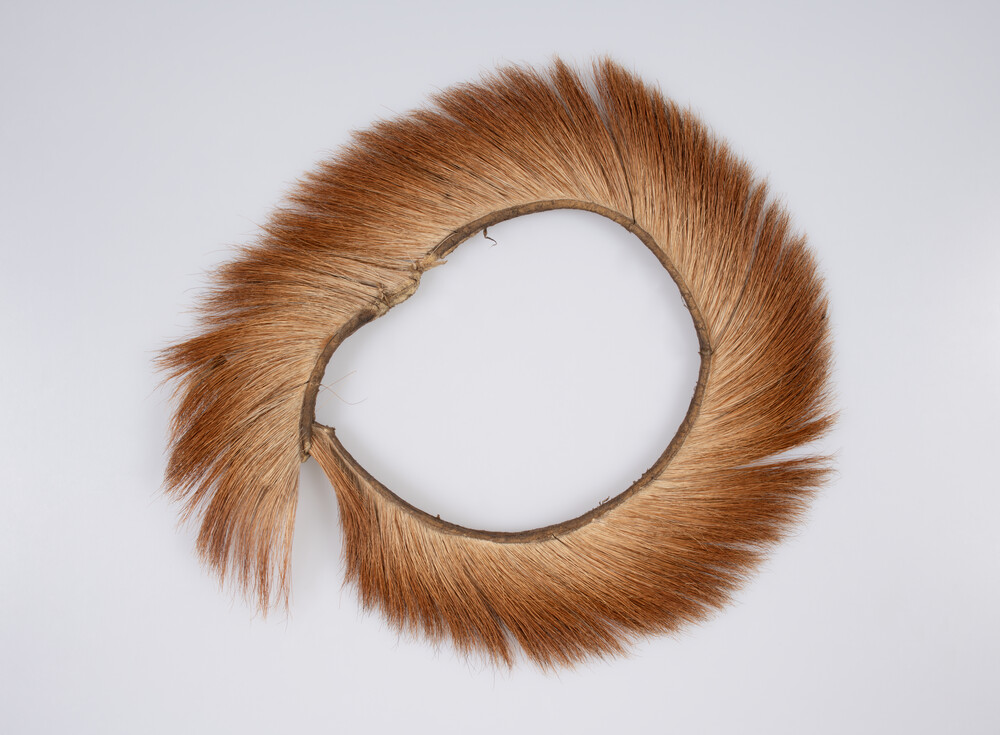 1931.66.31Fringe collar of giraffe hide with hair attached, for hanging round the neck of a favourite bull calf.1931.66.31
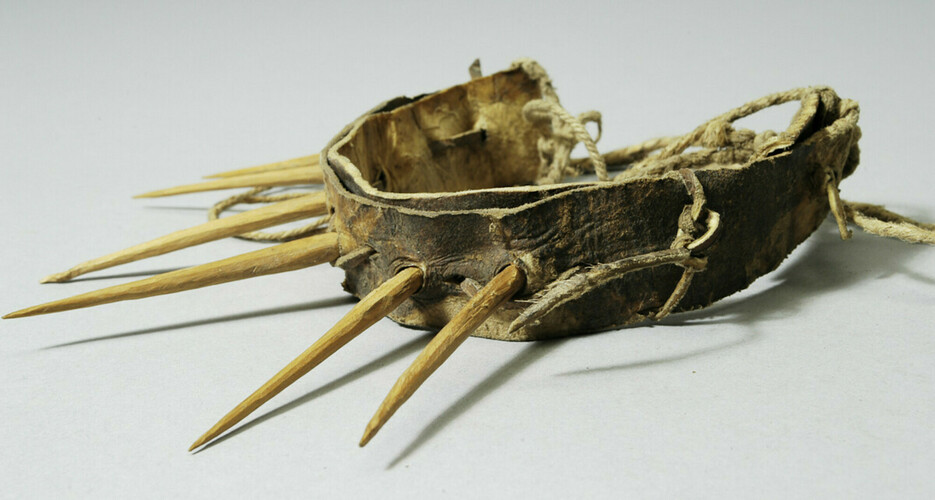 1936.10.30Rectangular hide band with long, projecting wooden spikes, used to wean calves [RTS 30/6/2005].1936.10.30
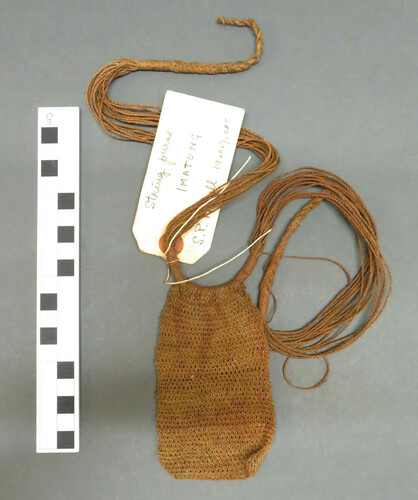 1940.7.085String bag. [ASh [OPS move] 26/5/2017]1940.7.085
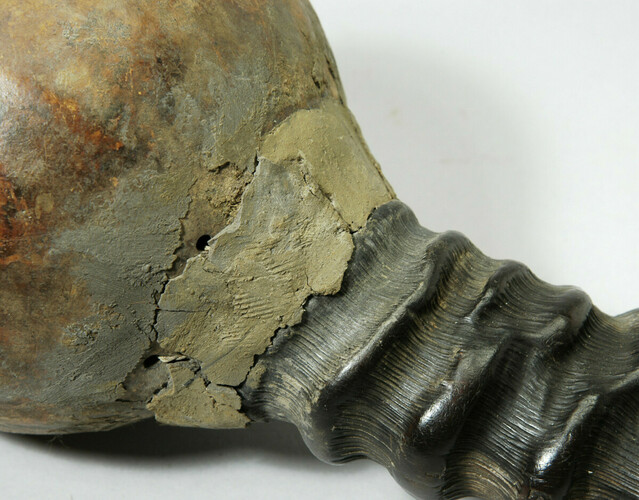 1979.20.85Horn side-blown trumpet with gourd bell mouth and decorative goat's hair tassel used in hunting and initiation ceremonies. [SM 14/05/2007]1979.20.85