
- Collection type
- Object
- Description
- Openwork apron made from a double thickness of twisted plant fibre netting with tie cords at the sides; worn by girls and women when working the fields [RTS 8/3/2005].
- Long description
- Openwork apron made from twisted yellowish brown grass fibre string (Pantone 7508C), with each length made from two strands twisted together. The upper part of the apron consists of a broad band of single thickness, in which there are pairs of horizontal strings running across the pattern, one left free and the other woven in with vertical elements composed of a series of interlocking loops. The horizontal strings extend beyond the finished edges of this band as 10 cords that could be used as waist ties. These are fraying along their lengths and at their ends. Several of these have taken on a pinkish red colouring from contact with ochre. Below this waist band, the body of the apron is made of these interlocking loops only; this has been woven as a continuous cylinder of netting, with the top edges looped into the waist band on both sides to create a double thickness of netting, without any seams. At its base, the open edges were then sewn together by overstitching with another length of twisted fibre, and finished with a knot at one side. Occasional knots are also visible across the surface where separate lengths of fibre were joined together. The apron could probably be worn with either side facing outwards, and occasional ochre stains across both sides suggest this had been the case. The object is complete, but has been mended; there is also a crease running down the centre of the garment where it has been folded. It has a weight of 178.3 grams. The apron body is 365 mm long, 410 mm wide and 7 mm thick; the waistband is 28 mm wide; the bundle of string ties have a total length of 1600 mm, stretched out, and the grass string has a diameter of 1.5 mm [RTS 8/3/2005].
- Geographical reference
- [Equatoria] Eastern Equatoria Logwi
- Cultural groups
- Imatong
- Date / Period
- Date made: Before 1940
- Date collected
- By 1940
- Acquisition information
- Loaned: 1940
- Materials and processes
- Material Grass Fibre Plant, Material String, Process Looped, Process Openwork Woven, Process Netted
- Dimensions
- Thick 7 mm, Length: max 1600 mm including ties, Length 365 mm apron, Width 410 mm, Weight 178.3 g
- Object numbers
- Accession number: 1940.7.090
- Research and responses
A province known as 'Equatoria' or 'Al Istiwa'iyah' was in existance from some time in the 1940's to 1981, after which point it was divided into the districts of Eastern and Western Equatoria; in the 1990's these were subdivided further into the modern administrative districts of Western Equatoria, Bahr el Jebel, and Eastern Equatoria. Logwi is located in Eastern Equatoria. The 'Imatong' tribe are presumably a group located somewhere around Jebel Imatong, which is a mountain peak in Southeastern Sudan, in Eastern Equatoria, south of Torit [RTS 11/11/2003].
Search terms: Clothing, Children and Childcare, Status, Ornament, Cordage, Apron, Waist Ornament, Skirt, Groin-cover
Further items to explore
 1969.29.106.2Wooden spear shaft with socketed iron spear-butt. [AFS [OPS move] 5/7/2018]1969.29.106.2
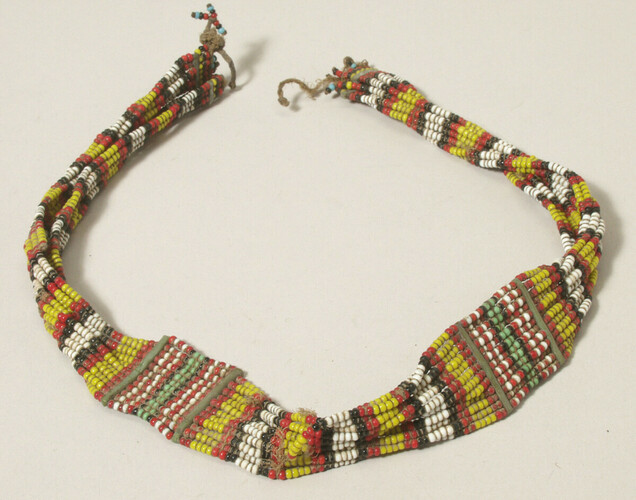 1979.20.15312 stranded necklace made up of small glass beads in several colours, worn by women [RTS 25/5/2004].1979.20.153
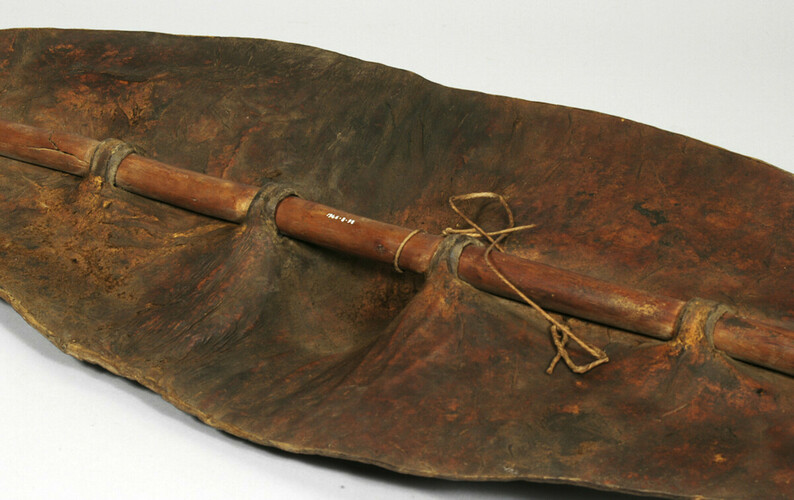 1946.8.98Shield made from elephant hide skin with lentoid-shaped body on a central wooden support [RTS 3/8/2005].1946.8.98
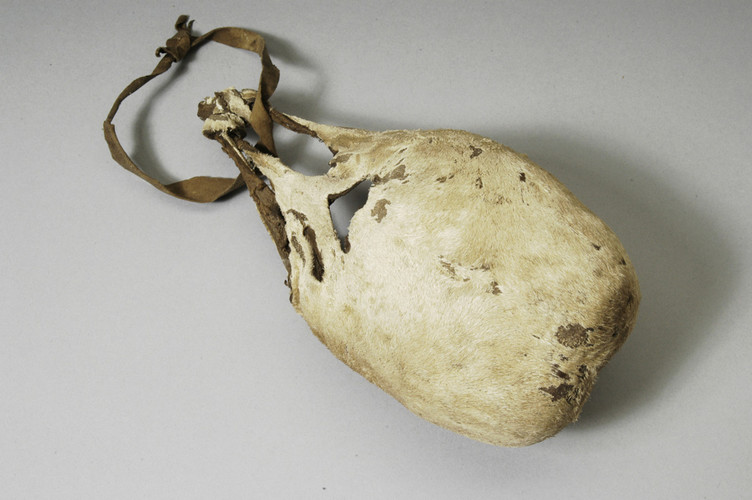 1931.66.19Animal scrotum bag with globular body, loop handle tied in a knot, and a soft hide suspension loop. [JC [OPS move] 20/07/2016]1931.66.19