
- Collection type
- Object
- Description
- Animal scrotum bag with globular body, loop handle tied in a knot, and a soft hide suspension loop. [JC [OPS move] 20/07/2016]
- Long description
- Hide bag made from an animal's scrotum, possibly from a giraffe. This has been cut to have 3 narrow tapering strips that are knotted together at the top to form a loop handle that extends above the oval mouth of the vessel. The body expands below this to reach its maximum diameter mid-way down the sides; the base is irregularly convex, and pinches in slightly across the centre; this is also oval in plan view. There is one long oval slit and a larger triangular opening cut in the upper body on one side, just below the base of one of the handles. The hide is stiff and inflexible, a mid brown colour on the inside surface (Pantone 7532C), and covered with whitish buff hair over the exterior (close to Pantone 7401C). A narrow strip of soft flexible hide has been tied around the handles to form a suspension loop. The bag is complete and intact, but has lost patches of hair across the outer surface and has some damage along the edge of the loop. It has a weight of 117.5 grams and total length of 390 mm. The handles are 113 mm long, 9 mm wide and 4 mm thick near their tops, while the body is 143 mm long, with a mouth diameter of 70 mm and a maximum body diameter of 118 mm, and the added loop is 160 mm long, 10.5 mm wide and 0.8 mm thick [RTS 4/8/2005].
- Geographical reference
- Cultural groups
- Nuer
- Date / Period
- Date made: Before 1931
- Date collected
- 1930 - 1931
- Acquisition information
- Donated: 1931
- Materials and processes
- Material Animal Hide Skin, Material Cattle Skin Animal, Material Giraffe Skin Animal, Process Knotted
- Dimensions
- Depth: max 120 mm, Width: max 115 mm, Length: max 255 mm, Weight 117.5 g
- Object numbers
- Accession number: 1931.66.19
- Research and responses
This object was probably collected during his first or second season of fieldwork amongst the Nuer, e.g.: in 1930 or 'the dry season' of 1931. In the former, he spent around three and a half months in Leek territory at Yahnyang and Pakur on the Bahr el Ghazal, in Lou territory at Muot Dit, and at Adok, amongst the Dok Nuer. In the latter, he spent five and a half months at Nasir, on the Nyanding River, and at Yakwat on the Sobat River (see E.E. Evans-Pritchard, 1940, The Nuer, and the map of Evans-Pritchard's fieldwork in D.H. Johnson, "Evans-Pritchard, the Nuer, and the Sudan Political Service", African Affairs 81 no. 323, p. 233).
Evans-Pritchard illustrates 2 Nuer bags, made from the scrota of a bull and a giraffe; he says that the scrota of bulls are made into bags that are used to hold tobacco, spoons and other small objects (E.E. Evans-Pritchard, 1940, The Nuer, p. 30 and fig. 3; the illustrated objects are in the Cambridge Museum of Archaeology and Anthropology). The Pitt Rivers Museum has 2 such bags from his collection; for the other bag, see 1931.66.20, which is somewhat smaller. For a similar bag, used by the Shilluk, see R. Boccassino, 1966, "Contributo allo studio dell'ergologia delle popolazioni nilotiche e nilo-camitiche, parte V", Annali Lateranensi XXX, fig. 58, and p. 302. The Bari also made use of animal scrota for small purses; these have flattened bodies rather than the fuller shape seen in this example (see 1934.8.42-43) [RTS 27/2/2004].
Search terms: Bag, Transport and Travel, Carrying Device, Vessel
Further items to explore
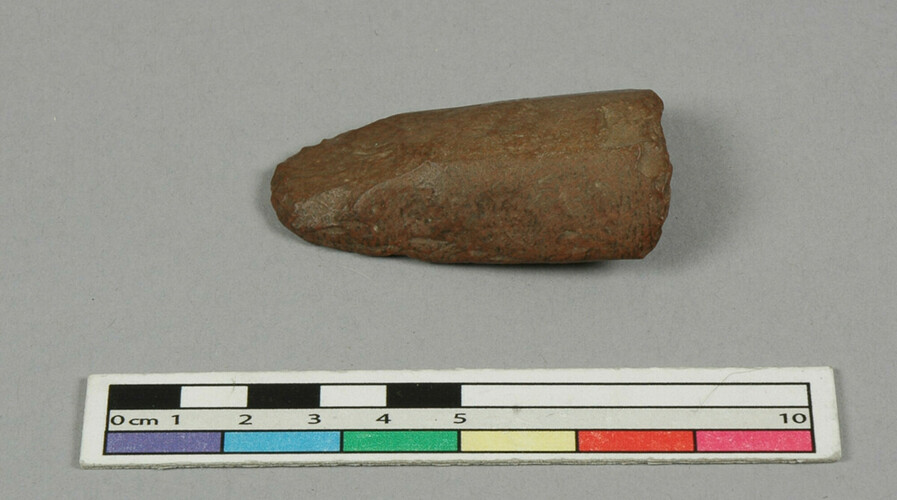 2010.13.66Stone tool.2010.13.66
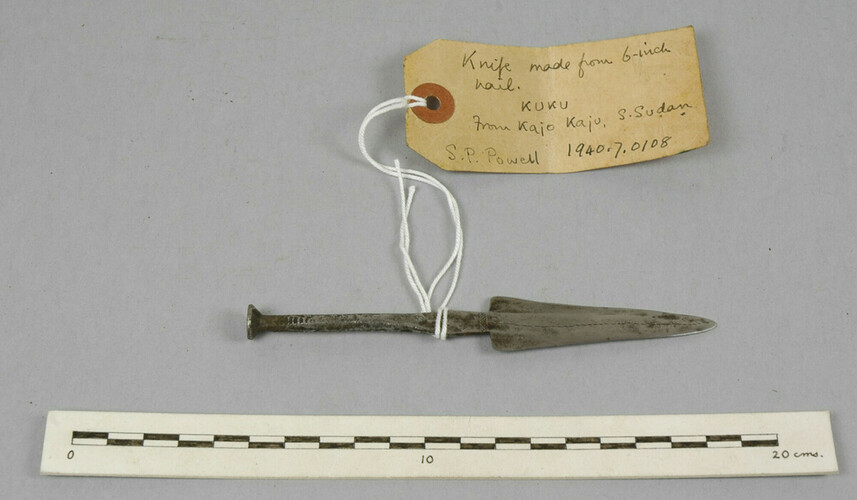 1940.7.0108Iron nail, recycled to form a small knife with triangular blade and incised decoration [SM 19/06/2007]1940.7.0108
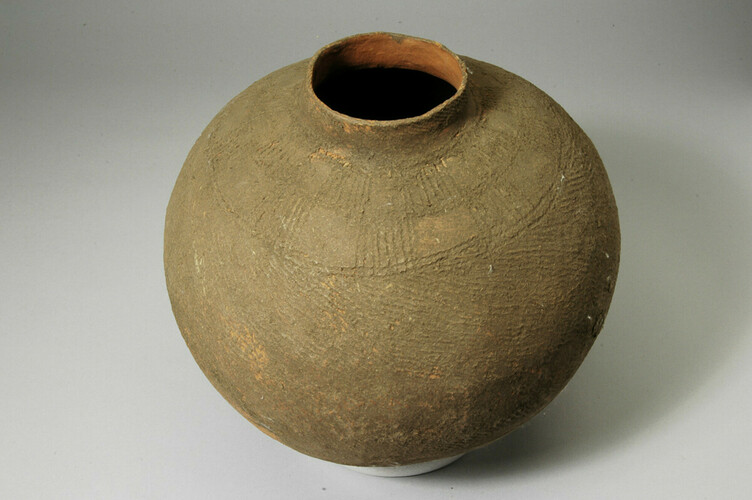 1979.20.113Decorated red pottery jar with narrow mouth, short neck and globular body, used for drinking beer [RTS 3/8/2005].1979.20.113
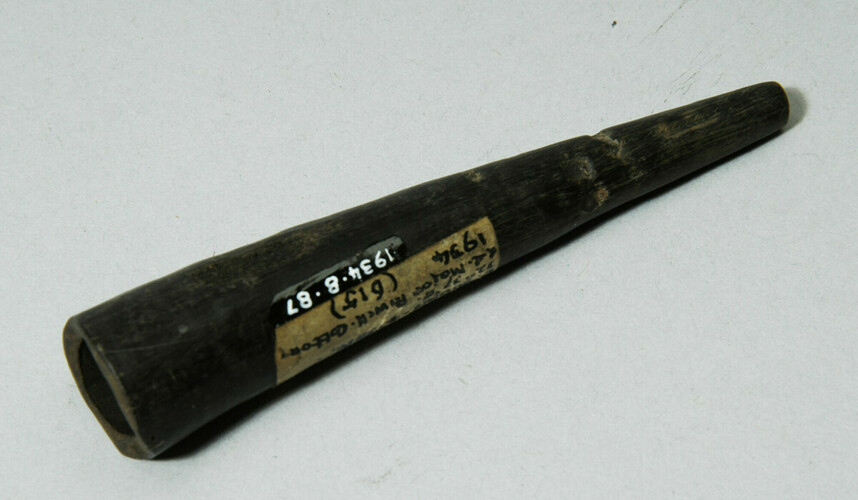 1934.8.87Notched end-blown flute of antelope horn with a short tapering body and single finger-hole at base, used by boys [RTS 28/5/2004].1934.8.87