
- Collection type
- Object
- Description
- Orange body cloth with black stripes and a central white panel with lozenge and triangle patterns in orange supplementary weft.
- Long description
- Orange body cloth with black stripes and a central white panel with lozenge and triangle patterns in orange supplementary weft. The cloth is formed of two lengths of orange cotton textile, with a narrow length of white cotton textile stitched in the middle with white thread. One of the orange panels has eleven evenly spaced black lines, including along each edge, each comprising four or five warp threads. The other orange panel has eighteen black lines, including along each edge, each comprising four or five warp threads and getting increasingly closer together towards the selvedge. The short ends of each orange panel have four transverse black stripes, each comprising three to five weft picks. The central white panel has a repeating pattern of elongated lozenges and triangles, these formed by floating supplementary wefts, where each pick is composed of four or five orange threads. There are also five decorative warp lines of black flanked by orange, which form lines of symmetry for the pattern. The lozenges are arranged in rows of three, with another half on either side, and all have a central black line of floating supplementary weft. The triangles are arranged in opposing rows of four. Each has a black line along the base from which four tiny triangles descend. At both ends are more lines of black and orange bundles of supplementary weft, each floating over the weave to create tiny lozenge motifs. At one end this is followed by four transverse lines of single orange supplementary weft, at the other six lines of the same. The warp ends of the cloth have been loosely twisted to form a fringe at each short edge. [JC] The textile comprises three panels (two side panels and a narrow strip of band in the middle. Each panel is attached to one another edge-to-edge using simple looping stitches. All panels are woven in warp-facing plain weave. All yarns are in Z twist. On average 13 warps and 7 wefts are counted in 1cm2 on side panels, while 17 warps and 8 wefts are counted in 1cm2 on the middle panel. Fringes are a series of loosely S-twisted bundles. On average 24 warps are twisted together create a fringe, approximately 80mm im length. Both side panels are woven predominantly with orange-ochre and black thread warp ends and orange-ochre weft threads. The narrow central band is woven using black, orange-ochre and off-white warp threads and off white weft yarns with orange-ochre and black supplementary wefts. Please see annotated image for further details. [MT 23/07/2021]
- Geographical reference
- Cultural groups
- Ao Naga
- Date / Period
- Date made: Before 1923
- Date collected
- By 1923
- Acquisition information
- Loaned: 10/1923 Donated: 1928
- Materials and processes
- Material Cotton Seed Fibre Textile Plant, Material Cotton Seed Fibre Yarn Plant, Material Wool Yarn Animal, Process Woven, Process Dyed, Process Supplementary Weft Woven, Process Stitched
- Dimensions
- Length: Max 1640 mm, Length 1495 mm excluding fringes, Width: Max 1172 mm
- Object numbers
- Accession number: 1928.69.453
- Associated publications
- Reference: Naga Textiles Design, Technique, Meaning and Effect of a Local Craft Tradition in Northeast India, Main author: Marion Wettstein; Stuttgart, 2014, Page: 137
Search terms: Textile, Clothing, Status, Body Cloth
Further items to explore
 1919.59.79.110 fragments [.1-10] of a silver or copper vessel1919.59.79.1
 1907.21.23Rolled rectangular cloth of woven strips of plant ?leaf fibre. All four edges of the cloth are fringed. [EH [OPS Move] 26/6/2017]1907.21.23
 1928.69.167Girl's first skirt, white cloth with dark blue lines.1928.69.167
 1928.69.846Fringed cloth worn by both sexes1928.69.846
 1952.6.6.4Bangle: band covered with yellow lacquer & sequins with patterns in red, green and golden coloured foil. [EC 'DCF 2004-2006 What's Upstairs?' 20/1/2006]1952.6.6.4
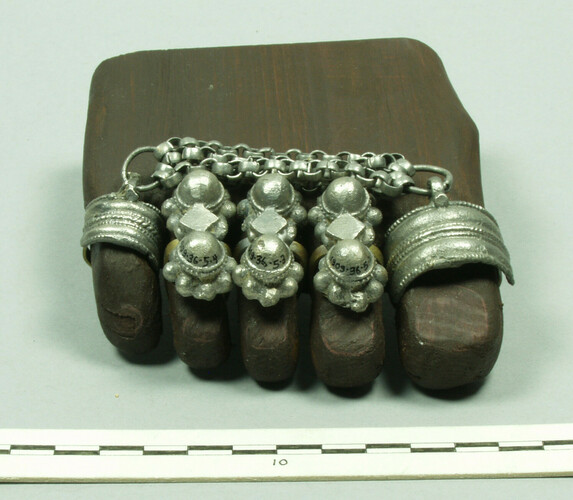 1909.36.5.1Toe rings, [.1 - .5], the big toe and 'baby' toe ring are chained together [L.Ph 'DCF 2004-2006 What's Upstairs?' 19/5/2005]1909.36.5.1
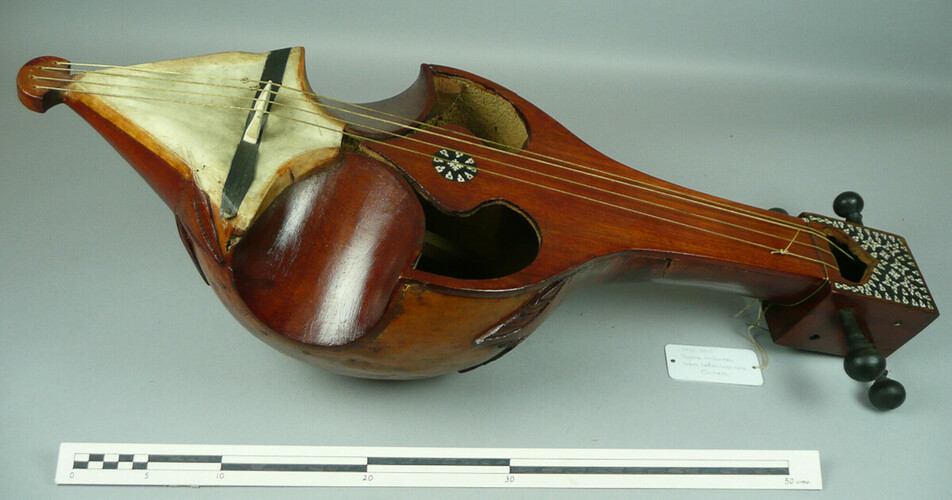 1986.39.5Necked box lute with four strings. Wooden neck and square pegbox with gourd resinator. Pegbox decorated with inlaid bone in 'Tagore' style. [MJD 17/9/2008]1986.39.5
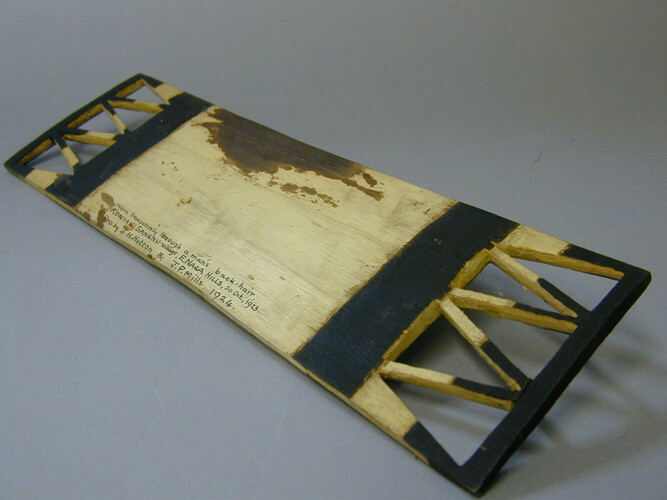 1923.85.289Hair ornament.1923.85.289