
- Collection type
- Object
- Description
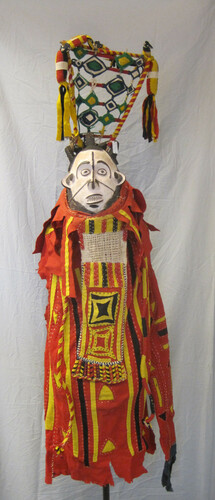
- Headdress [.2] from a dance costume [.1]
- Long description
- This headdress [.2] is from the rest of the dance costume, comprising a mask and tunic, which are securely joined together [.1]. The head-dress is made from a wooden frame bound with coloured strips of felt and decorated with squares of blue, green and white wool, plus squares of yellow felt and green wool. Stitched onto the felt along the top of the frame are three stuffed felt birds, there is also a stuffed tassel at each end of the top of the frame. Originally the two pieces of wood forming the sides of the frame slotted into two holes in the top of the mask, one side of the frame is still attached in this manner, the end section of the other side of the frame is missing. [ZM 26/04/2013]
- Geographical reference
- Date / Period
- Date made: Before 1920
- Date collected
- 1909 - 1920
- Acquisition information
- Donated: 1966
- Materials and processes
- Material Wool Textile Animal, Material Wood Plant, Material Felt Wool Textile Animal, Process Felted
- Dimensions
- Length: max 1710 mm total, Height: max 420 mm, Width: max 375 mm
- Object numbers
- Accession number: 1966.16.79.2
- Research and responses
See Cole, Herbert M. "Igbo." Grove Art Online. Oxford Art Online. Oxford University Press. Web. 26 Apr. 2013. http://www.oxfordartonline.com/subscriber/article/grove/art/T039869 for a description of the cloth covered framework structures sometimes attached to masks by the northern Igbo during the late 19th and early 20th century. [ZM 26/04/2013]
John Picton examined this mask and costume during a consultation visit to look at Igbo masks on 12 November 2013 and noted the following: The original identification of this as Idoma is possible (see accession book description), as female white-faced masks like this are found amongst the Idoma and the Igbo, however Sidney Kasfir is an expert on the Idoma so the identification of this as Igbo rather than Idoma is probably correct. If Igbo this is likely to be northern or north-eastern Igbo. The felt and wool is imported, the blue cotton on the sleeve factory woven and resist dyed and white panel to create an opening to see out is locally spun cotton, which has an interactive warp-weft structure (an interesting technique widely used but in West Africa quite rare). The panel on top of the head represents an elaborate hairstyle and the square woollen sections could provide a means of tying in magical medicine. The figures on the top of the panel look like birds, which can be either pretty and decorative or an association with witches. 1966.16.80.1 could be a bird because of the two legs and a tail and 1966.16.80 .2 a leopard because of the spots. [ZM 20/11/2013]
Search terms: Clothing Headgear, Ornament, Mask, Headdress

Further items to explore
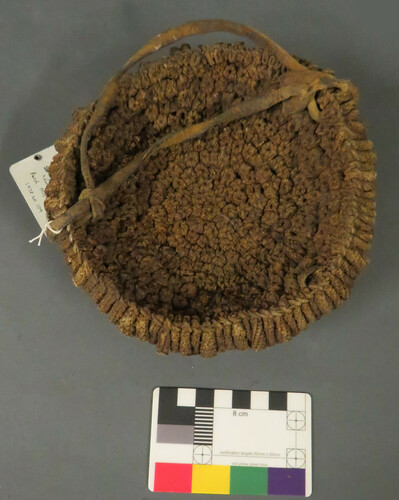 1978.20.109A circular mass of ?crocheted string tubes joined together, with a leather thong tied through the rim and knotted in place. [CW [OPS Move] 4/4/2017]1978.20.109
 1985.6.3Sāyakūī pink-purple silk scarf with decorative border of weft stripes in blue, green, white and gold, and a black fringe at each edge. Worn by Iranian Zoroastrian women.1985.6.3
 2017.103.50.2Otter fur turban, part of an outfit made in an Eastern Woodlands style [2017.103.50]. [JMC 15/8/2019]2017.103.50.2
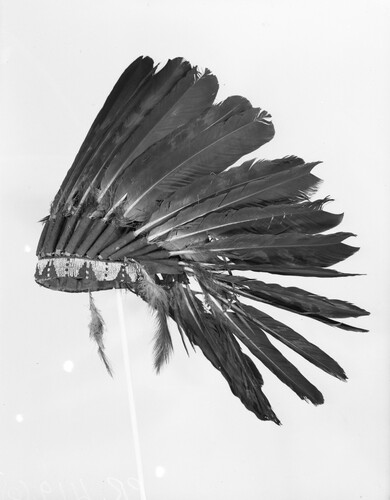 1954.8.141"War bonnet"1954.8.141
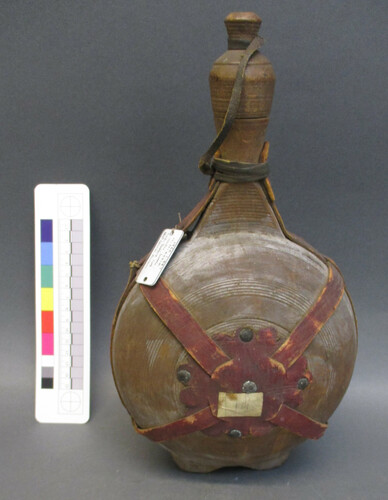 1966.1.987.1Turned wooden water bottle with concentric circular designs on opposite sides and four rounded feet. For the lid stopper of this object see [1966.1.987 .2] [BS [OPS move] 7/10/2016]1966.1.987.1
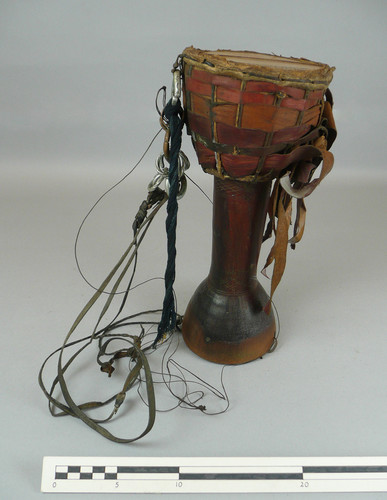 1933.69.1Single membrane drum with pedestal body. Strips of animal hide woven through the twisted hide strings bracing the membrane. Incised designs on wooden pedestal stem. [LKG 15/9/2008]1933.69.1
 1975.3.45Typed manuscript1975.3.45
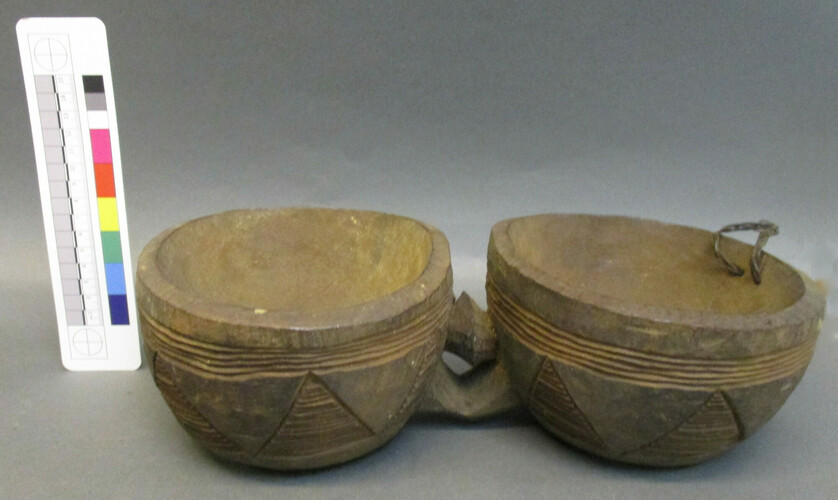 1942.13.379Twin wooden food bowl cut from a single piece of wood. [RM [OPS move] 12/10/2016]1942.13.379