
- Collection type
- Object
- Description
- Sword [.1] Tulwar with decorated curved blade and ?gilded hilt with velvet tassel, and cream velvet covered wooden sheath [.2] [SM 17/10/2007]
- Long description
- Sword [.1] Tulwar with decorated curved blade and ?gilded hilt with velvet tassel, and cream velvet covered wooden sheath [.2] The blade is made of steel and is decorated on both surfaces with decorative channeling/grooves and punched dots. The hilt is ?gilded with ?gold which is still visible in places, most of the hilt is now a shiny dark grey colour. It has long langets, each perforated four times at the tip and flared quillons with rounded ends. A knucklebow projects from one quillon to the disc shaped pommel, terminating in two animal head figures side by side. A dark blue velvet tassel with red silk lining is attached to the top of the pommel. The sheath is covered all over with cream velvet and decorated with cream and green thin yarn up the back and widthways below the mouth. The mouth is V shaped and the sheath has an embossed/impressed iron chape that has also been ?gilded with ?silver. It is a dull mid grey in colour. [SM 17/10/2007]
- Geographical reference
- Date / Period
- Date made: Before 1902
- Date collected
- By 1902
- Acquisition information
- Loaned: 1902
- Materials and processes
- Material Steel Metal, Material Iron Metal, Material Wood Plant, Material Velvet Textile, Material Silk Textile Animal, Material Metal, Material Yarn, Process Forged (Metal), Process Carved, Process Covered, Process Impressed, Process Stamped, Process Grooved
- Dimensions
- Length: max 948 mm sword, Length: max 833 mm sheath
- Object numbers
- Accession number: 1902.87.7.1 Accession number: 1902.87.7.2
- Research and responses
The talwar has one full or true edge on the convex side, and a ‘false’ or partial edge on the distal third of the back edge. Comparison of this blade form with European cavalry sabres reveals how closely European cavalry modelled their weapons on Indian sword forms. The distinctively Indo-Muslim talwar hilt form with knuckle-guard is known as Delhishahi, although it does not indicate a Mogul origin. The talwar was the most widely and numerously distributed Indian weapon form (Egerton, 1896: 104), due to the widespread influence of Rajput Maharajas. Talwar were historically conceived by Rajput men as the embodiment of their honour, commitment and agency; Egerton (1896: 105-6) remarks on two of the commonest Rajput oaths – ya sil ka an (‘by this weapon’) and dhal talwar ka an (‘by my talwar and shield’). Talwar were an integral part of the weaponry displays in Rajput rulers’ Silleh-Kana armouries. Research Conducted for DCF Cutting Edge 2006/2007 [AM].
Search terms: Weapon, Figure, Sword, Sheath, Animal Figure
Further items to explore
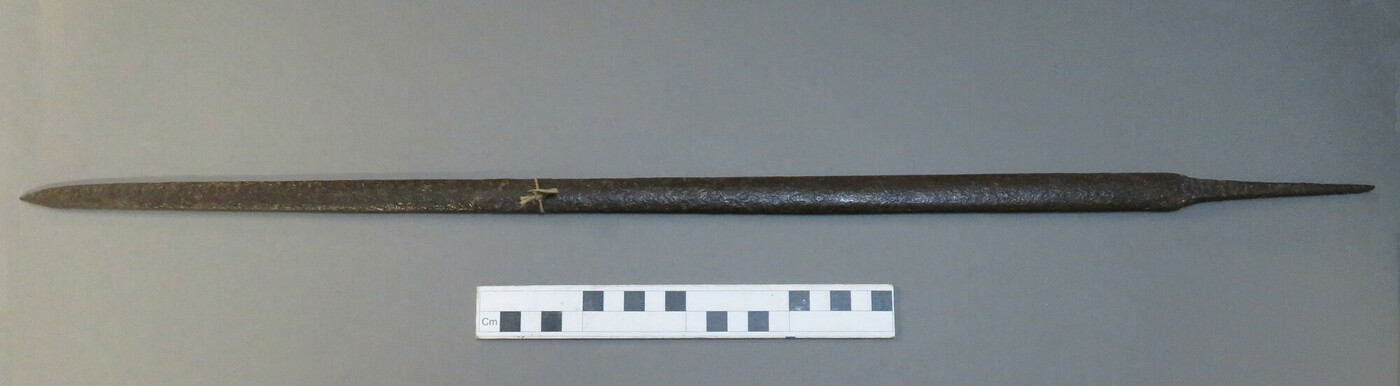 1884.140.1858Iron sword blade, missing its handle. [JMC 15/10/2018]1884.140.1858
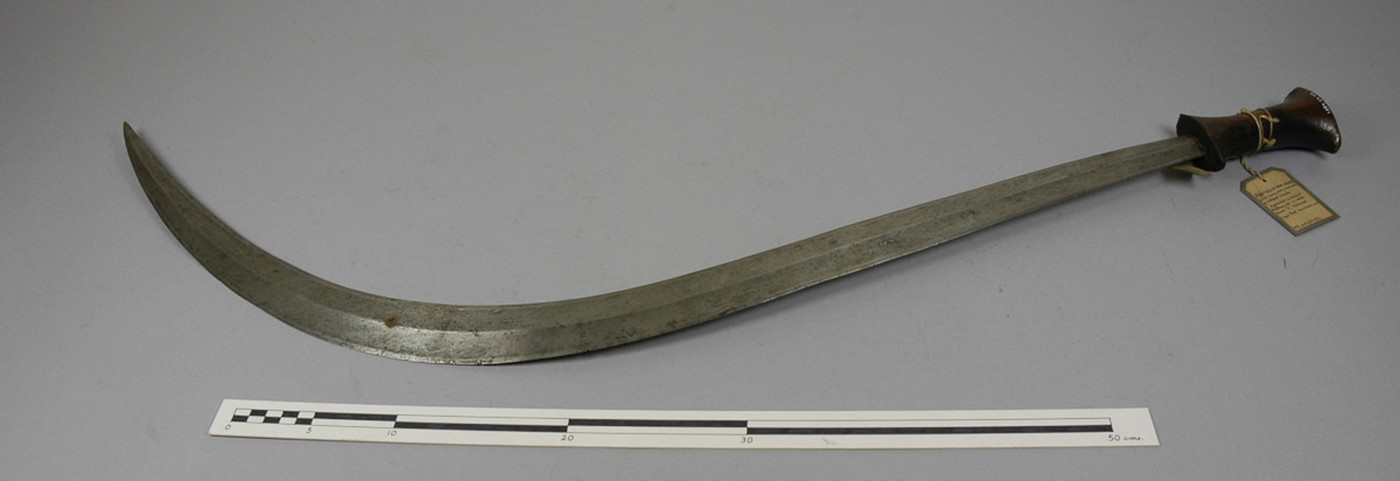 1884.24.113Long sword, strongly curved, two-edged pointed blade, tang clinched through a plain hard-wood handle (reel-shaped). [El.B 5/6/2007]1884.24.113
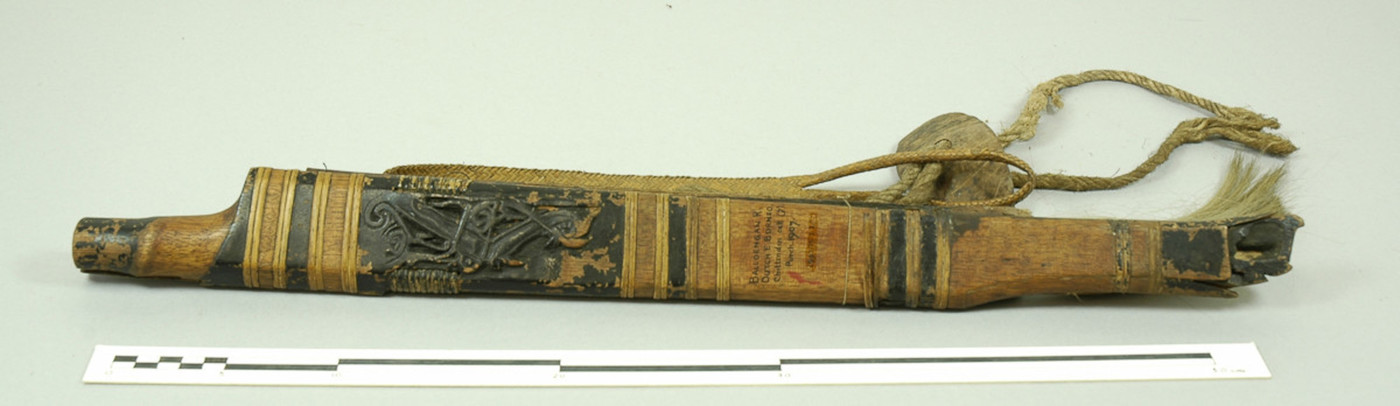 1907.75.7.2Wooden sheath for a sword [1907.75.7 .1], with belt of plaited cane and rope, coconut shell toggle and fringe of animal hair. [El.B 14/2/2007]1907.75.7.2
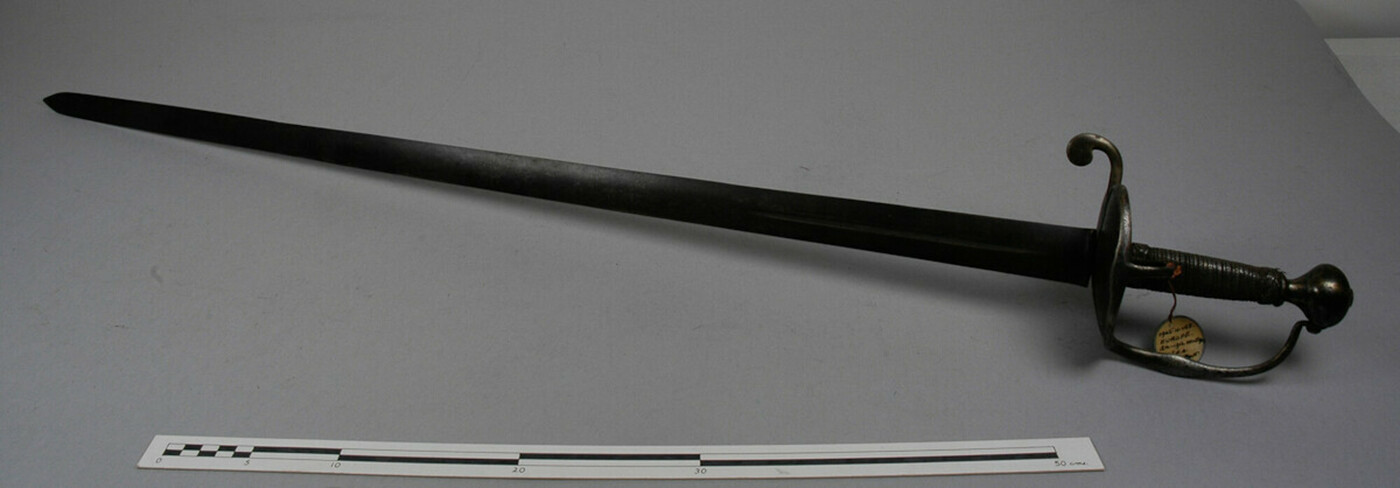 1945.11.103Sword with straight, tapering, two edged blade and iron hilt with perforated guard, knuckleguard, scrolling quillon and pommel. [SM 31/10/2007]1945.11.103
 1923.85.334.2Crossbow stock. For the bow see [1923.85.334 .1] [SB [OPS move] 16/8/2017]1923.85.334.2
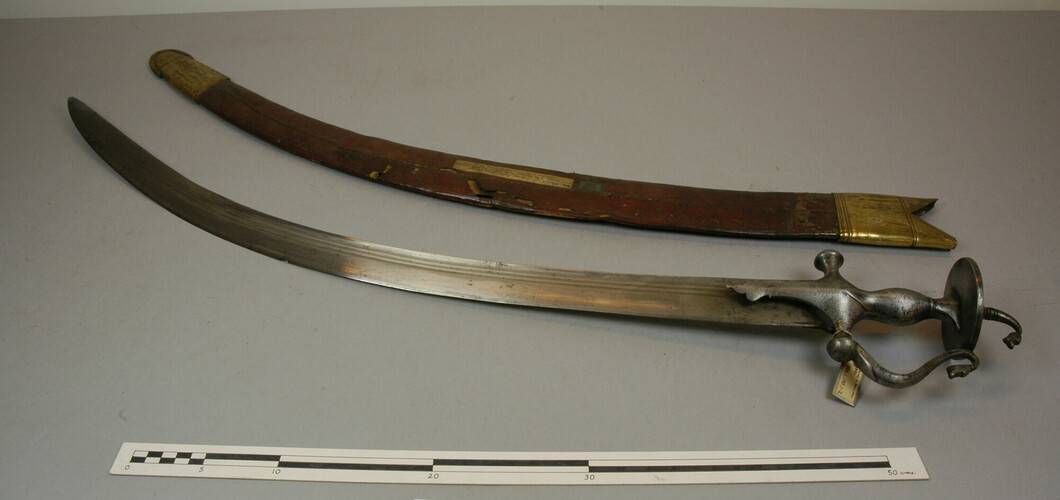 1886.1.190.1Talwar sword [.1] with curved blade, sharpened along the convex side and the distal third of the back edge. Two fullers. Metal hilt with knucklebow and disc pommel, both having animal head terminals. Wooden sheath [.2] covered with tooled reddish leather and with brass mountings. [LM 15/10/2007]1886.1.190.1
 2008.54.15Woman's skirt / wrap. [MdeA 11/09/2008]2008.54.15
 1928.69.297.1Arm ornaments of woven cane and orchid stem.1928.69.297.1