
- Collection type
- Object
- Description
- Basketry hat with square crown strengthened with cane cross-pieces, brown band with vertical lozenge-shaped motifs around body and a broad flat brim, worn by men [RTS 7/2/2005].
- Long description
- Basketry hat consisting of a flat, square crown woven from narrow strips of yellow coloured palm fibre in a twill pattern of over 2, under 2. This has been strengthened across the top with 2 narrow cane pieces that cross over one another at the centre and have shaved ends that have been pushed through each corner of the hat to hold them in place. The cane pieces have convex upper surfaces and flat undersides, and are a yellow colour (Pantone 7508C). The body of the hat becomes circular below the crown, with the twill weave continuing for its upper part only. Then, one third the way down the sides, this changes to a looser weave, in which vertical yellow strips (Pantone 7508C) are contrasted with horizontal palm strips that have been dyed a dark brown colour (Pantone Black 7C). The vertical strips largely run down the inside face of the hat, while the brown strips overlay these at right angles on the outside face, with the two elements sewn together using a fine fibre thread, also dyed dark brown, with oblique stitching. This creates a dark brown band that runs around the lower part of the hat. A simple geometric motif is picked out at the centre of each side in yellow, where the horizontal and vertical strips temporarily change places from front to inside face, and vice versa; this consists of a large lozenge with a smaller lozenge stacked inside it. The space between each of these motifs is decorated with 2 small cross-shaped motifs made from squares of yellow with a brown square at the centre, stacked one above the other. A broad brim has been added at right angles to the base of the body. This is made up of several elements. The vertical palm fibre strips from the body turn at their bases and splay outwards towards the brim edge as oblique ribs. On the upper face, thin strips of flexible cane or fibre have been woven around the hat in a continuing spiral. These are then bound to the underlying frame using further fibre strips that wind obliquely around both parts. This creates an upper surface that is slightly ridged, and a flatter underside. The style of binding changes slightly at the outer edge to allow the loose ends to be woven in place. The hat is complete and in good condition, although with some surface dirt on the outer sides. There are 2 areas on the interior where the loose ends of the fibre strips making up the body have been left protruding rather than being woven back into the fabric of the hat; otherwise it is well finished. It has a weight of 83.3 grams and is 124 mm high. The crown measures 130 by 130 mm along its sides and 185 mm diagonally across from corner to corner. The base has an internal diameter of 187 mm, while the external diameter of the brim is 313 mm. The cross bars are 7.3 mm wide, and the fibre strips have a width of 2 mm [RTS 10/2/2005].
- Geographical reference
- Cultural groups
- Zande
- Date / Period
- Date made: Before 1930
- Date collected
- 1927 - 1930
- Acquisition information
- Purchased: 31/12/1930
- Materials and processes
- Material Palm Fibre Plant, Material Cane Plant, Process Basketry, Process Twill Woven, Process Wound, Process Bound, Process Stitched, Process Carved, Process Dyed
- Dimensions
- Diameter: max 187 mm internal, Length 130 mm crown, Length 185 mm diagonal between corners, Width 130 mm crown, Height 124 mm, Diameter: max 313 mm, Weight 83.3 g
- Object numbers
- Accession number: 1930.86.35
- Research and responses
Evans-Pritchard discusses Zande hats in his book, The Azande; although published in 1971, his comments presumably refer to the situation back in 1926-1930, when he conducted his fieldwork amongst this group: “In sketches by early travellers Azande men are shown wearing straw hats. Schweinfurth describes them as using ‘a cylindrical hat without any brim, square at the top and always ornamented with a waving plume of feathers; the hat is fastened on by large hair-pins, made either of iron, copper, or ivory, and tipped with crescents, tridents, knobs and various other devices’. The same kind of cylindrical, brimless straw hat was still worn in 1906 when Gezer visited the Azande of Tembura’s kingdom and of the old kingdom of Ezo. This is the old Mbomu hat, called kutuku, and some of the older men still keep to a version of it. The hat which is today fashionable, and has been for some years, is of much the same shape but with two new features: black lateral patterns, often wavy lines, and a broad brim, the first being copied from the Mangbetu and the second from the earliest Europeans” (Evans-Pritchard 1971, pp 70-71). Brock stated that Zande hats were worn from greenish white split grass, being round at the base and square at the top, with patterns around the top in blackened grass. He suggests that the presence or absence of brims was according to fashion, which also determined how the hat's feathers were arranged (R.G.C. Brock, Sudan Notes and Records 1, 1918, 254).
This hat has a wider base diameter than many contemporary brimless varieties used by the Zande, and may have been worn lower down on the head; similar hats are illustrated in E.E. Evans-Pritchard, 1937, Witchcraft, Oracles and Magic among the Azande, pls V, VII, IX and XXV [RTS 7/5/2004].
RDF 1930.86 contains a letter from Evans-Pritchard to Mr. Malcolm dated 12 December 1930, offering him some 81 Zande and Nuer objects. As Malcolm was curator of the Wellcome Historical Medical Museum, it seems unlikely that these objects were ever sent to the Pitt Rivers Museum and this letter is only useful as background for Evans-Pritchard's attitudes to the intended future use of his material, and as evidence for the temporary storage of these objects in Professor Seligman's office in the London School of Economics at the time. The file also contains an undated list of 48 objects, which does not seem to match accessioned material and could be the list of rejected items that Balfour mentions in another letter on file, dated 31 December 1930 [RTS 10/1/2005].
Search terms: Clothing Headgear, Basketry, Hat, Headgear
Further items to explore
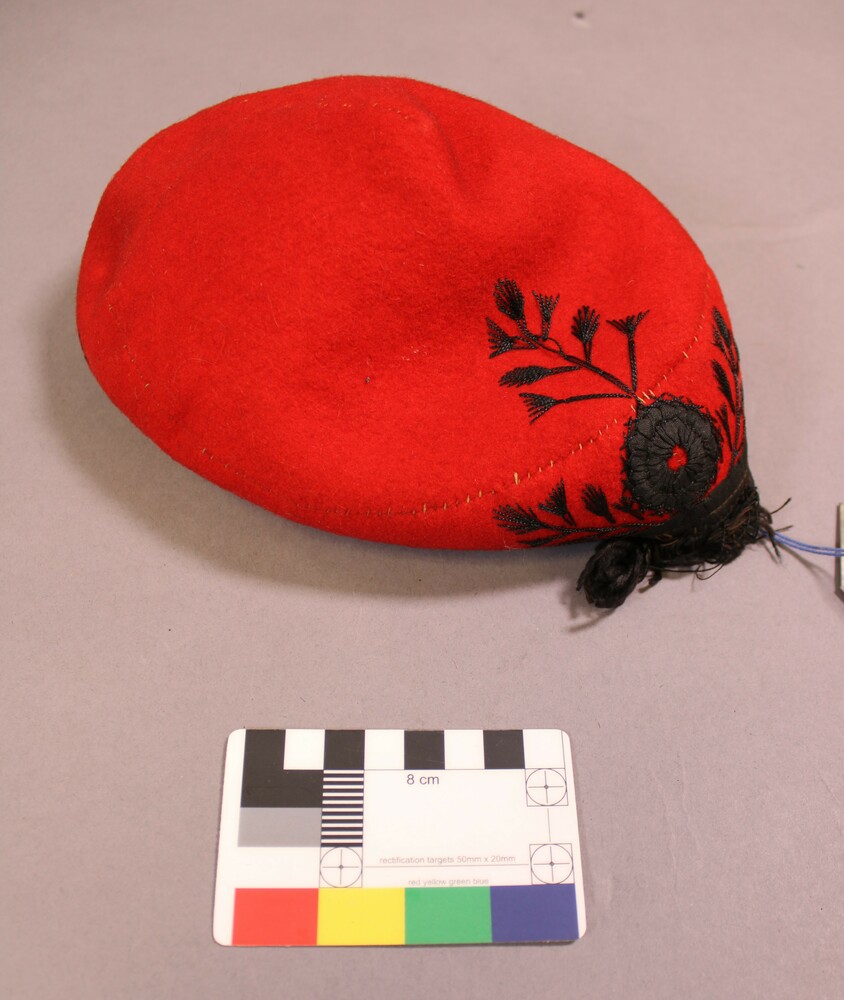 1941.10.77Red hat trimmed with black ribbon and silk embroidery.1941.10.77
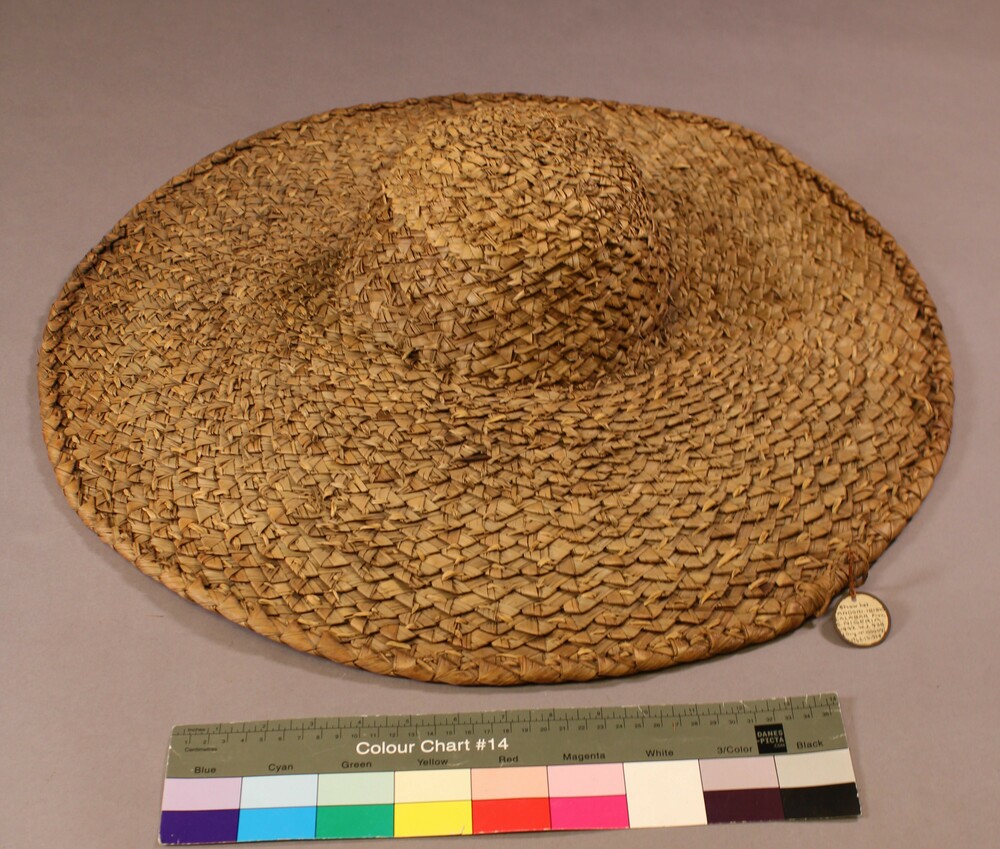 1942.13.938Hat1942.13.938
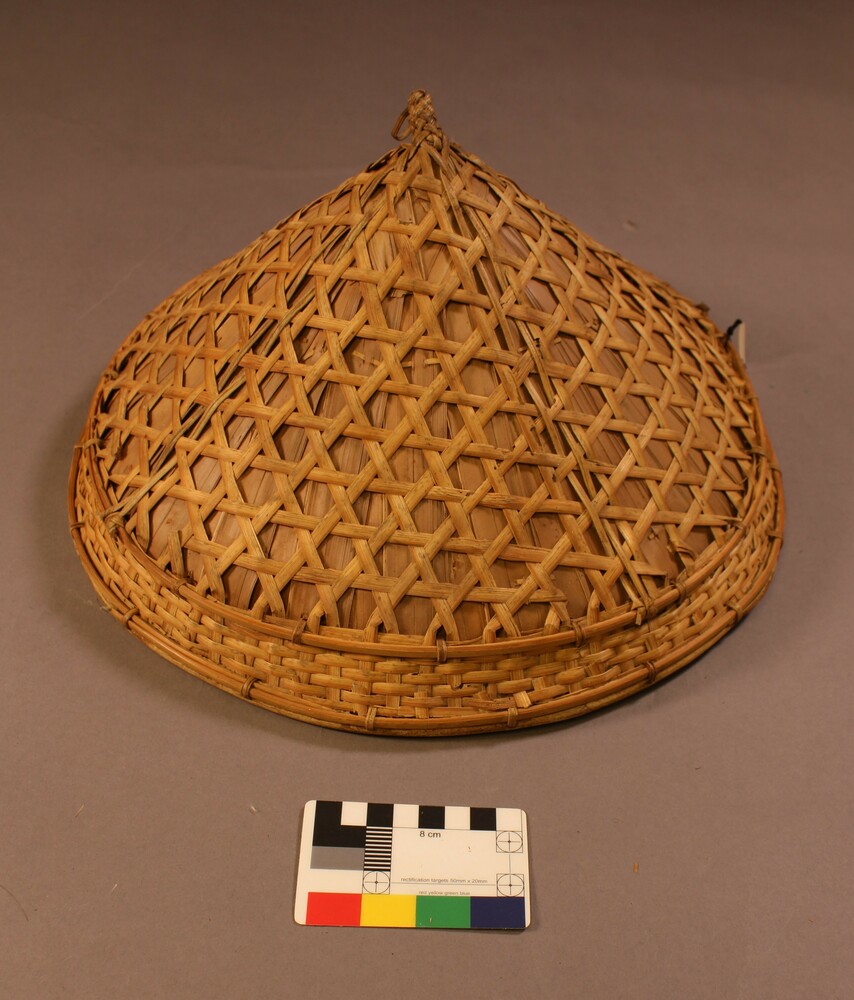 1919.54.2Man's hat1919.54.2
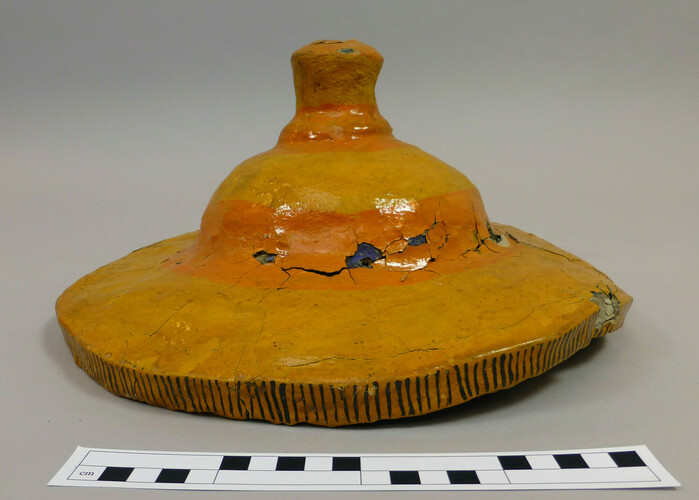 1967.25.14.2Conical hat made of papier-mâché. Painted with yellow and orange bands. The brim of the hat is flat with a conical-like centre, there is a hole in the centre of the top. Around the edge there are black vertical lines painted. For mask see entry 1967.24.14.1 [AB [OPS Move] 19/9/2016]1967.25.14.2
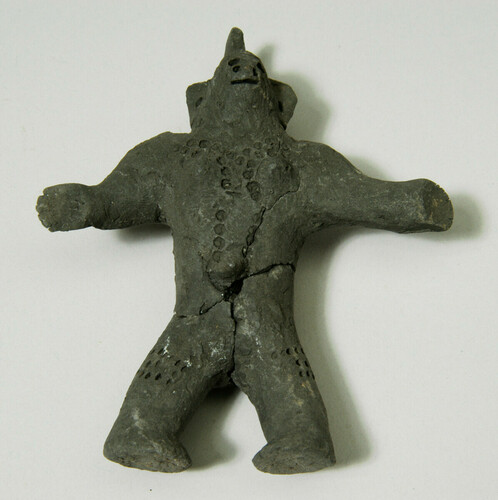 1937.34.74Hand modelled gray clay figure of a man standing with outstretched arms, used as a children's toy [RTS 28/9/2004].1937.34.74
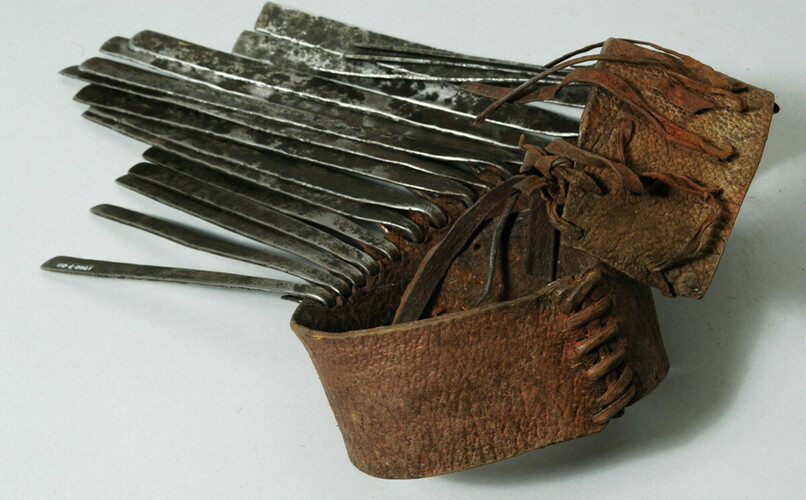 1940.7.011Waist ornament consisting of a broad leather belt with a fringe of narrow iron strips, worn by very young girls [RTS 8/3/2005].1940.7.011
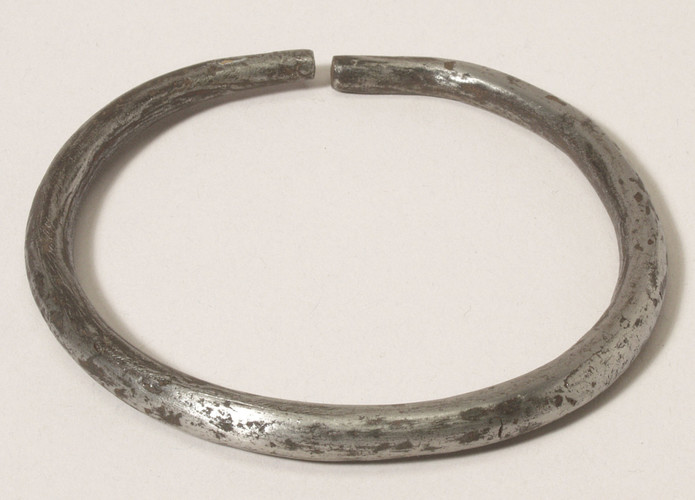 1884.82.26Narrow iron anklet with open ends [RTS 16/3/2004].1884.82.26
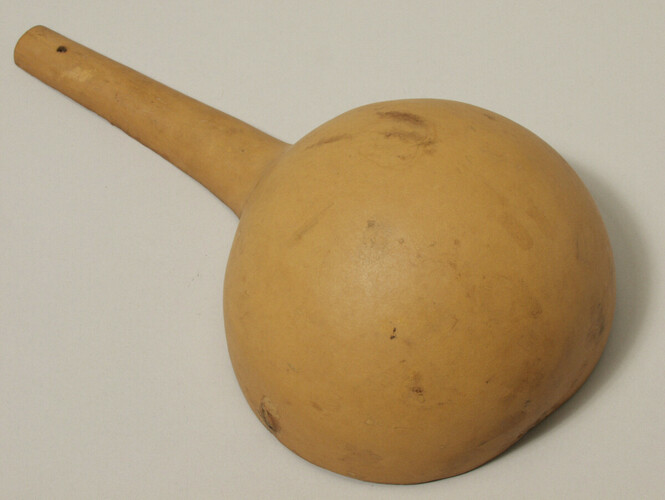 1979.20.12Deep spoon made from half a gourd [RTS 28/6/2004].1979.20.12