
- Collection type
- Object
- Description
- Arrow with triangular blade, barbed tang and wooden shaft with bound and nocked end [RTS 28/9/2005].
- Long description
- Arrow consisting of an iron arrowhead with a triangular blade, thickened down the centre on both sides, ending in two sharp, pointed barbs at its base. It has a long rectangular sectioned tang, the edges of which have been roughened by chiselling a series of oblique notches down opposite sides and faces; towards its base, these notches have been cut into both sides of each face. The end of the tang has been fitted into the socketed top of a slightly oval sectioned shaft carved from a lightweight yellow wood (Pantone 7508C) with some irregularities along its surface. The base of the tang has been bound round with strips of plant fibre, with similar binding around the top of the shaft and just above the nocked butt, which has 2 rectangular notches cut into opposite sides. The end of the butt has been blackened. This fibre has a faint pinkish colour that may be the result of using a pigmented fixative (Pantone 4715C and 476C). The arrow is complete, but part of the upper binding is coming loose. It has a weight of 52.3 grams, and a total length of 827 mm. The arrowhead has a length of 162 mm, down to its junction with the shaft; the blade is 60 mm long, 21 mm wide and 3.7 mm thick, while the tang has a width of 5 mm. The shaft is 664 mm long, 10.5 by 10 mm in diameter, and has a nock length of 11 mm; the upper binding is 8 mm long around the metal and 38 mm long around the shaft, while the lower binding has a length of 32 mm [RTS 28/9/2005].
- Geographical reference
- Cultural groups
- Moru
- Date / Period
- Date made: Before 1930
- Date collected
- By 1930
- Acquisition information
- Purchased: 31/12/1930
- Materials and processes
- Material Iron Metal, Material Wood Plant, Material Plant Fibre, Material Pigment, Process Forged (Metal), Process Hammered, Process Carved, Process Bound, Process Notched
- Dimensions
- Length: max 162 mm arrowhead, Width: max 21 mm blade, Length: max 664 mm shaft, Length: max 827 mm, Diameter: max 10.5 mm shaft, Length: max 60 mm blade, Weight 52.3 g
- Object numbers
- Accession number: 1930.86.18.5
- Research and responses
This object was collected by Edward Evan Evans-Pritchard in the Southern Sudan sometime before December 1930, as part of a group of arrows. For the quiver associated with this arrow, see 1936.86.18.1; for other iron-headed Moru arrows collected by Evans-Pritchard, see 1936.86.18.2-4, 1936.86.18.6-15, and 1936.86.19.2-12.
The arrowheads in this group share a number of features, including the type of wood; the butt nocking, the use of fibre binding around areas vulnerable to splitting on use (butt and where point is hafted in place) and with some kind of red adhesive coating, and the presence of binding at the base of the tang, probably to prevent impact forcing the arrowhead too deeply into the shaft socket. Other arrows in this group have a more obvious red staining over the bound areas (see, for example, 1930.86.19.3).
Powell-Cotton also collected Moru archery equipment, consisting of a bow (kusu), arrow (atu) and hide ring for drawing back the bow string (driba; see 1934.8.32-34). Several decades later, Patti Langton collected a group of iron-headed arrows from the Moru Misa (see 1979.20.18-21), and these share a number of features with the Evans-Pritchard group,including the use of iron heads, often with various types of barbing, similar types of wood and the use of a pinkish fixative around the shaft binding.
RDF 1930.86 contains a letter from Evans-Pritchard to Mr. Malcolm dated 12 December 1930, offering him some 81 Zande and Nuer objects. As Malcolm was curator of the Wellcome Historical Medical Museum, it seems unlikely that these objects were ever sent to the Pitt Rivers Museum and this letter is only useful as background for Evans-Pritchard's attritudes to the intended future use of his material, and as evidence for the temporary storage of these objects in Professor Seligman's office in the London School of Economics at the time. The file also contains an undated list of 48 objects, which does not seem to match accessioned material and could be the list of rejected items that Balfour mentions in another letter on file, dated 31 December 1930 [RTS 10/1/2005].
Search terms: Archery Weapon, Hunting, Arrow, Arrow-head, Arrow Shaft, Weapon
Further items to explore
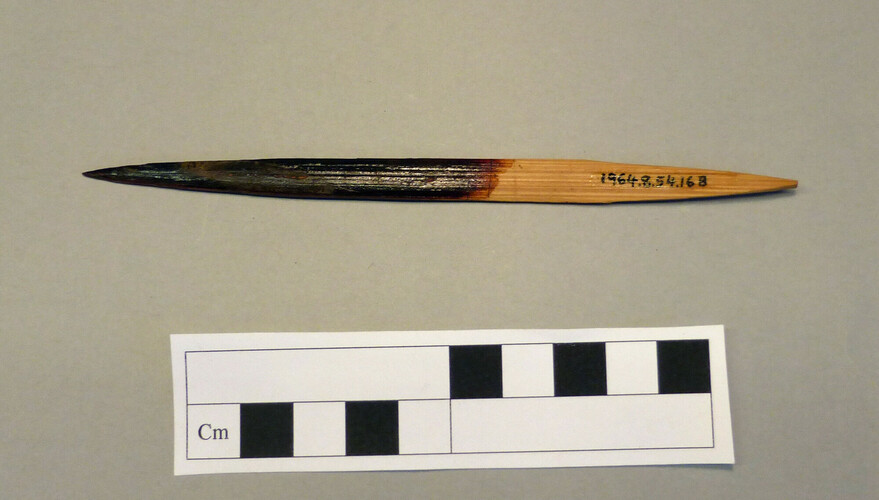 1964.8.54.16B1 of 17 Curare poisoned arrow-heads made from split bamboo. The head is carved with bands of lines covered with poison. [RH [OPS move] 12/10/2018]1964.8.54.16B
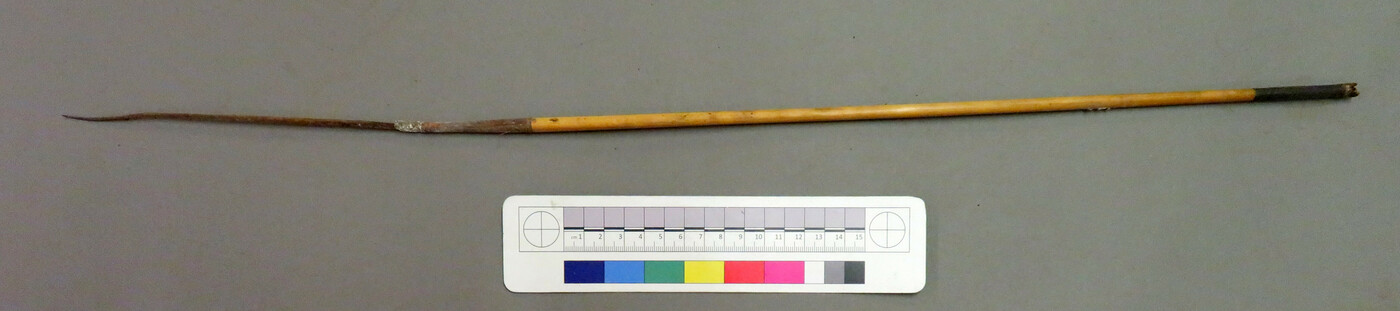 1978.6.6Iron tipped arrow. See [1978.6. 3] for the associated quiver and [1978.6 .3 - .14] for the associated arrows. [BS [OPS move] 20/9/2017]1978.6.6
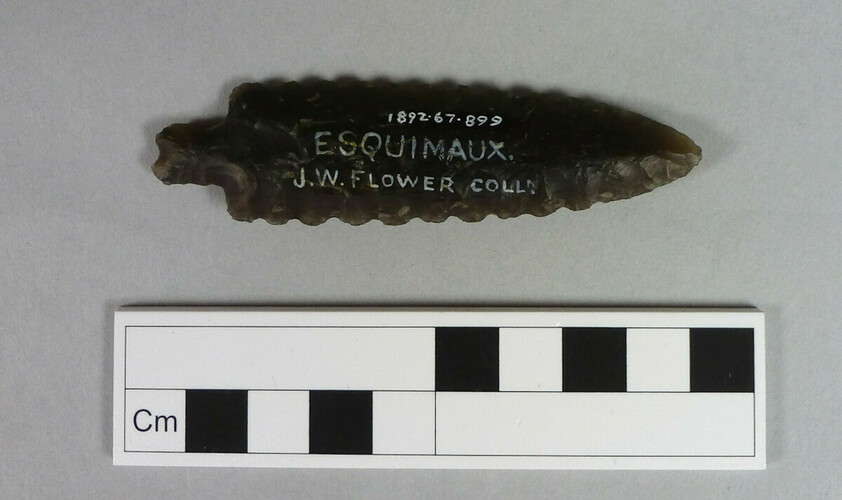 1892.67.899Flint arrow-head1892.67.899
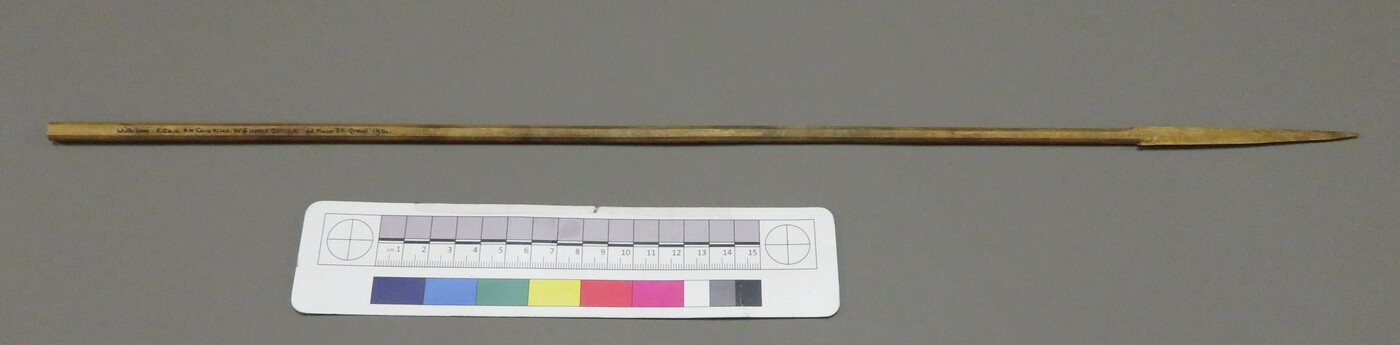 1934.81.33Bamboo arrow, made from a shaved length of bamboo. The butt of the arrow is square. The arrow is unfletched and has a long single barbed point. [SB [OPS move] 29/9/2017]1934.81.33
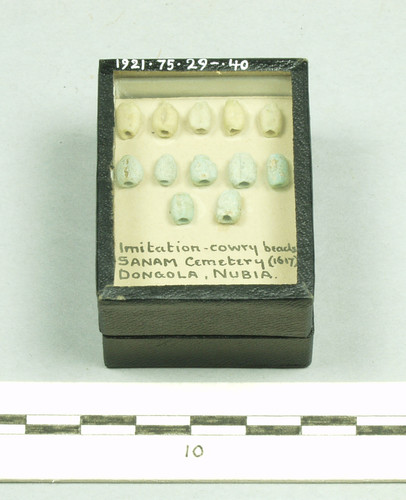 1921.75.29Miniature cowrie shell imitation made of buff faience. [N.B. 'DCF 2004-2006 What's Upstairs?' 1/8/2005]1921.75.29
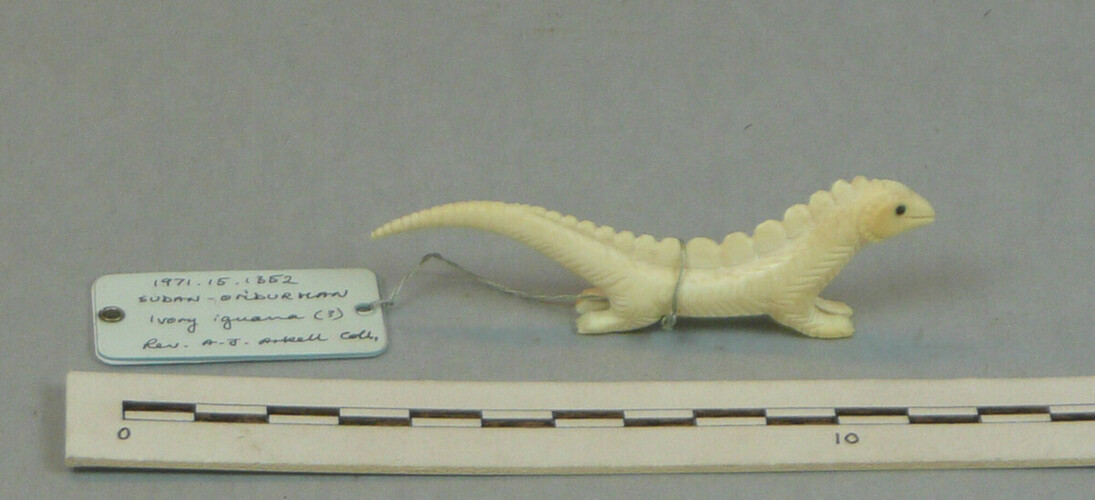 1971.15.1352Carved ivory lizard with black painted eyes. [LKG 10/07/2009]1971.15.1352
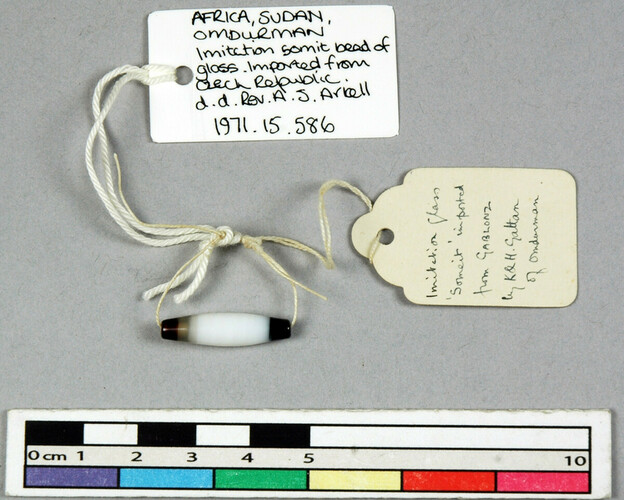 1971.15.586Tapering glass barrel bead, black at each end and white in the centre. [SM 27/10/2010]1971.15.586
 1930.86.18.4Arrow with triangular blade on tanged base, hafted into a wooden shaft with fibre binding and nocked end [RTS 28/9/2005]1930.86.18.4