
- Collection type
- Object
- Description
- Iron spear head, socketed. [ASh [OPS move] 26/9/2017]
- Long description
- Iron spear head, with a long tapering blade with a ridge down the centre. The blade is socketed and decorated around the join of the socket with ridges and chevrons. [ASh [OPS move] 26/9/2017]
- Geographical reference
- Cultural groups
- Zande
- Date / Period
- Date made: Before 1930
- Date collected
- 1927 - 1930
- Acquisition information
- Found unentered: 1948
- Materials and processes
- Material Iron Metal, Process Socketed, Process Cast
- Dimensions
- Depth: max 24 mm, Width: max 61 mm, Length: max 508 mm
- Object numbers
- Accession number: 1948.2.155
- Research and responses
For an essay on the variety and cultural significance of spears in South Sudan, particularly among the Dinka and Nuer, see ‘“Spears” that are not Spears’, by Jok Madut Jok, in Pieces of a Nation: South Sudanese Heritage and Museum Collections, edited by Zoe Cormack and Cherry Leonardi (Leiden: Sidestone Press, 2021), pp. 110–114.
Larken describes the Zande spear as follows: "A Zande carries a spear (baso) or a club (kere). The former has a blade from fourteen to eighteen inches long, and about three inches broad at its widest point. It has a socket of four or five inches, into which the haft (para) fits. Both edges are kept sharp, as it is often used as a billhook or knife, but the blade is not polished, nor is any covering or sheath used. The haft is about six feet long and an inch or less in thickness. It is made from the heart of a tree called bakiwe, though if a young bamboo is available it will be used. A binding of narrow flat bands of beaten brass, copper, or iron is sometimes applied to one end or the other. One end of the haft is cut to a point and inserted in the socket of the spear, and sometimes fixed there by a nail. On the other is usually a small iron shoe, called suguru, which is used to dig up roots, or to make holes for posts when house building. Smaller spears are made for boys, and heavier ones for hunting elephant or buffalo. Only one spear is usually carried" (P.M. Larken, 1926, "An Account of the Zande", Sudan Notes and Records IX no. 1, p. 39) [RTS 19/8/2005].
Search terms: Weapon, Spear-head, Spear
Further items to explore
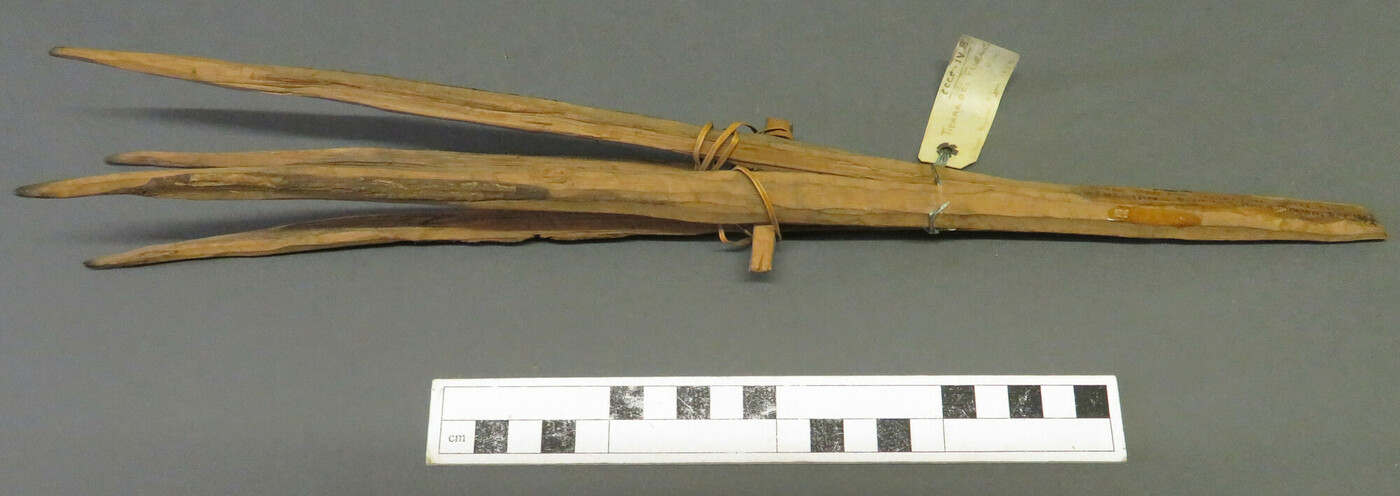 1892.50.7Spear head, for collecting shell fish. [ASh [OPS move] 23/6/2017]1892.50.7
 2018.232.2Iron spear-head, socketed iron head with long ogee blade. [MdeA [OPS move] 21/9/2018]2018.232.2
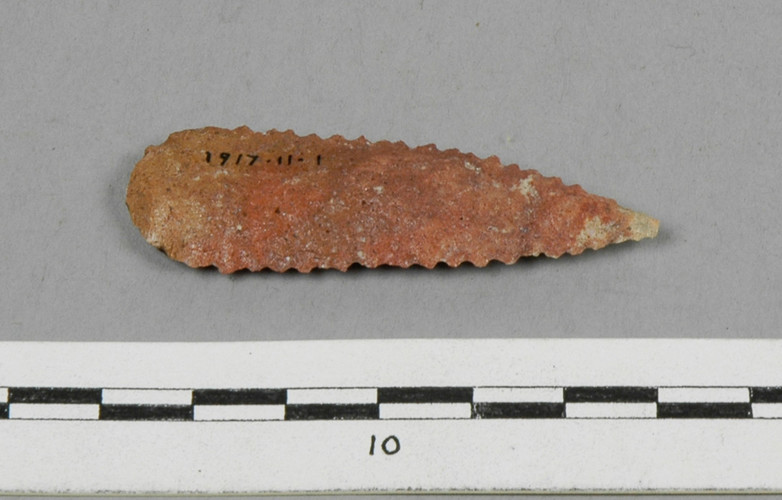 1917.11.1Spear head of red quartzite. In a small box mounted in a bigger glass-topped box. [El.B 15/08/2007]1917.11.1
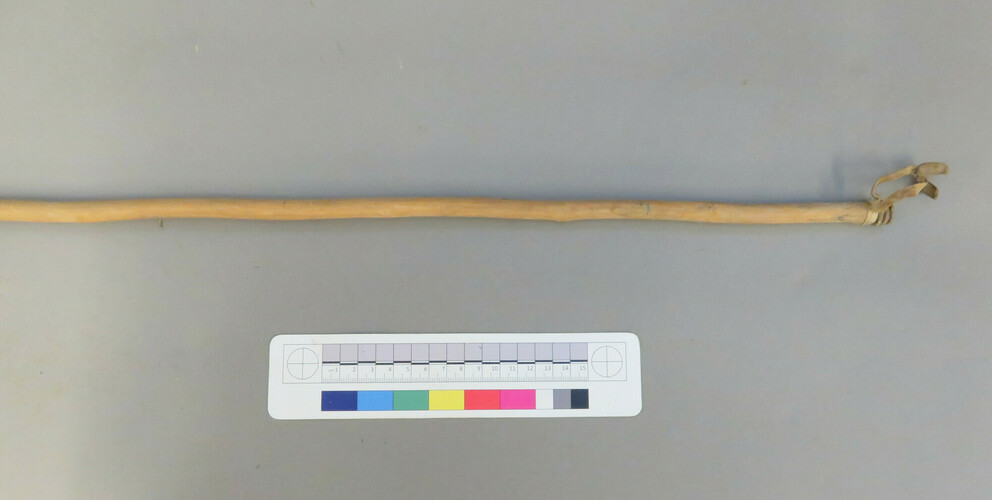 1966.1.1355.2Wooden spear shaft with leather and cloth bound to the end. For the associated spear head see [.1]. [DV [OPS move] 2/7/2018]1966.1.1355.2
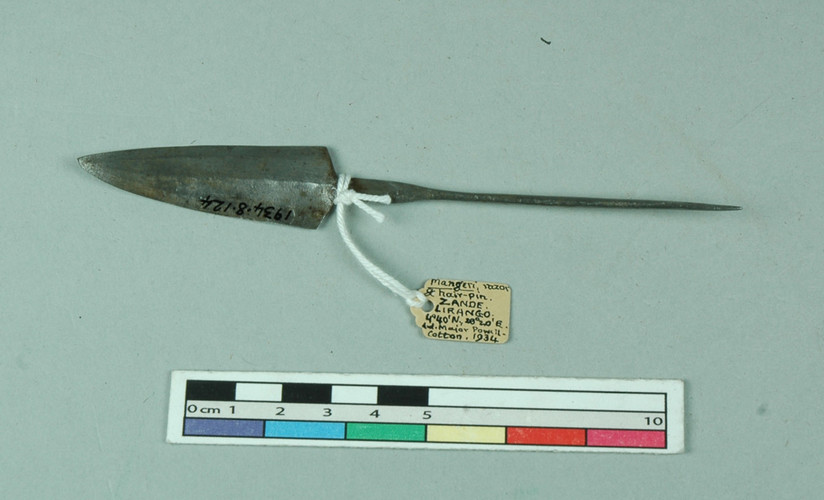 1934.8.124Iron object with a triangular, two edged blade, used as a razor, and a long narrow handle ending in a point, used as a hair pin [RTS 7/6/2004].1934.8.124
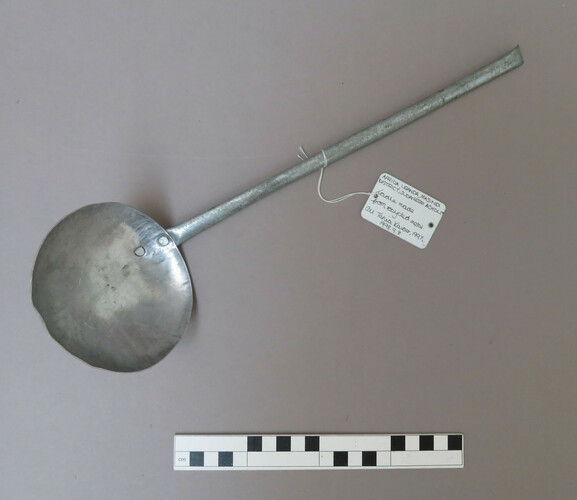 1998.9.8Long handled ladle made from recycled aluminium [RTS 18/6/2004].1998.9.8
 1940.7.091.12 pieces of goatskin, worn as a shirt by men [RTS 16/2/2005].1940.7.091.1
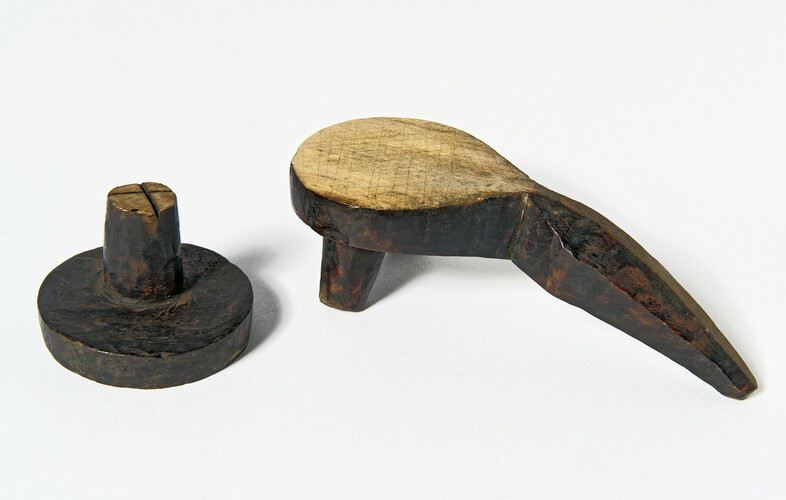 1940.12.608.1Rubbing-board oracle, consisting of a miniature wooden table [.1] with separate circular upper part that slides across the surface [.2].1940.12.608.1