
- Collection type
- Object
- Description
- Silk amulet (black patterned with flowers) in the form of an almond-shaped stone axe. [CF 3/12/2002]
- Cultural groups
- Spanish
- Date / Period
- Date made: Circa 1650
- Date collected
- By 1918
- Acquisition information
- Purchased: 1918
- Materials and processes
- Material Silk Textile Animal, Material Silk Yarn Animal, Process Embroidered, Process Woven
- Dimensions
- Length: max 88 mm not incl tie
- Object numbers
- Accession number: 1918.53.2
- Research and responses
This object was shown at a meeting of the Oxford University Anthropology Society on 28.11.1918 when Balfour showed a series of objects [AP 27/02/2006]
- Associated publications
- Illustrated by a line-drawing (by Henry Balfour) as Figure 22 in Plate II (facing page 170) in ‘Concerning Thunderbolts (Continued)’, by H[enry]. Balfour, in Folk-Lore, Vol. 40, no. 2 (30 June 1929), pp. 168–72. Caption (page 172) for Figures 20–23: ‘Figs. 20–23—Silk amulets having the shape of pre-historic implements. Eastern Catalonia,Spain, c. 1650 A.D. From Sir Charles Dawson’s collection. One of these, Fig. 20 [1918.53.3], is a replica of a tanged-and-barbed neolithic arrowhead. A second, Fig. 21 [1918.53.4], has the form of a stone arrowhead with lateral basal notches, a type rare in Europe though very common in North America. A third, Fig. 22 [1918.53.2], is in the shape of a neolithic almond-shaped celt. The fourth, Fig. 23 [1918.53.3], which is covered with tinsel appliquée decoration, is evidently modelled upon a flat bronze celt with expanded cutting-edge. These silk amulets, padded out and variously decorated, would appear to indicate a further stage in the employment of “thunderbolts” as amulets or talismans, at which the actual prehistoric implements have given place to more or less conventional representations of them (compare Figs. 10–14).’ [JC 4 12 2014] Illustrated along with 1918.53.1, 1918.53.3, 1918.53.4, 1918.53.6, 1918.53.7 on page 88 of Amulets: A World of Secret Powers, Charms and Magic by Sheila Paine (London: Thames and Hudson, 2004) with the following caption: 'Silk amulets, c. 1650, imitating stone celts, prehistoric implements and arrowheads, Catalonia, Spain.' all of which are credited on page 186 as 'Pitt Rivers Museum, University of Oxford, Acc. 1918.53.1' [sic]. Copy in RDF. [JP 15/10/2004]
Further items to explore
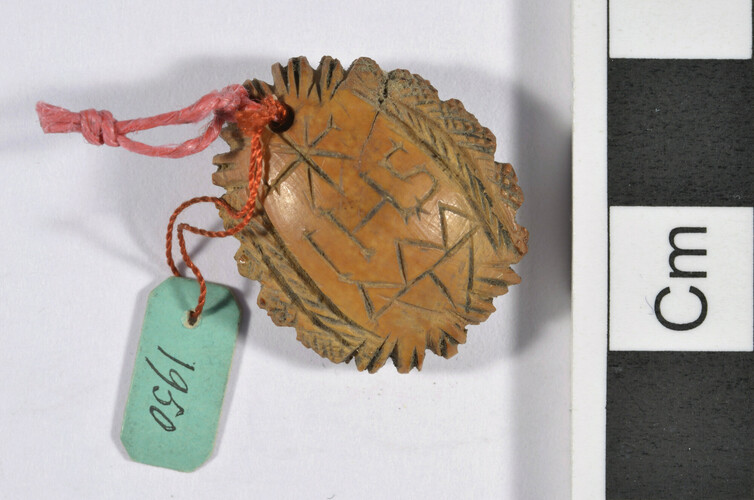 1985.52.982Amulet, reliquary pendant carved from an apricot stone, containing 'Agnus Dei' and a saint's relic, with a glass front and perforated for suspension. [RB 23/04/2012]1985.52.982
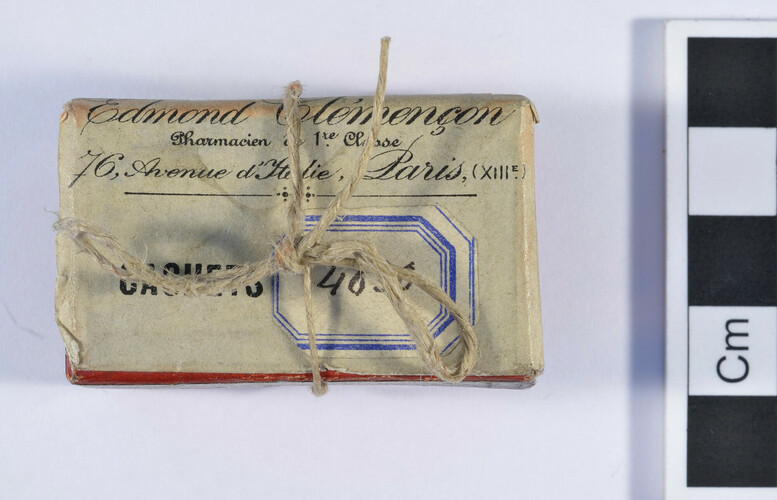 1985.52.2334Amulet, box containing seventy-seven lead models of people, animal figures, cutlery and household objects. [ACA 26/07/2012]1985.52.2334
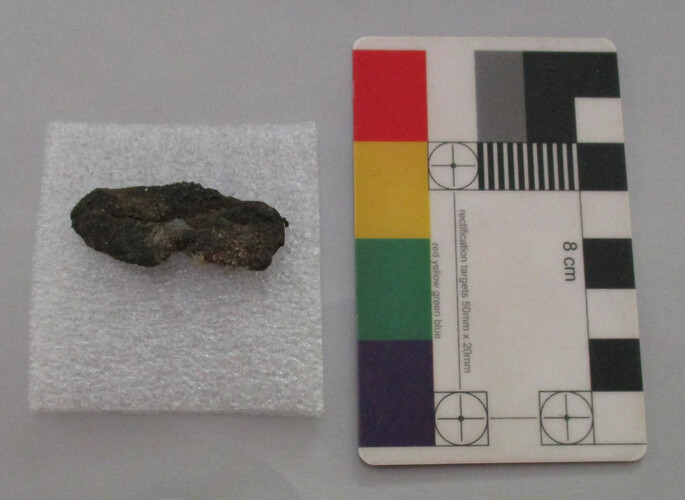 1985.54.882Amulet, vagina of a bitch. Dark brown in colour. Roughly oval in shape, with oval shaped opening in centre. Some hair attached. [EH [OPS move] 7/3/2017]1985.54.882
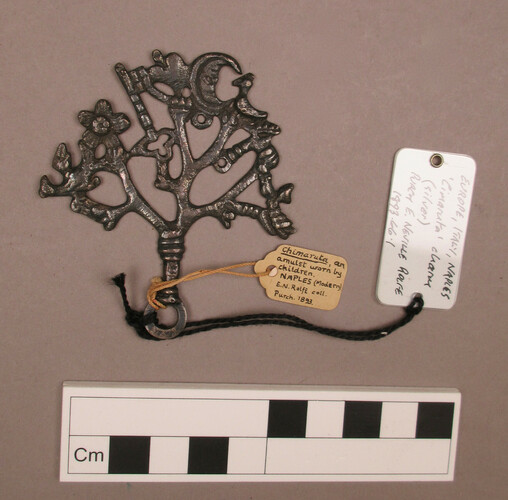 1893.66.1Silver amulet.1893.66.1