
- Collection type
- Object
- Description
- Wooden parrying shield with hollowed out hand grip at centre, tapering ends and flat inside edge [RTS 22/6/2005].
- Long description
- Wooden parrying shield, carved from a single piece of soft, lightweight wood, possibly ambatch wood, stained a light orangey brown colour (Pantone 729C). This consists of a narrow body with swollen centre, tapering to a rounded point at either end. This swollen area represents the handle grip, and has convex sides and back. It has been hollowed out from its inside face to leave a narrow rectangular handle running across the top of the opening. The inside face of the handle has two flat sides that slope in towards one another to meet at an angle, while the inside wall of the grip opposite is concave to allow room for the knuckles. The back of the shield curves down from the centre towards each end, and except for the central section, has a slight ridge running along its length. The opposite face is mostly straight, and has been cut flat. The shield is complete, but has numerous gouges out the surface that look to have been caused by weapon blows. It has a weight in excess of 1000 grams, and is 1485 mm long. The central grip area is 102.5 mm wide and 92.5 mm thick, while the handle is roughly 35 mm wide [RTS 15/7/2005].
- Geographical reference
- Cultural groups
- Dinka
- Date / Period
- Date made: Before 1912
- Date collected
- 1902 - 1912
- Acquisition information
- Donated: 1944
- Materials and processes
- Material Wood Plant, Process Carved, Process Hollowed, Process Stained
- Dimensions
- Height: max 99 mm, Width: max 95 mm, Length: max 1491 mm, Weight 1000 g
- Object numbers
- Accession number: 1944.10.21
- Research and responses
It seems there was originally a joint donor of both the Lightbody and Gorringe collections. There is no information in the accession book as to who this may have been. See Additional Accession Book Entry for 1944.10.17 for relevant text regarding this [MR 7/7/2000].
The actual provenance of this shield does not appear to have been specified when the object was received by the museum, and the assumption that it is Dinka is based on its similarity to 1944.10.20. This object is also similar in style to 1936.10.11 (Ngok Dinka), 1931.66.10 and 1934.8.9 (Dinka). Schweinfurth gives the Dinka name for this type of shield as kuerr / Kwerr (G. Schweinfurth, 1875, Artes Africanae, pl. I figs 13-15, giving the wood species as diospyrus mespiliformis; G. Schweinfurth The Heat of Africa, 1873, vol. 1, p. 156, in anglicised spelling as quayre). However note that Petherick also illustrated the type, which he associated with the Mundu, a group located between the Dinka and the Zande (J. Petherick, 1861, "On the Arms of the Arab and Negro Tribes of Central Africa, Bordering on the White Nile", Journal of the Royal United Service Institution IV no. 13, fig. 16). The Shilluk 'parallels' quoted in the accession book entry (H.A. Bernatzik, 1929, Zwischen Weissem Nil and Belgisch-Kongo, fig. 131; C.W. Domville-Fife, 1927, Savage Life in the Black Sudan, p. 69 and fig. on p. 70) should be disregarded, as they actually represent a different type of parrying shield, made of lightweight ambatch wood, with a squatter, blunt-ended body [RTS 15/8/2005].
Most of the shields of this type carry a shallow groove along their inside face, probably designed to allow a spear to slot in place, enabling both to be carried together more easily and freeing up the other hand. That groove is not present on this example [JC 20/1/2005; D. Plasche & M.A. Zirngibl, 1992, African Shields, p. 75].
Further items to explore
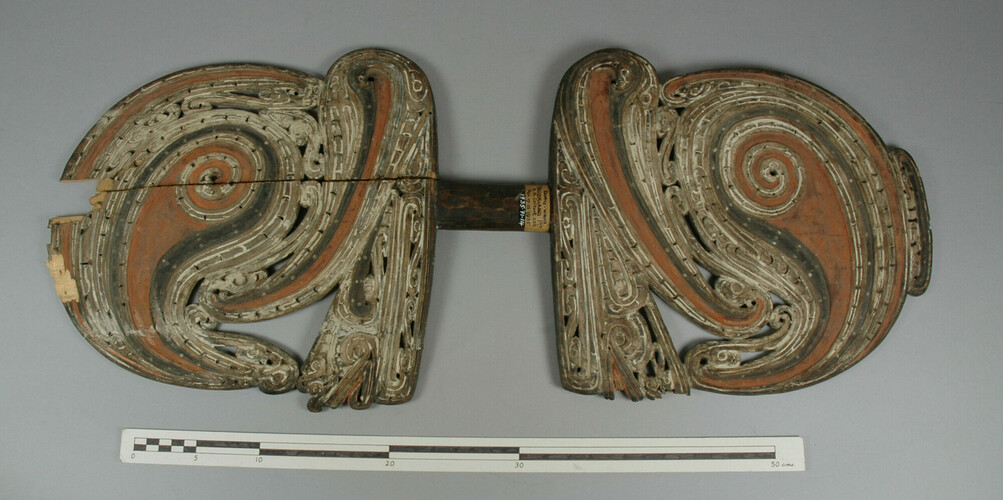 1935.71.14Dance shield of wood with two ornate paddles and central grip (a piece broken off). [El.B 25/01/2012]1935.71.14
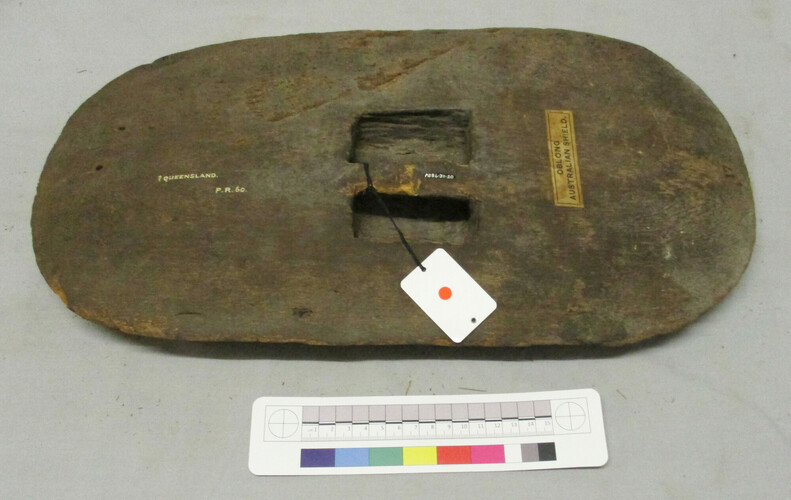 1884.30.20Shield, carved from one piece of wood. It is oval in shape with a rounded front. The handle is carved into the underside. The surface of the wood has coated with black pigment.1884.30.20
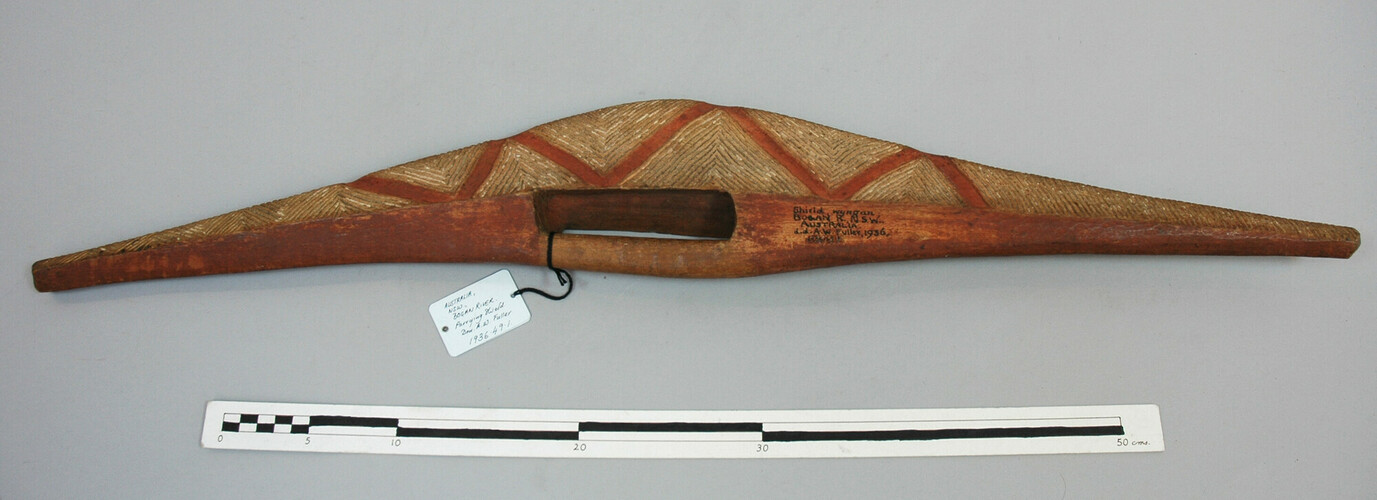 1936.49.1Narrow parrying-shield decorated with design of incised chevrons.1936.49.1
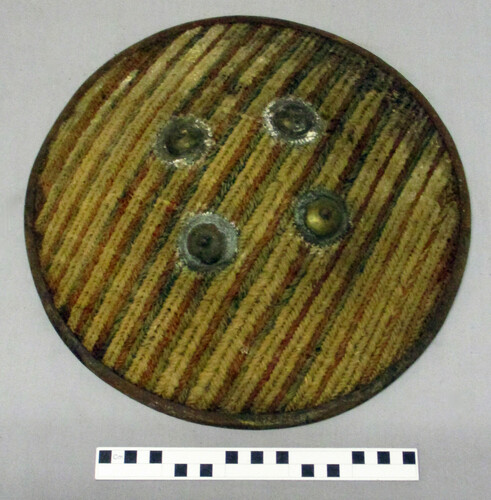 1969.29.9Circular shield made from strips of wood bound with red white and blue woollen thread and plaited together. The edge of the shield is rimmed with ?iron. There are four decorative metal bosses. on the reverse of the shield there are two leather handles attached to metal rings which are pierced through a leather pad which is stitched around the edges. [CW [OPS move] 19/8/2016]1969.29.9