
- Collection type
- Object
- Description
- Circular shield made from strips of wood bound with red white and blue woollen thread and plaited together. The edge of the shield is rimmed with ?iron. There are four decorative metal bosses. on the reverse of the shield there are two leather handles attached to metal rings which are pierced through a leather pad which is stitched around the edges. [CW [OPS move] 19/8/2016]
- Geographical reference
- Date / Period
- Date made: Before 1850?, uncertain
- Date collected
- By 1850 ?
- Acquisition information
- Transferred: 1969
- Materials and processes
- Material Wood Plant, Material Wool Yarn Animal, Material Iron Metal, Material Brass Metal, Process Bound, Process Plaited, Process Basketry
- Dimensions
- Height: max 75 mm, Diameter: max 391 mm
- Object numbers
- Accession number: 1969.29.9
- Research and responses
Dhal were most commonly made of Indian Rhinoceros (Rhinoceros unicornus) rawhide, which was dried and lacquered, but not tanned. Rhinoceros hide was valued for shield-making because it could take on a striking translucent quality, and was harder and more durable than buffalo leather. The Asian rhinoceros was much more widely available for hunting prior to 1600 AD. The skin of the freshwater porpoise was occasionally also used for making shields in India, as were steel, wood, and papier maché. Four brass bosses are typical of Indian shields, which both protect and conceal the fixings that support the two handles inside. These straps were held in the hand during fighting. They had a third leather strap, or silk scarf, tied between them when not in use, so that the shield could be slung over the back when riding. This style of convex circular shield was used throughout western and southern Asia – particularly Persia – from the early 7th century AD onwards – although the characteristic four-bossed shape is distinctive to the Indian subcontinent. Relevant Reading: Robinson, H.R. (1967) Oriental Armour. London: Herbert Jenkins. Egerton of Tatton, Lord (1968) Indian & Oriental Armour. London: Arms & Armour Press. Welch, S.C. (1985) India: Art & Culture, 1300-1900. New York: Metropolitan Museum of Art. Research Conducted for DCF Cutting Edge 2006/2007 [AM].
Further items to explore
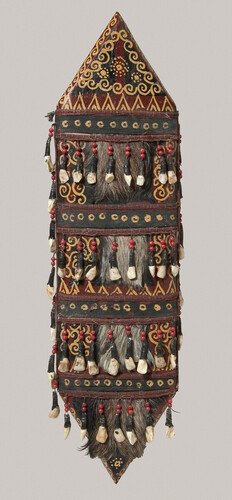 2000.31.2Shield. The shield is made of wood with sections of string bound onto it. The front of the shield is decorated with tassels of red plastic beads ending in ruminant (cattle) incisor teeth and tufts of ?goat hair. The front of the shield ie. the bound string and the wood, has been painted all over with black and red brown paint with swirling designs in yellow paint. The back of the shield is painted black with a wooden handle nailed on and running vertically down the length of the shield. At the top of the shield there is a string attached, probably for hanging the shield on a wall. This object was probably made for sale to tourists as it is extremely clumsily made. [MdeA 23/11/2001]2000.31.2
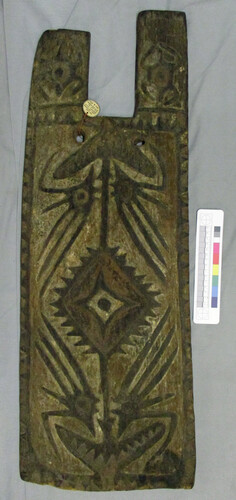 1947.8.5BShield. It is rectangular in shape and made from wood. There is a a rectangular notch at the top of the shield between two parallel extensions. There are two perforations for a bark cloth suspension loop, although this is missing. The reverse of the shield is undecorated. the front of the shield has a carved relief design of abstracted human faces at either end, with a star-pattern in the centre. There are traces of black and white paint used to highlight the carved designs. [CW [OPS move] 1/8/2016]1947.8.5B
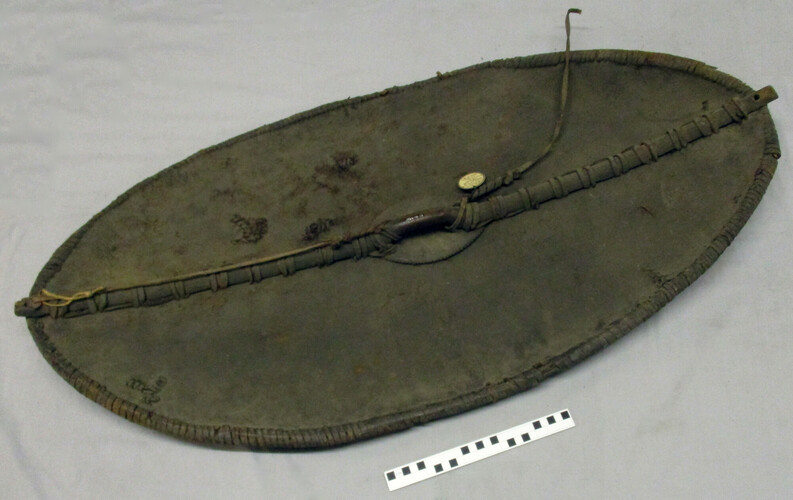 1944.10.12Painted shield of buffalo hide. Oval in shape and curved. There is a band of wood stitched along the length on the underside, the handle is carved from this. The edges of the shield are bound in hide. The front is decorated with red, black and white pigment. There is a central band of red and black and semi-circles either side of this. [AB [OPS Move] 16/8/2016]1944.10.12
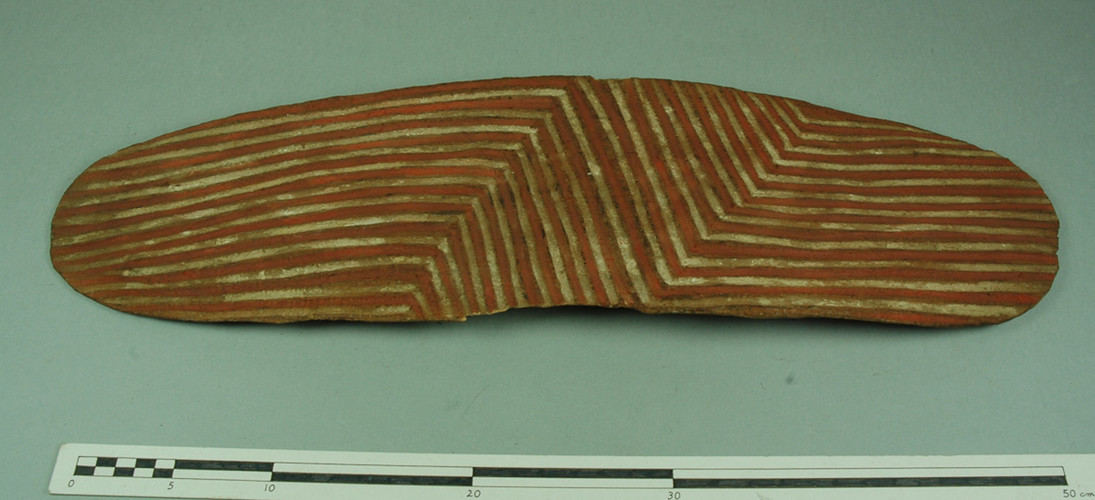 1931.78.10Narrow parrying-shield with flat outer surface carved with parallel grooves painted red and white. [MJD DDF Body Arts Project 2010/2011 06/08/2010]1931.78.10
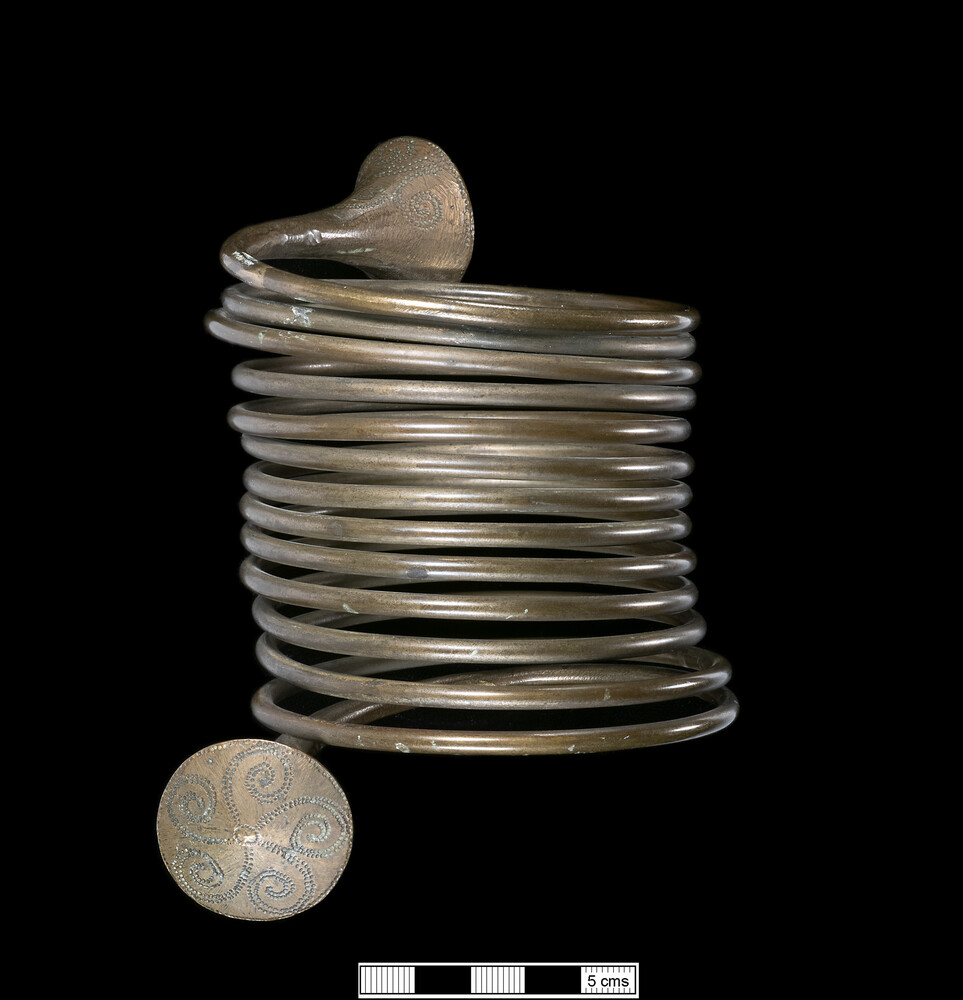 1952.3.1.2Brass arm ornament formed into a spiral, with enlarged conical ends decorated with dotted scrolls.1952.3.1.2
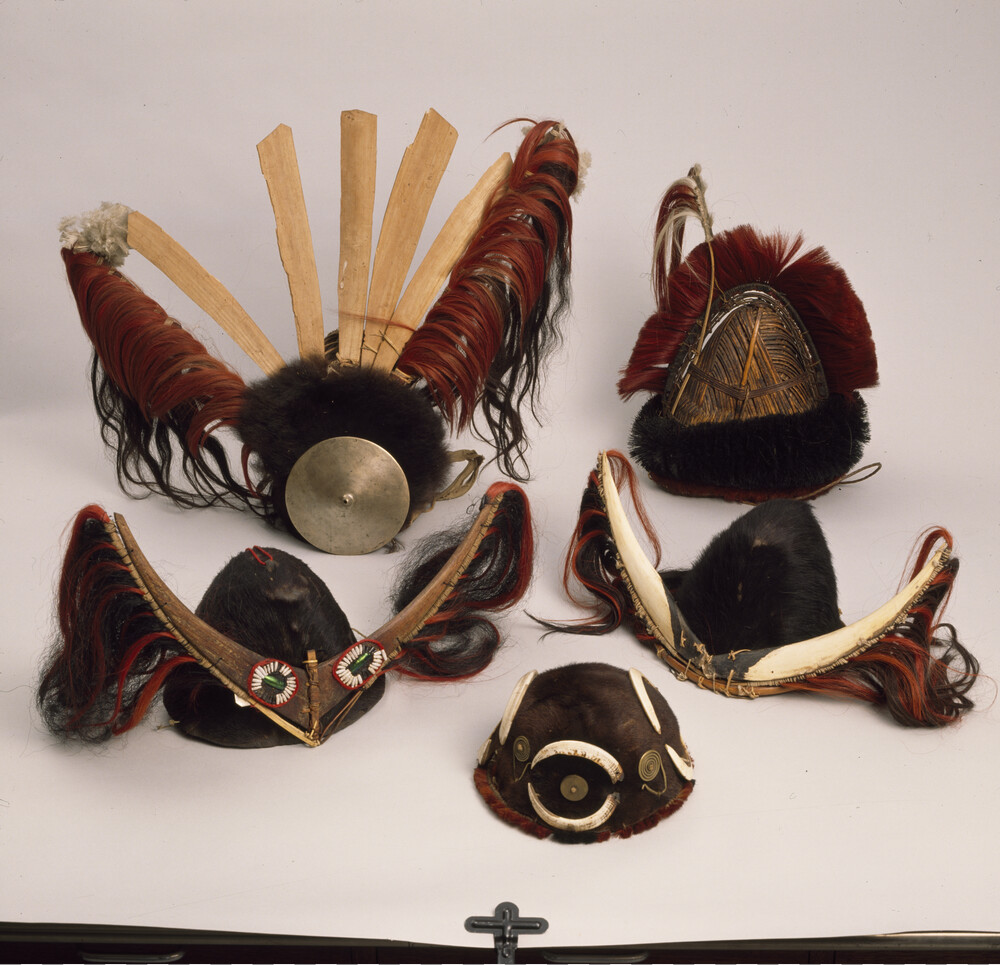 1928.69.486Hat1928.69.486
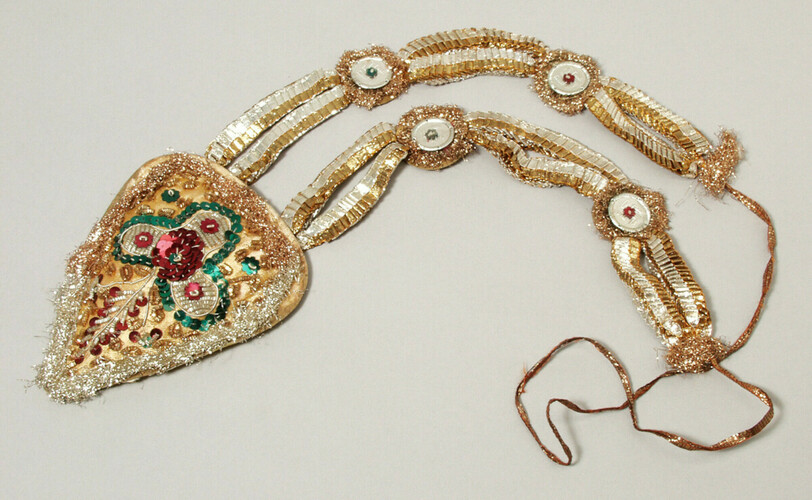 2001.30.38Marriage ornament. The ornament consists of a roughly heart shaped pendant attached to which is a loop of decorated ribbons. [MdeA 10/5/2002]2001.30.38
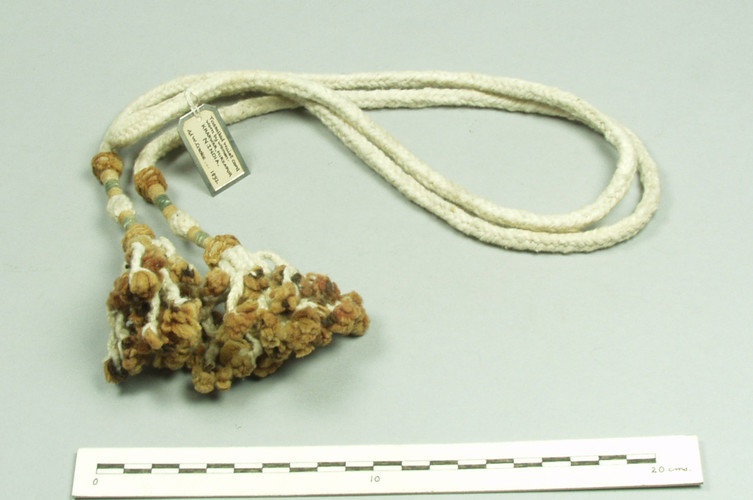 1892.24.147Waist string of white wool with tassels of white & brown wool. [EC 'DCF 2004-2006 What's Upstairs?' 9/2/2006]1892.24.147