
- Collection type
- Object
- Description
- Single-faced helmet mask surmounted by a figure representing a mother with a child. [ZM 30/08/2013]
- Long description
- Carved and painted helmet mask from the Oye-Etiki region, often called an epa mask, which is usually worn and danced by a younger man in masquerades as a demonstration of strength. The lower face is associated with healing power and the figure above represents a woman seated on a stool with a child. [ZM 04/03/2014]
- Geographical reference
- Western Nigeria Ekiti State Oye-Ekiti village
- Cultural groups
- Yoruba
- Date / Period
- Date made: Before 1969
- Date collected
- By 1969
- Acquisition information
- Purchased: 1969
- Materials and processes
- Material Wood Plant, Material Pigment, Process Carved, Process Painted
- Dimensions
- Height 1070 mm
- Object numbers
- Accession number: 1969.9.2
- Research and responses
John Picton examined this mask during a consultation visit about the Yoruba masks on 20 August 2013 and noted the following: This is a very typical 'epa' type helmet mask from Oye-Etiki (as Etiki is now known), which falls under the north-eastern area of the Yoruba-speaking region. Kevin Carroll in Yoruba Religious Carving (1967, London: Jeffey Chapman) includes a photograph of a helmet mask from Oye-Etiki being worn and used (see figure 50 on page 65). Ogun is the god of iron, a major deity, the masks can be worn to perform at the annual feast for Ogun in June/July during the rainy season when the yam is harvested. Before being worn masks, like this, are painted and the lower face receives a blood sacrifice to conjure into that part of the mask a healing presence (for example women may then pray to them if they are having trouble getting pregnant). So the lower part of the mask is an intermediary providing a source of healing energy, whereas the sculpture on the upper part is about display. These masks are visually dramatic when they are worn with the blood covered lower face and the brightly painted figure on top. The figure on the top is a mother with a child, which is standard imagery found in this type of mask. The woman is sitting on a stool, with her hair braided decoratively, which would be done with either beadwork or brass, and is depicted wearing carnelian stone ear-plugs, which are imported from the north. The child on her back is depicted wearing a necklace, which could be decorative or have amulet type qualities. These masks tend to be worn by younger men of particular age grades as a demonstration of their strength. The two Oye-Etiki helmet masks in the Museum collection (1969.9.1 and 2) are not a pair, rather there are a number of characters (like the warrior, hunter, ram, mother with children) carved as the upper figures on these types of mask. Although heavy, these two masks are actually lighter than some 'epa' type helmet masks. Note 'epa' is a general term that tends to be used in the written literature. Whereas amongst the Yoruba-speaking communities 'epa' is not used consistently rather these types of mask can be called by various names. [For further information about this type of mask see John Picton, 2000, 'Two masks from the Yoruba-speaking region' pages 171-187 in Karel Arnaut (editor), RE-VISIONS New Perspectives on the African Collections of the Horniman Museum, London: Horniman Museum.] [ZM 30/08/2013]
- Associated publications
- Listed with 1969.9.1 as numbers 33 and 34 on page 8 of Art from the Guinea Coast (Pitt Rivers Museum, Illustrated Catalogue No. 1), Oxford: Pitt Rivers Museum (1965): 'NIGERIA Western Region ... 33 & 34. Helmet masks, probably used in dances in honour of Ogun, the god of war and of iron. Carved in the style of Oye village, Ekiti District, one [1969.9.1] is surmounted by a male figure, the other [1969.9.2] by a female figure with a child on her back. Eastern Yoruba. Lent by Mr. Boris de Chroustchofff. (97.6. & 107 cm.)'. Also illustrated in black and white in unnumbered plate XV. (For details of exhibition, see under 'Display History'.) [JC 12 9 2013]
Further items to explore
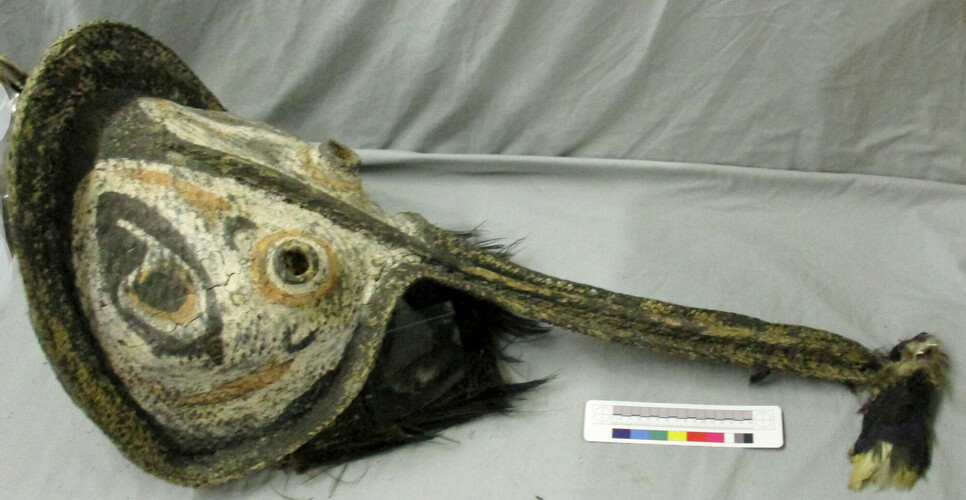 1972.2.3Basketry dance mask. The mask has a pointed head with a long nose and a fringe of cassowary feathers around the mouth. The surface is covered with a black pigment with white, pinkish and black designs on the face and around the eyes. At the tip of the nose there is a bunch of feathers. [AB [OPS Move] 31/08/2016]1972.2.3
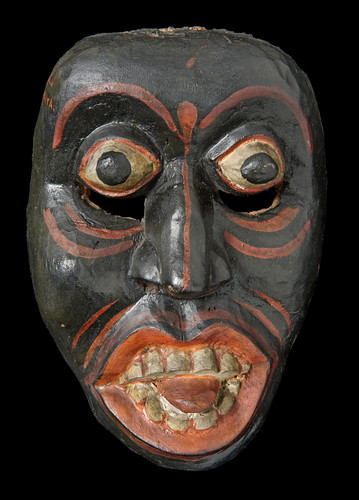 1895.36.1Golu Sanniya mask used in dances performed for curing, carved with eyes and mouth open and holes under the eyes to enable the wearer to see. [JN 15/07/2008]1895.36.1
 2020.40.6Covid face mask2020.40.6
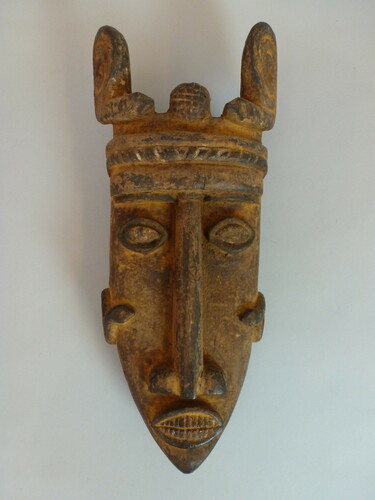 1916.45.100Wooden mask said to be from a headdress. [ZM 02/04/2013]1916.45.100