
- Collection type
- Object
- Description
- Wooden mask said to be from a headdress. [ZM 02/04/2013]
- Long description
- Wooden mask said to be from a headdress. There are carved, raised serpents on the cheeks and head and a carved ornamental circle. The face has a long stylized nose with flared nostrils, an open mouth baring 2 rows of teeth, raised eyes and a prominent brow. There is a band of carving around the forehead. Traces of yellow or orange pigment remain all over the mask. The mask is perforated around the edge, perhaps for attachment to the headdress. [MdeA / CW 30 4 98]
- Geographical reference
- Southern Nigeria Niger Delta Rivers State Abonnema
- Date / Period
- Date made: Before 1916
- Date collected
- By 1916
- Acquisition information
- Donated: 1916
- Materials and processes
- Material Wood Plant, Material Pigment, Process Carved, Process Painted, Process Perforated
- Dimensions
- Length: max 380 mm, Depth: max 121 mm, Width: max 176 mm
- Object numbers
- Accession number: 1916.45.100
- Research and responses
John Picton examined this mask during a consultation visit about the Ijo masks on 20 August 2013 and noted the following: This is a Kalabari Ijo head-dress mask worn as part of a costume in water-spirit (owu) masquerades. Amongst the Eastern Ijo, who are categorised as the groups living on the east side of the Nun River, which includes the Kalabari, water-spirit masquerades are looked after by the Ekine society. This type of mask is worn on top of the head with the carved face pointing skywards, although this makes the mask invisible to spectators at times they do see glimpses of the mask through the movements of masquerader's dance. This one is in good condition with carvings of snakes on the sides of the face and top of the head, these are probably pythons which are the biggest water deities. In the Kalabari area pythons are found in the water and can be dangerous. [ZM 21/08/2013]
- Associated publications
- Illustrated in black and white photograph as figure 27 (page unnumbered) of Kalabari Sculpture, by Robin Horton (Nigeria: Department of Antiquities, 1965). Caption same page reads: ‘Masquerade headpiece representing the water-spirit Abiogbo. Note python motifs on cheeks and above brow. Paint faded. The piece is here photographed as it would be seen in a museum - i.e. in a position which shows of its principal features to the best possible visual advantage. When it is used in a masquerade, however, the headpiece is mounted atop of the dancer's head with its face up to the sky. Pitt Rivers Museum, Oxford. 1" x 4"' [ZM 22/08/2013] Also see Talbot, 'Tribes of the Niger Delta', 1932, pp. 307-317. [CF 27/3/2001]
Search terms: Mask, Figure, Clothing Headgear, Theatre and Drama, Dance, Religion, Head Ornament, Headdress, Dance Accessory
Further items to explore
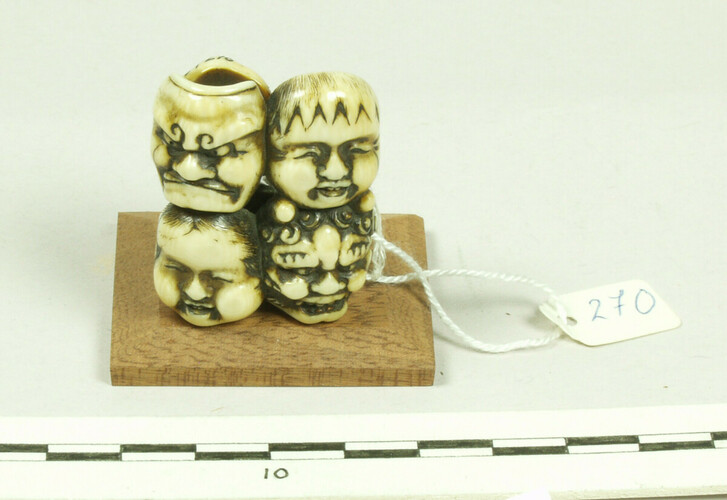 1980.34.270Netsuke toggle showing a group of seven masks, four on one side and three on the other [L.Ph 'DCF 2004-2006 What's Upstairs?' 5/4/2005]1980.34.270
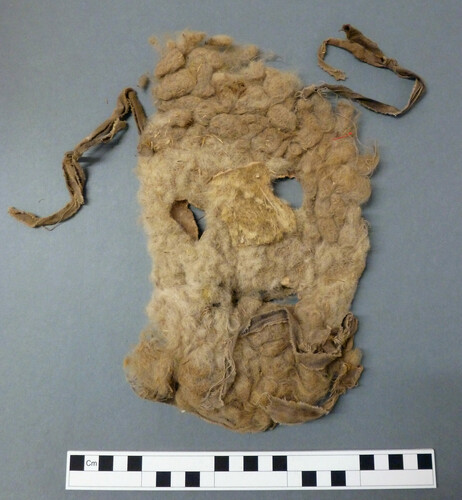 1961.10.13BMask of sheepskin. It depicts a face with holes for eyes, a nose sewn to the centre and a mouth cut from the sheepskin. There are five lengths of fabric sewn to the mask to tie it to the wearer. [AB [OPS Move] 31/8/2016]1961.10.13B
 1934.9.2.7Fringe for waist, part of a bark cloth mask costume. For Bark cloth shirt with long sleeves attached see 1934.9.2 .1, for the separate trouser legs see 1934.9.2 .2 and 1934.9.2 .3, for the wood and bark cloth mask see 1934.9.2 .4, for the head fringe see 1934.9.2 .5, for the neck fringe see 1934.9.2 .6. [CW [OPS move] 14/10/2016]1934.9.2.7
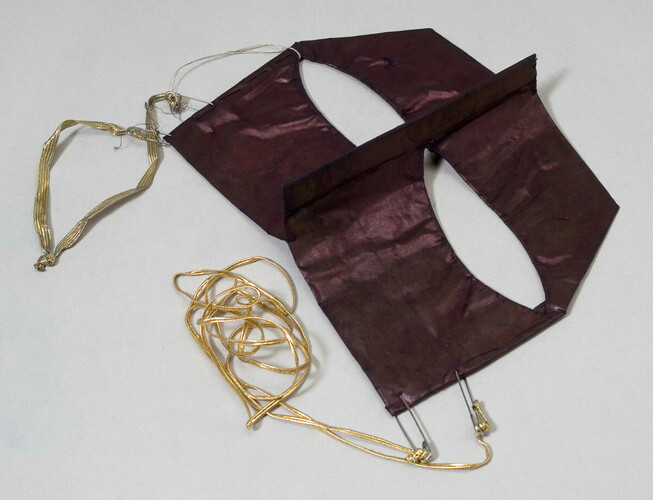 2003.9.275Indigo mask2003.9.275