
- Collection type
- Object
- Description
- Sword, chiisa katana [.1] with curved blade and lacquered sheath [.2] both decorated with dragon motif, and decorated small knife [.3] [SM 08/10/2007]
- Long description
- Sword, chiisa katana [.1] with curved blade and lacquered sheath [.2] both decorated with dragon motif, and decorated small knife [.3]. The sword has a single edged blade decorated on one surface with an incised dragon and a wooden hilt bound with copper alloy at the base and centre and with a copper alloy cap at the butt. It has an iron guard, tsuba, decorated with dragons. The sheath is decorated with dragon in relief and is highlighted with gold paint. The small knife kogai, is single edged and has a copper alloy hilt decorated with two flying cranes and a crescent moon. [SM 08/10/2007]
- Date / Period
- Archaeological period: Late Muromachi, uncertain Date made: 1500-1560?, uncertain Date made: Before 1898
- Date collected
- 1898
- Acquisition information
- Donated: 1946
- Materials and processes
- Material Steel Metal, Material Wood Plant, Material Lacquer Varnish, Material Copper Alloy Metal, Material Iron Metal, Material Gold Metal, Material Pigment, Process Forged (Metal), Process Carved, Process Lacquered Varnished, Process Incised, Process Inlaid, Process Bound
- Dimensions
- Length: max 173 mm, Length: max 685 mm, Length: max 532 mm
- Object numbers
- Accession number: 1946.12.70.1 Accession number: 1946.12.70.2 Accession number: 1946.12.70.3
- Research and responses
Related Documents File - Excerpt from notes by Colin Langton, 1998: 'Wakizashi blade in unusual Koshirae . . . the Tokugawa Aoi Mon, having been cut into the Omote side, I think this is of questionable authenticity probably being added when the blade was shortened or remounted . . . I think this blade is possibly associated with the Sue Mihara school of smiths of Bingo province active during the late Muromachi period (1470-1570) . . . the use of an all wooden hilt together with the flambotant scabbard almost certianly point to this pair of swords being late 19th cent pieces made up for export or for sale to visitors to Japan . . . conclusion, blade mid to late 16th cent, mounts late 19th cent, of ordinary quality.' [GI 18/1/2002]
Japanese swords can perhaps justly be described as the finest cutting swords ever made, and it is well documented that the very best blades were capable of cutting up to four men in half through the waist with a single stroke, or cutting steel rifle barrels in half without damage. The production of such blades took months. All five elements of the traditional Japanese cosmology – earth, metal, fire, water and wood – contribute something to the creation of the sword, and several different artisans worked separately on the forging, sharpening, making of the guard, and production of the other sword furniture. The swordsmith himself (kaji) was the most respected and prominent of these artisans, and, even though the artisan class were conventionally ranked below the agricultural class, the importance of the sword meant that the kaji often became highly celebrated individuals. During the final stages of forging a sword, the kaji dressed in the ceremonial costume of a court noble (kariginu & yeboshi), and consecrated his forge (kajiya) as a Shinto shrine, hanging a straw rope talisman (shime-nawa) over the doorway to ward off evil and negative influences. At the beginning of each day of this final forging process, the kaji purified himself with cold baths, as well as abstaining from sex, eating meat, eggs or dairy products, and drinking alcohol. He invoked the spirits to assist his work, and nobody except himself and his assistant were permitted to enter the forge (Robinson, 1961: 25). At the end of the Kofun Period (3rd-7th Centuries AD), the slightly-curved, single edged cutting sword appeared in China and Japan, and crystallised very rapidly into more or less the form exhibited by all later Japanese longswords. In the 6th century AD, Chinese swords were considerably superior in manufacturing to Japanese swords, but by the 11th century AD, Japanese forging, sharpening techniques, and artistry, had superseded those of the Chinese. Swords became a major Japanese export to China, and this relative difference in quality remained the same until the sword’s abandonment at the end of the 19th century. The period between 1250-1350 AD is regarded as the peak of Japanese swordsmithing. There was a second major peak in smithing around the beginning of the Tokugawa Period in the late 17th century (the Shinto or ‘New Sword’ Period), followed by a similar decline into display and gaudiness which is demonstrated by the later Tokugawa armours. During the late 18th century Shinshinto or ‘Recent Sword’ Period, Kawabe Suishinshi Masahide led an archaistic revival in functional swordsmithing, which remained at a high level of quality until the Meiji Restoration in 1876. In this year, the Emperor passed the Sword Edict, which prohibited the carrying of swords, and effectively signalled the abolition of the Samurai class. This virtually eradicated the art of swordsmithing overnight. Officer’s swords of the Japanese military in World War Two (showa-to) were generally low-quality mass-produced artefacts, taken from castings of historic weapons. Today the Society for the Preservation of Art Swords (Nippon Bijutsu Token Hoson Kyokwai) maintains interest and knowledge in swords among the Japanese people, organises periodical forging competitions, and so on (Robinson, 1961: 15-25). The katana is the classic Japanese longsword, and was the exclusive prerogative of individuals of samurai class. The katana has been described as ‘the living soul of the bushi’, and ‘the pride of warriors and theme of poets’ (Robinson, 1961: 15). The katana has no fittings for slinging from a belt, but has small wooden lugs which secure it when it is slid through the waist-sash. It is worn edge-upwards, which historically permitted rapid drawing. The making of a katana blade could occur in one of two basic ways: The entire blade was made of high-grade ‘pattern-welded’ steel. This steel was forged by taking two fairly thick flat plates of steel (one hard and brittle, the other soft and flexible), and welding one on top of the other. This was then heated and beaten out to length, folded back on top of itself, and welded again – creating four layers in the steel. This operation was repeated 15-20 times, until the steel itself became a ‘filo pastry’ of steel, containing several thousand microscopically-thin layers. Experimentation had shown kaji that folding more than 20 times tended to begin homogenising the two steels into one, which reduced their dynamic tension of elasticity and sharpness. Once this was done, the blade was beaten into the desired shape. The result was a wood-like grain on the flat of the blade, known as mokume. Alternatively, the katana could be made using a composite method, where a soft flexible core (shintetsu) of iron was strip-edged (uwagane) with a V-sectioned fillet of high-grade laminar steel manufactured in the manner above. Once completed, the blade was passed to the professional sharpener, who brought it into the final shape with rasps and abrasive stones. Up to twenty different grades of stone were used in increasing fineness, until the mirror-like polish was achieved. Then the blade was passed to the manufacturer of fittings for the attachment of the multitude of hilt parts, and the manufacture of the scabbard (saya). The tsuba (circular/sub-rectangular hand-guard) was an aesthetically important part of any sword, and their manufacture became a distinct art in Japan from the 15th century onwards. Research Conducted for DCF Cutting Edge 2006/2007 [AM].
The term chiisa katana can be used to describe a sword that is shorter than a katana or more specifically for a sword with a length between that of a katana and a wakizashi. See www.nihonto.com/abtglos.html. [El.B DDF Body Arts Project 2010/2011 04/10/2010]
Further items to explore
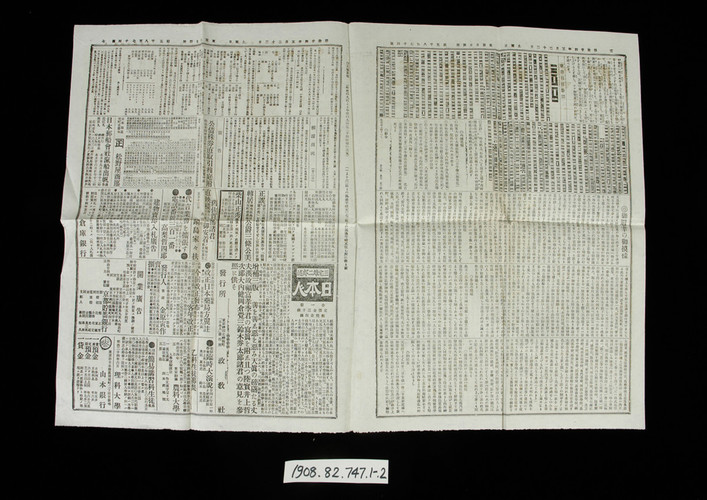 1908.82.747.1Pages from a newspaper [.1-.2] showing censorship. [SM 22/10/2008]1908.82.747.1
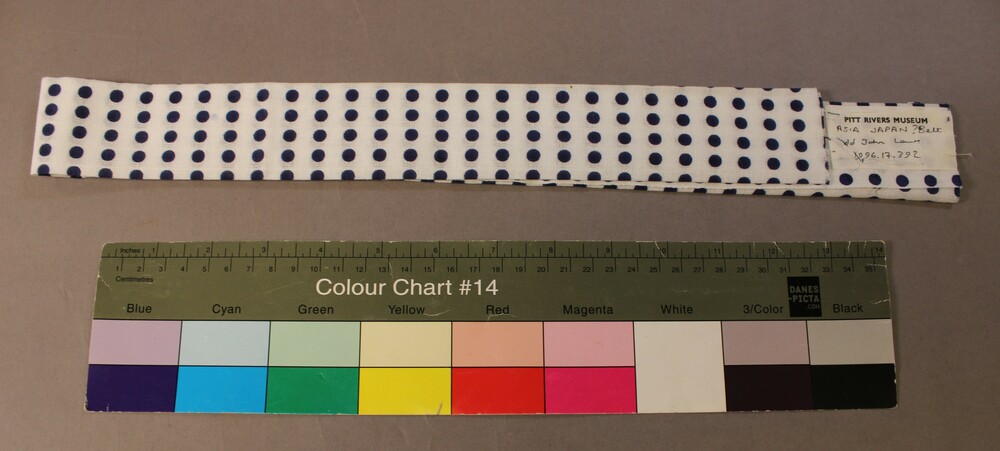 1996.17.392Sash1996.17.392
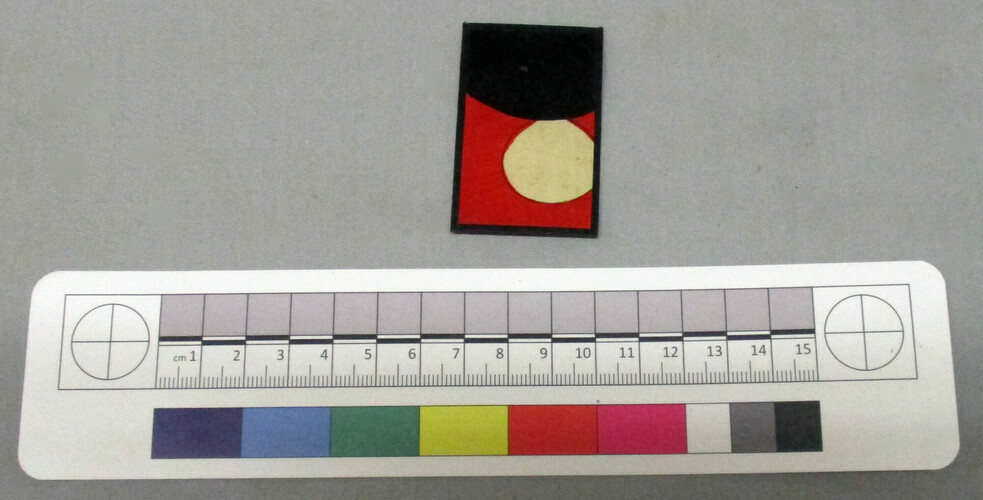 1901.47.1.102Gaming card. With an image which depicts a sun? with a red sky and black hill shape. The card is rectangular and made from paper, the back of the card is black with an image glued to the front. The card is one of forty-nine black cards in a game set. [CW [OPS Move] 21/7/2016]1901.47.1.102
 1997.24.17.1-6Rectangular printed envelope containing five smaller printed envelopes.1997.24.17.1-6