
- Collection type
- Object
- Description
- Neck ornament composed of multicoloured glass beads, nuts or seeds, cowrie shells and an animal's claw and tooth, strung on a plant fibre cord [RTS 30/11/2004].
- Long description
- Neck ornament made from a yellow plant fibre cord (Pantone 7508C), made from two strands twisted together and tied in a knot at the top. This has been strung with a variety of beads and pendants that cover most of the cord's surface. The design is partially symmetrical, in that the maker has placed broad blocks of similar colours and shape on either side, with some sections mirroring each other closely - but then there are anomalies, such as the block of red, which appears on one side only, or the inclusion of a black seed on one side where a cowrie shell appears on the other. There are 37 beads down one side, 2 beads and 2 pendants at the base, and 38 beads up the other side. Several different types of beads are used in its construction. These include 2 sizes of cylindrical beads with a white core and a turquoise outer coating (7 small, 8 large), of the type the Lotuko call gwen bor, with some variation in tone from deep blue, mid blue to blue-green (Pantone 301C, 7474C and 7473C). These range in diameter from 2.8 to 5 mm. There are 7 examples of a larger type of ring bead, with a typical diameter of 9 mm, with flat cut ends and slightly convex sides, made in a similar way with a white core coated with red glass (Pantone 187C). There are 7 ring beads in various tones of blue, from royal blue (Pantone 2747C) to turquoise (Pantone 7468C), which have the same colour throughout their body, and a typical diameter of 7 mm; 2 very worn dark blue ring beads that look much older than the others (Pantone 294C), and are 8.2 mm in diameter; a series of 5 faceted octagonal beads, mostly in royal blue (Pantone 2758C), measuring 8.8 mm in width; a hexagonal sided cylinder bead in a different tone of purplish blue (Pantone 2718C) with a width of 5.2 mm, and 8 hexagonal beads with the corners flattened to create additional facets, in royal blue (Pantone 2747C), and 1 in turquoise (Pantone 325C) which measure 7 mm across. There are also 2 sizes of opaque glass beads with broad flat moulded midribs, in sky blue (Pantone 310C, 9 examples) and royal blue (Pantone 2728C, 1 example) - these have diameters of 4.8 and 5.5 mm. Finally, there are 3 cowrie shells, with varying amounts of their backs removed to allow them to be strung; an opaque black seed with convex sides that has been perforated through its centre (diameter 14 mm), and 2 dark brown nuts with hemispherical bodies and knobbed exteriors, bearing red ochre staining, that measure 15 mm in diameter. Dominating the base of the necklace are two large pendants, one being the incisor tooth and the other the claw of a large animal, possibly a lion. These are separated by two royal blue ring beads, and framed on their outer sides by the knobbed plant nuts. The tooth is 72.3 mm long, 21.6 mm wide and 13.3 mm thick; the claw is 45 mm long, 50.5 mm wide and 14.5 mm thick; this also includes the bony surrounds. Both have been perforated near their tops. The necklet is complete, and in good condition. It has a length, as strung, of 348 mm, with a cord diameter of 1.3 mm [RTS 30/11/2004].
- Geographical reference
- [Upper Nile]
- Person
- Field collector Henry Balfour
- Field collector Armine Charles Almroth Wright
- PRM source Henry Balfour
- PRM source Armine Charles Almroth Wright
- Date / Period
- Date made: Before 1939?, uncertain
- Date collected
- ?By 1939
- Acquisition information
- Donated: 1942, uncertain
- Materials and processes
- Material Glass, Material Cowrie Shell, Material Plant Nut, Material Plant Seed, Material Cat Claw Animal, Material Cat Tooth Animal, Material Grass Fibre Plant, Process Twisted, Process Knotted, Process Perforated, Process Moulded, Process Strung, Material Leopard Bone Cat Animal, Material Leopard Tooth Cat Animal, Material Lion Bone Cat Animal, Material Lion Tooth Cat Animal
- Dimensions
- Length 72.3 mm tooth, Length 348 mm as strung, Length 45 mm claw, Weight 78.2 g
- Object numbers
- Accession number: 1942.1.449
- Research and responses
'Upper Nile' in this context is probably used in a very loose sense, for areas around the Bahr el Abiad and Bahr el Jebel rivers in the Southern Sudan and northern Uganda. It is not clear why the collection date is given as 'by 1939' on this record; the original documentation does not seem to be so precise.
Note that the beads are plant seeds or nuts, not wood; their form is entirely natural; the same type of bead is seen on 1942.1.448, which may be of Acholi origin. Knobbed nuts of this type are also seen on an Acholi necklet, now in the Museo Preistorico ed Etnografico 'Luigi Pigorini' in Rome, accession number 96122 (Boccasino, 1964, "Contributo allo studio dell’ ergologia delle popolazioni Nilotiche e Nilo-camitche. Parte quarta. Il vestito, il tatuaggio, le deformazioni del corpo, gli ornamenti e la circoncisione", Annali Lateranensi XXVIII, fig 47).
The turquoise blue beads with white cores are the same type of bead that the Lotuko call gwen bor. The faceted dark blue beads look similar to those seen on 1934.8.69 (also Lotuko), and 1942.1.450. These parallels might point to either an Acholi or Lotuko origin for this necklet.
The glass beads with mould lines around the centre appear on a variety of other objects collected around the 1930's and 1940's, in a range of colours (see 1934.8.62, 1934.8.66, 1934.8.76 - all Lotuko, 1934.8.104, Jur, and 1940.7.049, Labwor?). The same bead shape appears in Arkell's collection of trade sample cards, purchased in Omdurman and el Fasher and originally made in Jablonec nad Nisou in the Czech Republic (see 1971.15.195, 1971.15.196 and 1971.15.257). Similar red beads with white core are also found decorating a Bari pouch (1934.8.43). [RTS 30/11/2004].
Another possible donor for this item would be Samuel Powell [JC 30/11/2004].
Search terms: Ornament, Bead, Neck Ornament, Pendant
Further items to explore
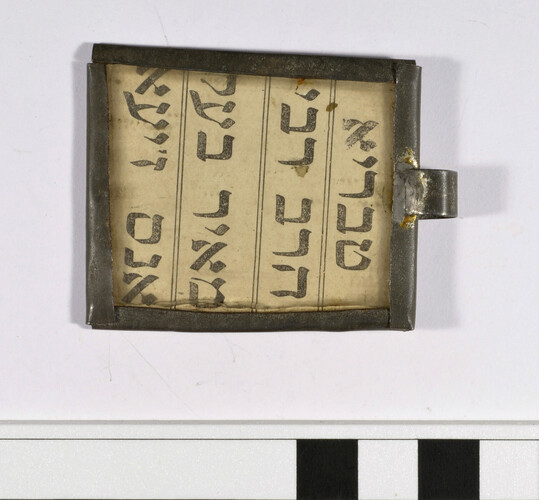 1985.52.132Amulet, white metal pendant frame, with a glass front, containing a printed Hebrew inscription. [RB 03/02/2012]1985.52.132
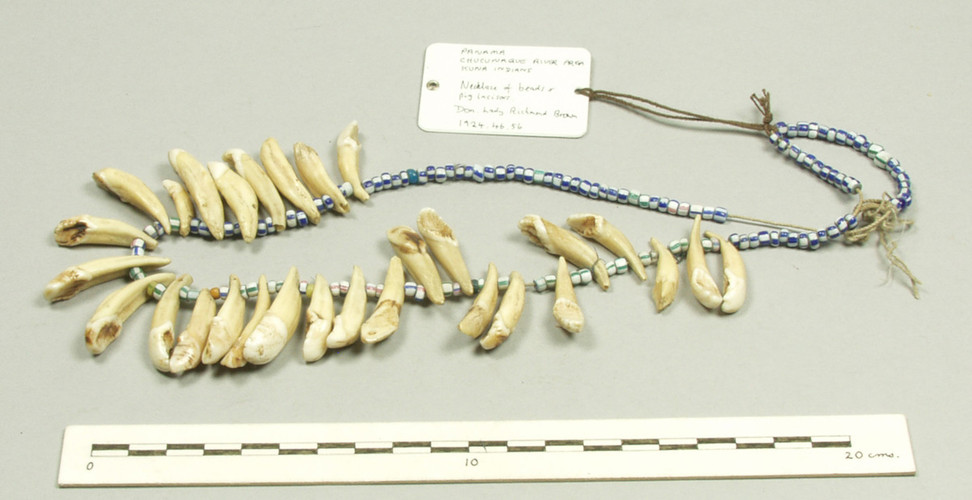 1924.46.56Necklace of glass trade beads (mainly blue-and-white striped) with 29 upper incisors of pigs. [El.B 'DCF 2004-2006 What's Upstairs?' 1/12/2005]1924.46.56
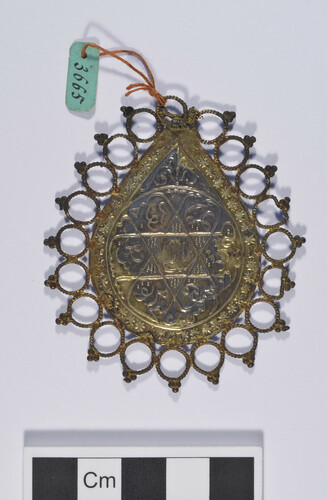 1985.52.1739Amulet, a metal drop-shaped pendant, with ?Arabic inscriptions on either side, with a border of rings and a loop for suspension. [ACA 06/06/2012]1985.52.1739
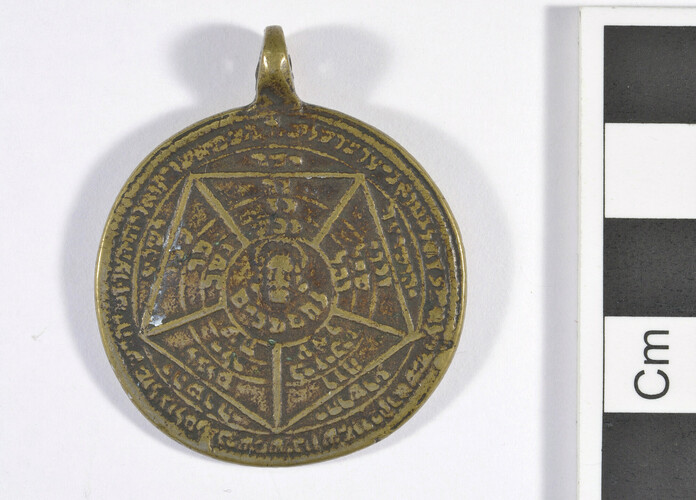 1985.52.434Amulet, pendant, a bronze disc with inscriptions in relief on both sides, and with a perforated loop for suspension. [RB 14/03/2012]1985.52.434
 1979.20.190.2Small tin ear stud with hemispherical head [RTS 12/5/2004].1979.20.190.2
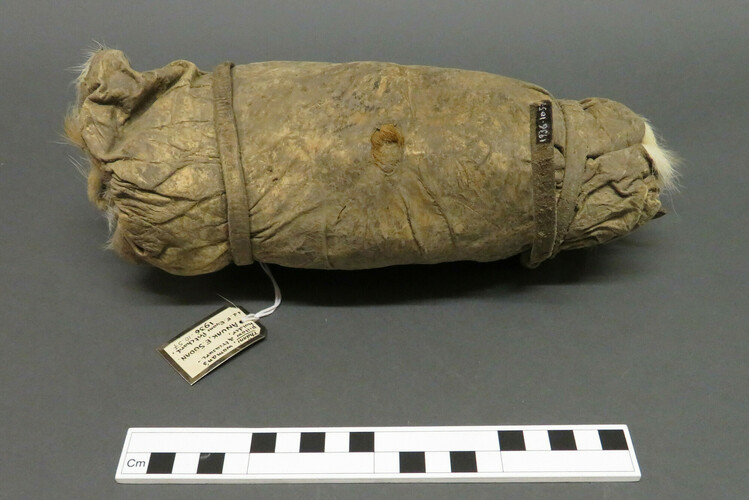 1936.10.57Cylindrical bundle made from a rolled up length of hide with animal hair still attached, used as a pillow and treasure bundle [RTS 17/5/2005].1936.10.57
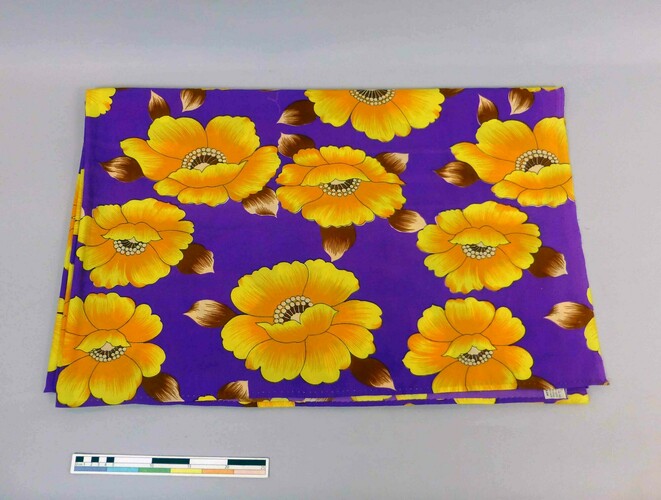 2014.69.2Piece of brightly coloured material worn by Dinka women. [FB 27/10/2014]2014.69.2
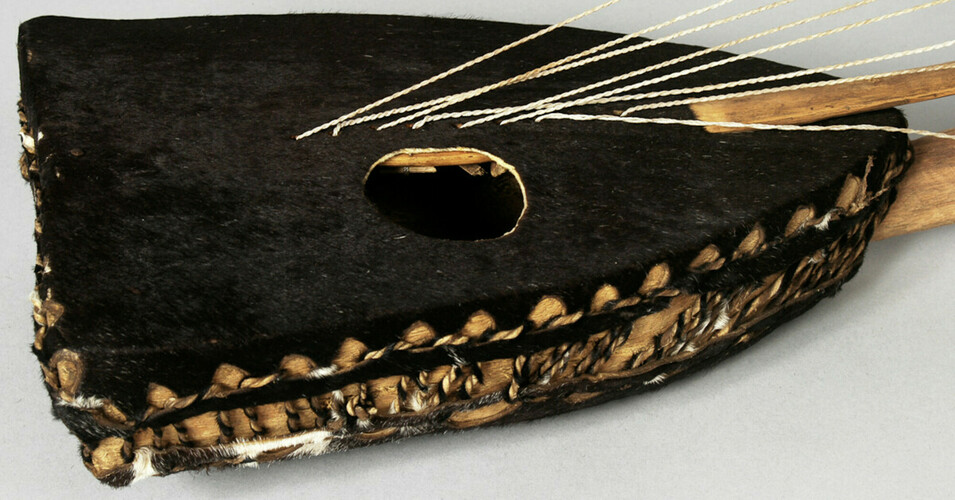 1985.24.1Bow harp with hide-covered resonator and 9 strings [RTS 23/9/2005].1985.24.1