
- Collection type
- Object
- Description
- Dagger [.1] with leather sheath [.2].
- Long description
- Dagger [.1] with leaf-shaped iron blade incised with two curved lines on each side, inserted in leather-covered wooden handle bound with a thong. With tooled, stitched leather sheath [.2], painted with dark brown lines on a reddish-brown ground. Sheath has leather loop for attachment to belt.
- Geographical reference
- Date / Period
- Date made: Before 1904
- Date collected
- Before 1904
- Acquisition information
- Purchased: 1904
- Materials and processes
- Material Animal Leather Skin, Material Iron Metal, Material Wood Plant, Process Forged (Metal), Process Incised, Process Tooled, Process Stitched, Process Painted
- Dimensions
- Length: max 148 mm, Length: max 270 mm
- Object numbers
- Accession number: 1904.54.2.1 Accession number: 1904.54.2.2
- Research and responses
Bornu - historical kingdom and emirate in northeastern Nigeria. Bornu was originally the southernmost province of the Kanem empire, an ancient kingdom that reached its peak in the 12th and 13th centuries. Toward the end of the 14th century the power of Kanem waned, and the empire shrank until little was left of it except Bornu. Succeeding centuries saw the final dissolution of the Kanem kingdom by its hostile neighbours (c. 1380) and the rise of Bornu. In the early 16th century, Bornu managed to recapture Kanem and made it a protectorate. The reamalgamated kingdom of Kanem-Bornu probably reached its height in the reign of Mai Idris Alawma (reigned c. 1571-c. 1603). Birni Gazargamu, the capital of the Bornu kingdom, was captured in the jihad (holy war) conducted by Fulani tribesmen in 1808. Muhammed (al-Amin) al-Kanami, a member of the royal family who advised the mais ("emperors") of Bornu, founded Kukawa (80 miles [130 km] north-northeast of Maiduguri) as the Kanuri capital in 1814 and restored Bornu's independence from Fulani domination in the 1820s. After the death of the Sefawa Mai Ali Dalatami in 1846, al-Kanami's son Umar (Omar) proclaimed himself the first shehu (that is, sheikh, or sultan) of Bornu. Bornu was defeated and Kukawa was destroyed by the Sudanese warrior Rabih
az-Zubayr (Rabah Zubayr) in 1893, and Dikwa (54 miles [87 km] east-northeast of Maiduguri) served as Rabih's headquarters until he was killed by the French in 1900. The French restored the al-Kanami dynasty in Dikwa; but, after the final partition of Bornu among the British, the French, and the Germans, Shehu Bukar Garbai fled in 1902 to Northern Nigeria and was recognized as the shehu of British Bornu. Bornu was thus acknowledged as an emirate, but Garbai moved its headquarters from Monguno (65 miles [105 km] north-northeast of Maiduguri) to Kukawa in 1904 and, finally, to Yerwa in 1907. The shehu of Bornu still resides at Yerwa and is officially recognized as Nigeria's second most important traditional Muslim leader, after the Fulanis' sultan of Sokoto. Much of the emirate's former territory is now in Borno and Yobe states. [Encyclopaedia Britannica on line] [AP 28/4/2000]
Further items to explore
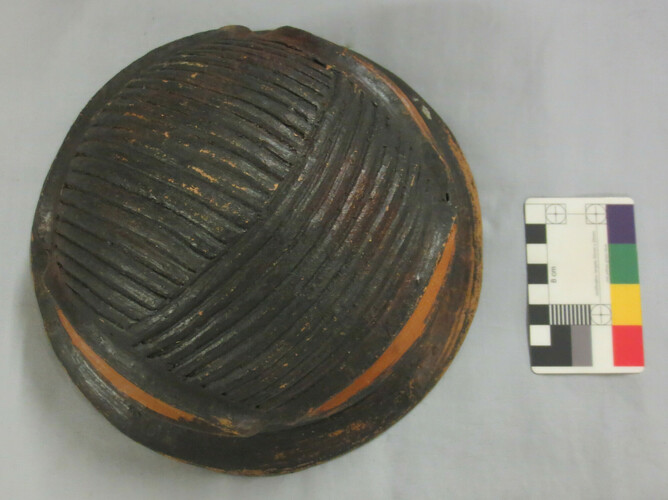 1942.13.454Round pottery bowl, with expanding rim, the outer surface decorated with mouldings, four elongated mouth-shaped projections and groove patterns,1942.13.454
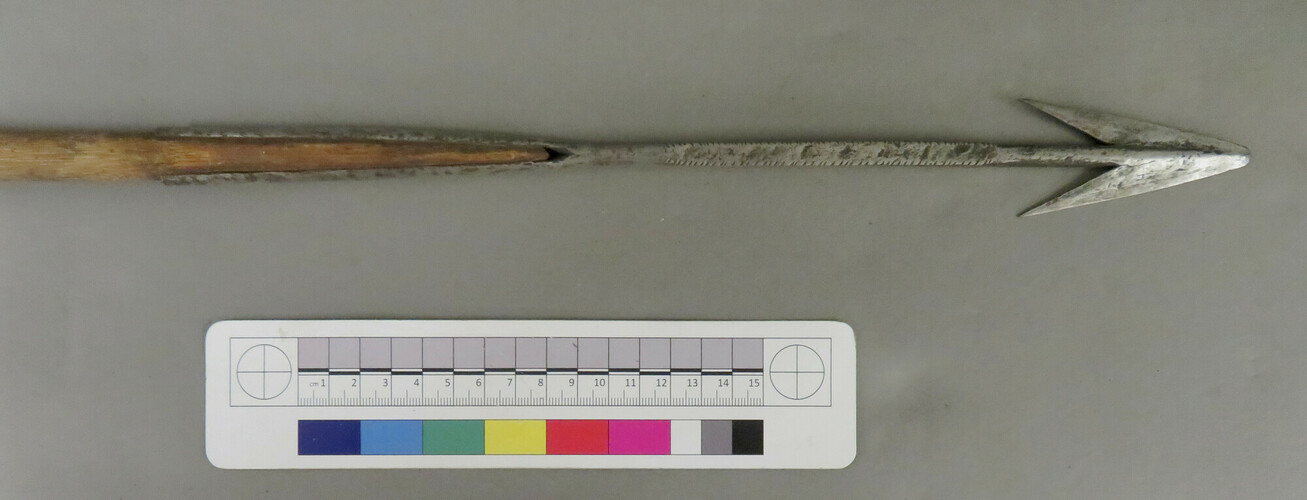 1887.1.152Spear with bamboo shaft and socketed metal head. The is a coil of metal at the butt. The head has an arrow blade. [DV [OPS move] 6/7/2018]1887.1.152
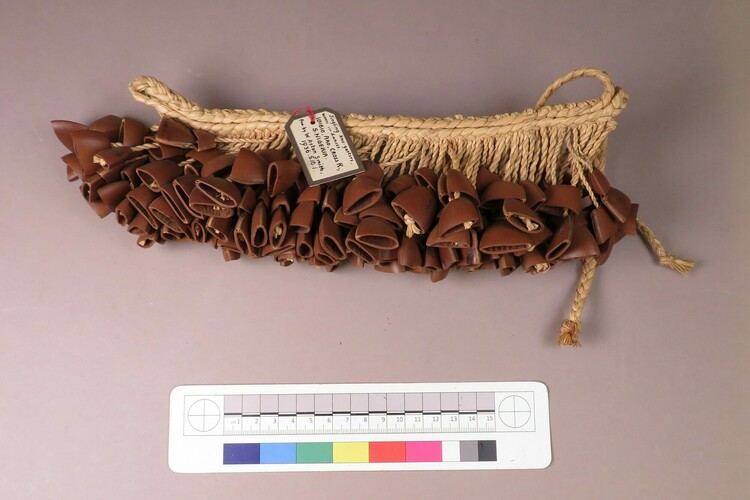 1936.5.10.1One of a pair of jinging knee garters. Made from nut shells cut in half and pierced at top. Threaded in pairs onto fibre twisted cord which is knotted at the end to secure shells. This cord is plaited into the main pait of fibre which ties around the leg, the plait is bent back double so that at one end of the nuts there is a loop at the other end the two ends. The ends are threaded through the loop to attach the rattle to the leg. [HLR]1936.5.10.1
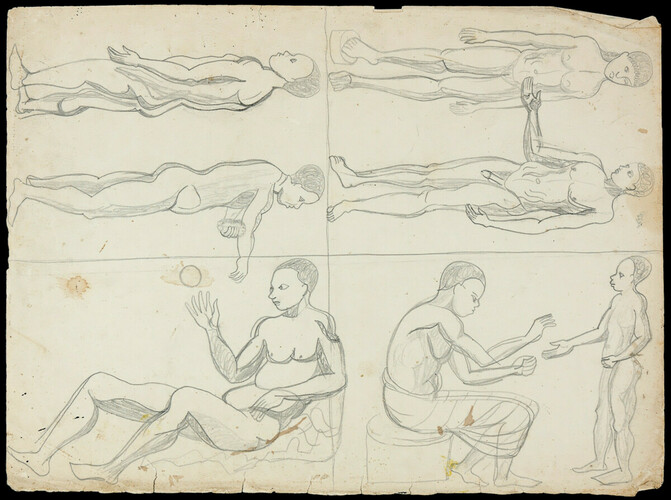 1996.5.24Four pencil drawings of people1996.5.24