
- Collection type
- Object
- Description
- Armlet of circular white Conus shell decorated with strings of banana seeds, red beads and discs of red shell. [MJD 17/12/2009]
- Long description
- Armlet of circular white Conus shell decorated with strings of banana seeds, red beads and discs of red shell. The outer curve of the shell is perforated with five holes, through which the decoration is strung. [MJD 17/12/2009]
- Geographical reference
- Milne Bay Province Kiriwina Goodenough District Trobriand Islands
- Person
- Field collector Charles Gabriel Seligman
- PRM source Charles Gabriel Seligman
- PRM source Brenda Zara Seligman
- Date / Period
- Date made: Before 1940
- Date collected
- By 1940
- Acquisition information
- Donated: 1940
- Materials and processes
- Material Conus Shell, Material Banana Seed Plant, Material Oyster Shell, Material Bead, Material String Plant, Process Carved, Process Perforated, Process Strung
- Dimensions
- Width: max 132 mm, Diameter: max 83 mm internal, Height: max 58 mm
- Object numbers
- Accession number: 1940.12.313
- Research and responses
Spondylus are bivalves known as thorny oysters. [Encyclopædia Britannica Online] [CF 10/4/2000]
- Associated publications
- Michael O'Hanlon refers to 1890.5.1 and 1940.12.313 as examples of the shell valuables circulated in the 'kula ring' in his article 'Take a case: Ornamental objects used as currency' published on page 5 of The Friends of the Pitt Rivers Museum, Oxford Magazine, issue 85 (Spring 2016). Talking about case L75A on the Lower Gallery, where these were both displayed until April 2016, O'Hanlon notes: 'The case is a favourite of mine, too, because it currently holds examples of the most celebrated shell ornaments in anthropology: the necklaces and arm shells which circulated in the 'kula ring'. First described by Bronislaw Malinowski in his 1922 classic Argonauts of the Western Pacific which set the standard for anthropological fieldwork, the kula is an elaborate system of ceremonial exchange linking island communities off the northeast coast of New Guinea. Malinowski described the perilous journeys people made by canoe to exchange these shell ornaments, necklaces circulating clockwise, arm shells anti-clockwise around the communities which make up the 'ring'. Neither arm shells nor necklaces are possessed permanently, or really worn on the body, but men compete for their temporary possession which brings great prestige. Malinowski brilliantly showed how the kula acted as a framework, uniting participants over a wide area, serving as a substitute for war and as an umbrella under which much trading of useful products also went on.' The article includes a colour photography of both objects, captioned: 'Kula armshell 1940.12.313 and necklace 1890.5.1, Trobriand Islands, PNG Armshells and necklaces were the principal valuables which circulated in the kula ring'. [ZM 2/9/2016]
Search terms: Ornament, Bead, Trade, Currency, Status, Arm Ornament, Status Object
Further items to explore
 1932.53.17Twill plaited fibre armlet, tied together by the label with four other armlets [1932.53.14-16, 18]. [LM 'DCF 2004-2006 What's Upstairs?' 23/11/2005]1932.53.17
 1897.67.69.76Man's armlet: a coiled strip of red-dyed cane, bound in one place with fine brown cane. Part of a set of of 29 (1897.67.69.74-102) mounted on a wooden cylinder. [LM 'DCF 2004-2006 What's Upstairs?' 15/11/2005]1897.67.69.76
 1897.67.69.124Man's armlet: a coiled strip of red-dyed cane, bound with thin dark brown cane. Part of a set of of 15 (1897.67.69.122-136) mounted on a wooden cylinder. [LM 'DCF 2004-2006 What's Upstairs?' 15/11/2005]1897.67.69.124
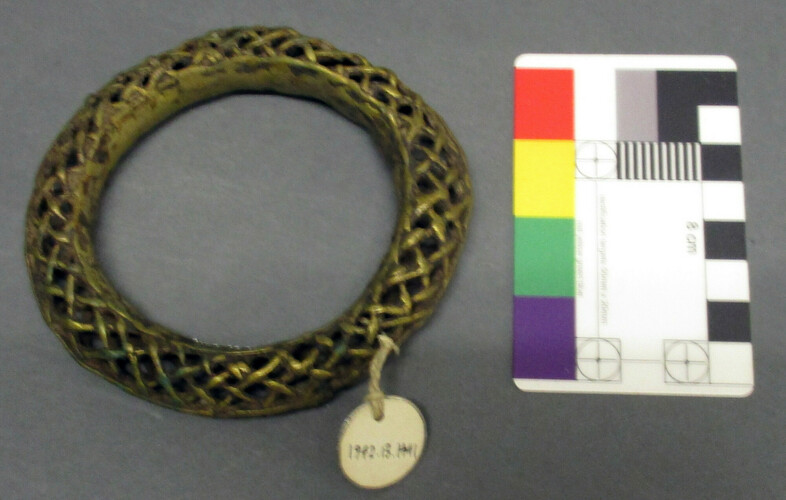 1942.13.1441Bracelet. Made from cast brass with an openwork, trellis pattern on the exterior. The copper is bent and there is some corrosion products present. [ASh [OPS move] 13/12/2016]1942.13.1441
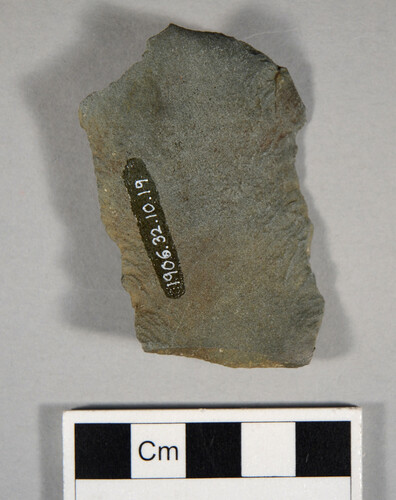 1906.32.10.19Stone flake. [MJD 26/09/2014]1906.32.10.19
 1909.30.15Bamboo shaft with an obsidian blade. The narrow blade, with missing point, is attached to the shaft with black resin. [DV [OPS move] 3/9/2018]1909.30.15
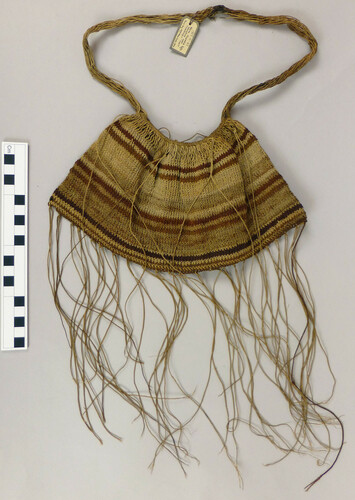 1909.30.69String-work bag string tassels and carrying strap [SM (Verve) 25/06/2014]1909.30.69
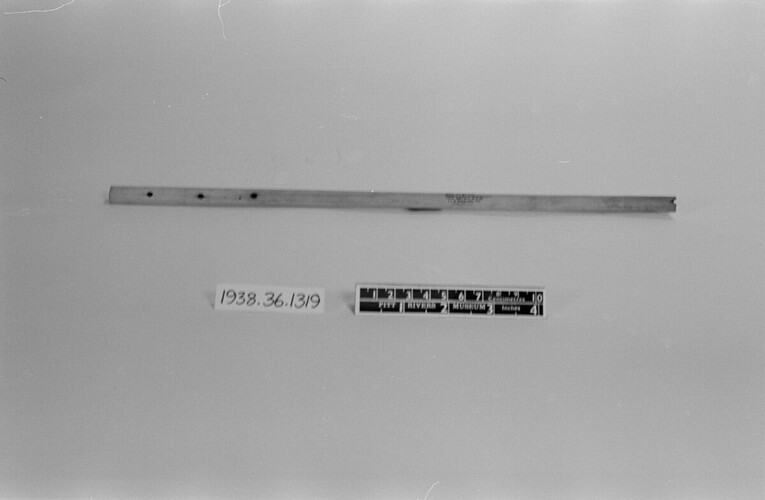 1938.36.1319Single bamboo flute, with three holes and notched mouthpiece, holes and mouthpiece burnt in. [HLR]1938.36.1319