
- Collection type
- Object
- Description
- Pigskin sandal with flat sole turned up at sides of heel and attached to hide straps; worn on the left foot, and also used in divination [RTS 14/4/2005].
- Long description
- Sandal consisting of a sole made from a thick piece of dark brown pigskin, used with the hairy side turned upwards (Pantone black 4C). This has been cut with a convex front and back and straight sides that taper in to an open-backed heel with 2 almost triangular flaps turning up on either side. A large hole has been cut near the top of each flap, and a short vertical hide loop attached. This, and the remaining hide elements are made from much thinner pieces of skin than the sole. At the front of the sandal, an iron bar has been pushed through sole to form a shallow loop that anchors the toe dividing strap. This strap has been knotted around the iron loop, then extends back towards the heel, where it passes through the perforated ends of the side straps and is knotted, before continuing to one side of the shoe where the loose end is secured. The straps themselves are made from 2 slightly wider hide strips, pierced at either end, then lain one over the other to make a double thickness. This was then fitted over the toe strap and bent back towards the triangular heel flap, where the doubled pair loops through the hole, back over itself then through the separate side loop before passing around the heel area, then back through the hole on the opposite side before rejoining the toe strap. The object is complete, but roughly finished, particularly on the underside. There is some burnish to the upper surface suggesting wear, and traces of red ochre around the front edges. It has a weight of 224.2 grams and is 250 mm long, 101.4 mm wide and 55 mm high. The sole has an edge thickness of 8 mm, while the doubled ankle straps are 10 mm wide and 3 mm thick [RTS 17/5/2005].
- Cultural groups
- Lango
- Date / Period
- Date made: Before 1925
- Date collected
- By 1925
- Acquisition information
- Donated: 1925
- Materials and processes
- Material Pig Skin Animal, Material Animal Hide Skin, Material Iron Metal, Process Perforated, Process Knotted, Process Tied, Process Forged (Metal), Process Hammered, Process Bent
- Dimensions
- Length 250 mm, Thick 8 mm sole, Width 101.4 mm sole, Height 55 mm, Weight 224.2 g
- Object numbers
- Accession number: 1925.14.3
- Research and responses
The term 'lamo war' would seem to refer to how these sandals were used rather than being their specific name; thus in his Lango-English dictionary, Driberg defines the term: 'lam’o: to invoke, adjure, consecrate. Kot, alam’i ichwe, rain, I invoke thee to fall; LAM’O WAR, to take the auspices by sandals' (J.H. Driberg, 1923, The Lango, p. 390). Driberg mentions this use of sandals for taking the auspices before a hunt, a battle, or before going on a journey (pp 111-113, 118, 263). He adds that this kind of divination 'is not open to women' (although see below, where a woman diviner carries out the procedure). '... an unlucky fall of the sandals is not necessarily conclusive, the inquirer persisting in the throws until a good omen is forthcoming; but should the omen persistently remain bad after several throws the prediction is accepted, and in extreme cases the projected journey is postponed. The Lango sandal is of very primitive structure, consisting of a sole with a slightly raised pad at the back of the heel. At the toe and on each side are small lapesl, through which laces are inserted joining up the lapels with the heel pad, the lace of the toe lapel passing between the wearer's big and first toes. To take the omens the sandals are held together sole to sole, and toe to toe, by the inner edges, if they belong to the man making the inquiry; but if they are borrowed, the thrower holds them by the outer edges. Having thus grasped the sandals, the inquirer throws them up in the air, imparting a twisting motion by a turn of his wrist, and the omens are read by their respective positions on falling to the ground. No skill is required for reading the omens, as the interpretations are all stereotyped, and no variation has been detected anywhere in the tribe' (p. 264). Driberg goes on to illustrate the different positions in which the sandals might fall, and their meanings, including 'hunting will be safe', 'you will kill a giraffe', 'rain', 'a friend will bring you good news,' 'someone will give you a goat', and 'someone will present you with a cow, but it will break loose and go back to its original owner' (pp 264-267).
Hayley gives the term for divining by the use of sandals as lamo amuk; he describes a female ajwaka called Akelo who would throw sandals in the air and then read their position they assumed on the ground (T.T.S Hayley, 1947, The Anatomy of Lango Religion and Groups, p. 25, 167, 194).
Sandals of somewhat similar design were also worn by the Acholi; see R. Boccassino, 1964, "Contributo allo studio dell’ ergologia delle popolazioni Nilotiche e Nilo-camitche. Parte quarta. Il vestito, il tatuaggio, le deformazioni del corpo, gli ornamenti e la circoncisione", Annali Lateranensi XXVIII, fig. 14, currently in the Museo Preistorico ed Etnografico 'Lugi Pignorini', Rome, accession number 96025 [RTS 28/6/2005].
Search terms: Clothing Footgear, Divination Religion, Sandal, Divination Accessory
Further items to explore
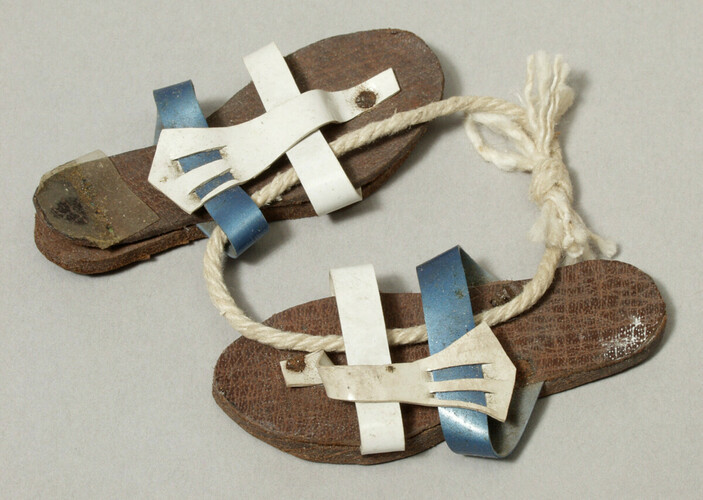 2001.30.1.1Pair of miniature sandals. The sandals have leather soles and uppers made from blue and white plastic nailed to the soles. The two sandals are tied together with a piece of string. [E.S-R 'DCF 2004-2006 What's Upstairs?' 27/1/2005]2001.30.1.1
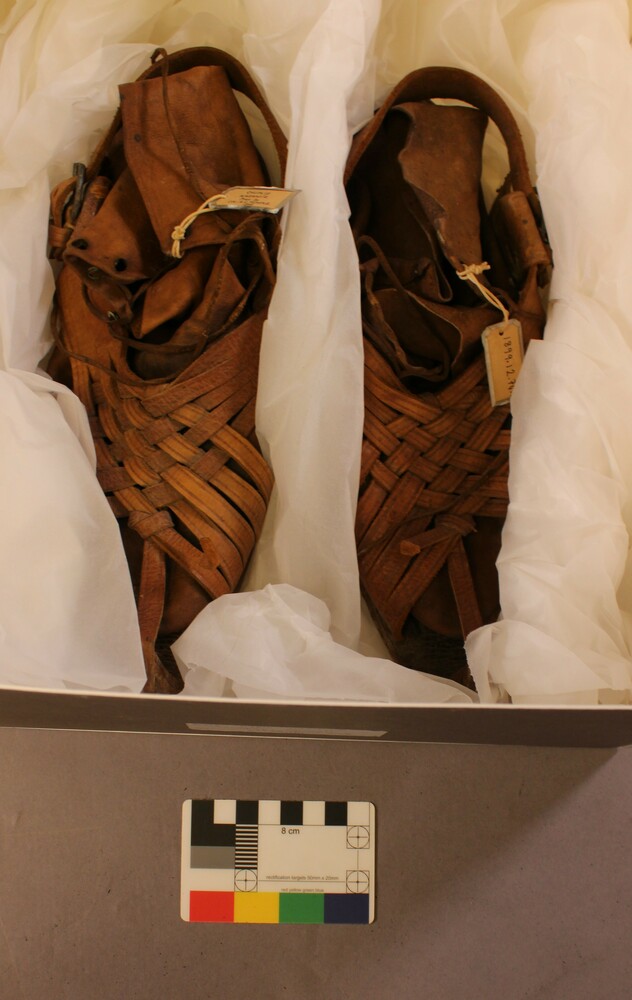 1899.12.74.1-2Leather ankle boot with tongue and lacing up the foot, in a stout leather shoe-sandal studded on the underside of the sole.1899.12.74.1-2
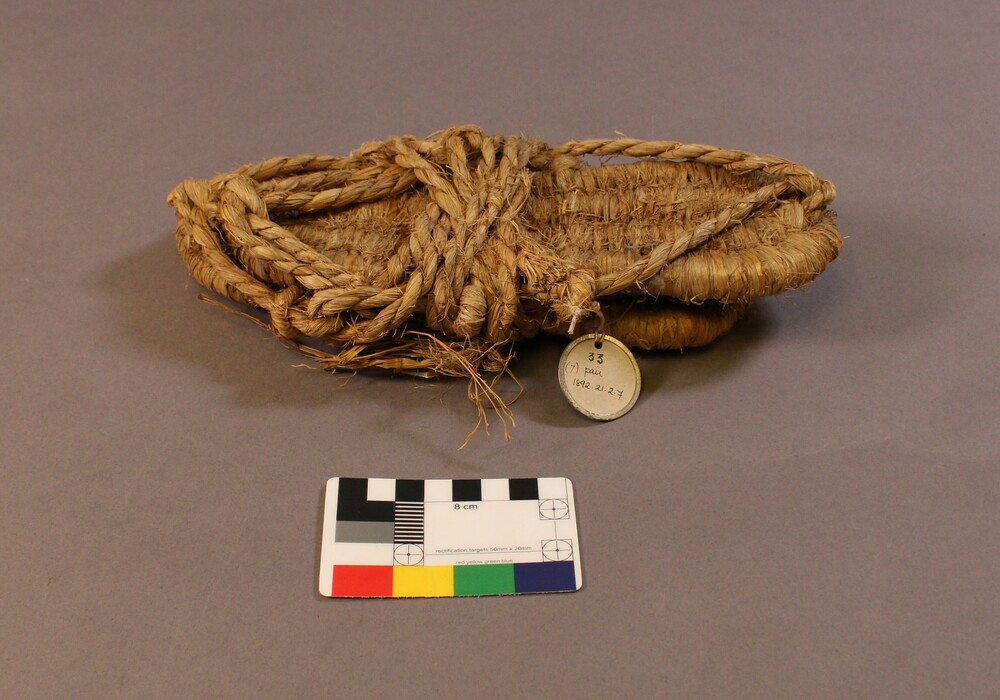 1892.21.2.7.1Part of pilgrimage suit. Pair of rush sandals.1892.21.2.7.1
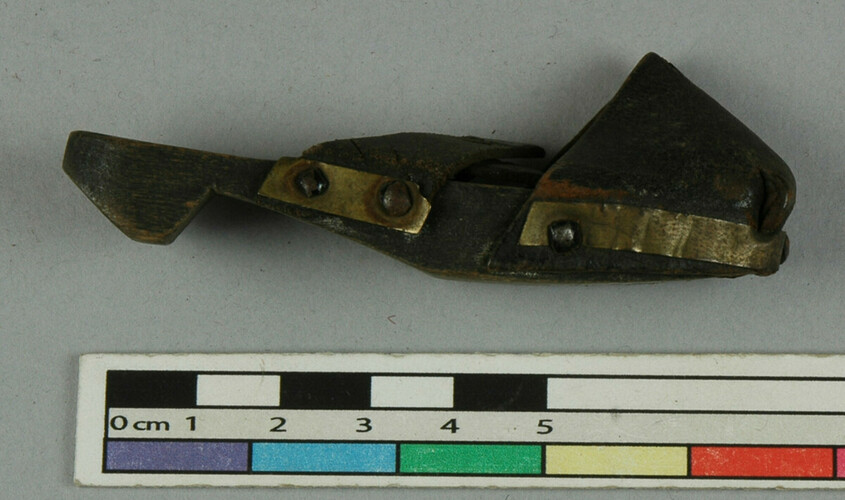 1985.51.148Lucky shoe. Miniature sandal, wooden base with leather upper and straps, secured into the base with iron nails and copper alloy strips. [SM 21/01/2011]1985.51.148
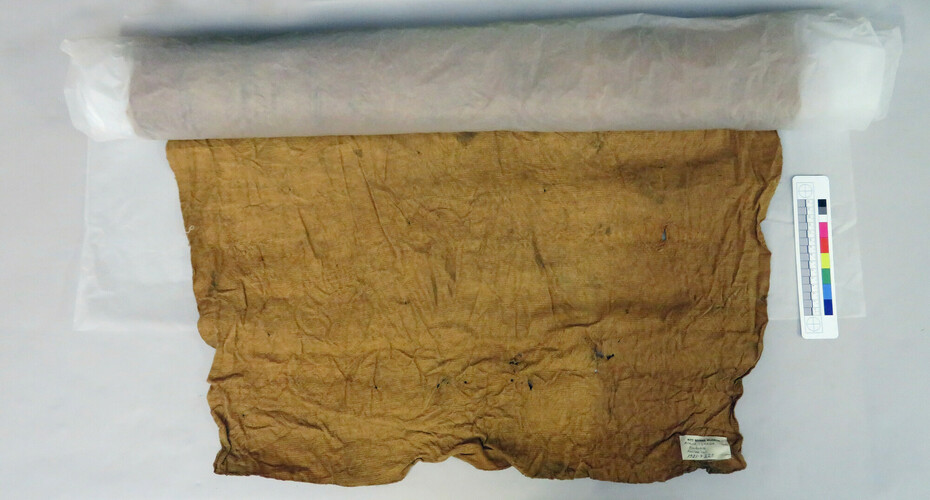 1921.9.225Piece of plain brown barkcloth, used as a packing material for the Roscoe collection. There are grooves from the beater on the surface. [AF [OPS move] 22/8/2017]1921.9.225
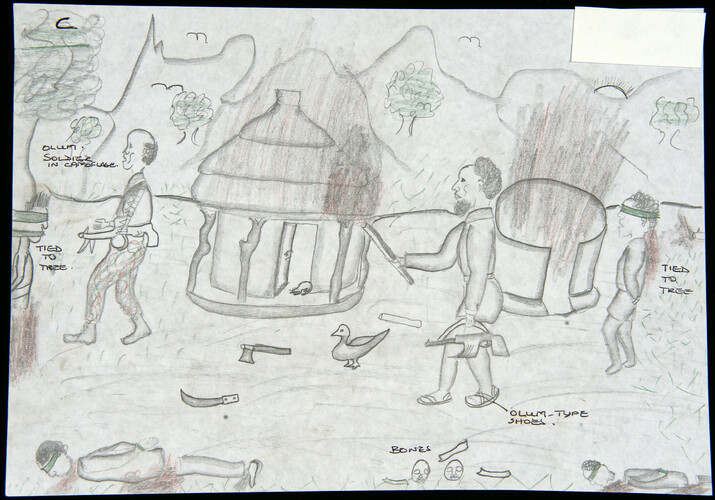 2006.93.56Drawing in pencil.2006.93.56
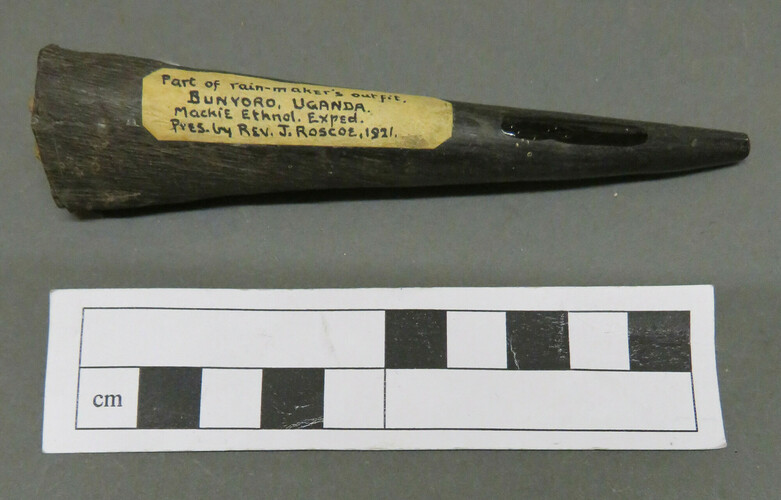 1921.9.136Vessel horn, part of rain maker's outfit. [ASh [OPS move] 12/5/2017]1921.9.136
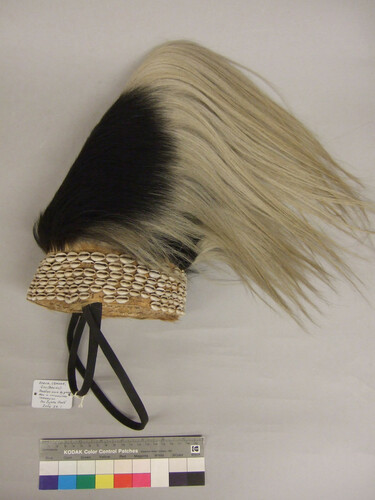 2006.93.1Headdress of black and white Colobus monkey fur trimmed with cowrie shells. Worn by young men in circumcision ceremonies. [MdeA 13/11/2007]2006.93.1