
- Collection type
- Object
- Description
- Wooden cylinder roulette with incised spiral cut into body, used for decorating pottery [RTS 2/6/2004]. With modern impression [.2]. [El.B 'DCF 2004-2006 What's Upstairs?' 22/11/2004]
- Long description
- Small roulette for decorating pottery, carved from a single piece of wood and consisting of a cylindrical body with oval section, cut roughly flat at either end. The body has been decorated with three roughly parallel v-shaped to u-shaped grooves that twist obliquely down the length, creating spirals. When impressed into clay, this creates a band of decoration, approximately 25 mm wide, composed of a oblique and slightly curving lines, or hatching. The roller is almost complete, with a small chip missing from part of the surface, and a pale yellowish brown colour (Pantone 7508C). It is 30.5 mm long, 7.5 mm wide and 6.8 mm thick. Each groove is between 1.5 to 2 mm wide. The object weighs 0.7 grams [RTS 2/6/2004].
- Geographical reference
- Cultural groups
- Lango
- Person
- Field collector T.A.C. Rubie
- PRM source T.A.C. Rubie
- PRM source Mr Driberg
- PRM source Jack Herbert Driberg
- Date / Period
- Date made: Before 1931
- Date collected
- By 1931
- Acquisition information
- Donated: 1931
- Materials and processes
- Material Wood Plant, Material Pottery, Process Carved, Process Incised, Process Decorated, Process Impressed
- Dimensions
- Width 7.5 mm, Depth 6.8 mm, Length 30.5 mm, Length: max 50 mm, Weight 0.7 g
- Object numbers
- Accession number: 1931.6.3.1 Accession number: 1931.6.3.2
- Research and responses
Driberg discusses pottery manufacture amongst the Lango: "Pottery is not confined to a manufacturing class, but pots are made by the males of the family as required, the women fetching the clay (dagi) from the riverbeds ... The clay is used unmixed, and the smaller pots are moulded by hand from the lump. In the case of the larger pots the base is moulded and the pot is gradually built up by successive strips of clay. When it is finished the pot is left for three or four days until quite dry, and then thickly wrapped in grass, which is fired from the base upwards. While the pot is still damp a small piece of stick (aked or agor) about one and a half inches long and spirally fretted is rolled over it to impress such patterns as the maker may choose, and the inside of the pot is gently smoothed with a calabash scraper called akwaya." (J.H. Driberg, 1923, The Lango, p. 88).
For other Lango roulettes, see 1931.6.1-2 and 1931.6.4. Other tribes that use roulettes to decorate their pottery include the Dinka Tuich (1979.20.125-6), Moru Misa (1979.20.27-28) and northern Larim (1979.20.149). These are usually made of plaited grass [RTS 2/6/2004].
Search terms: Tool, Pottery, Technique, Potter's Tool
Further items to explore
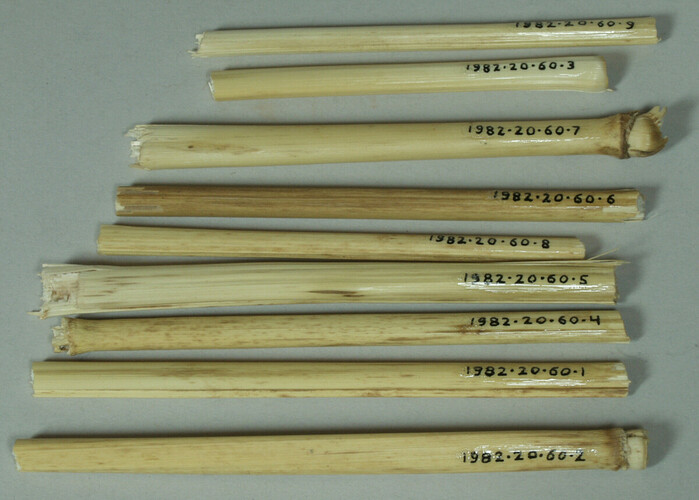 1982.20.60.1Cane for making neck of pots & boring holes1982.20.60.1
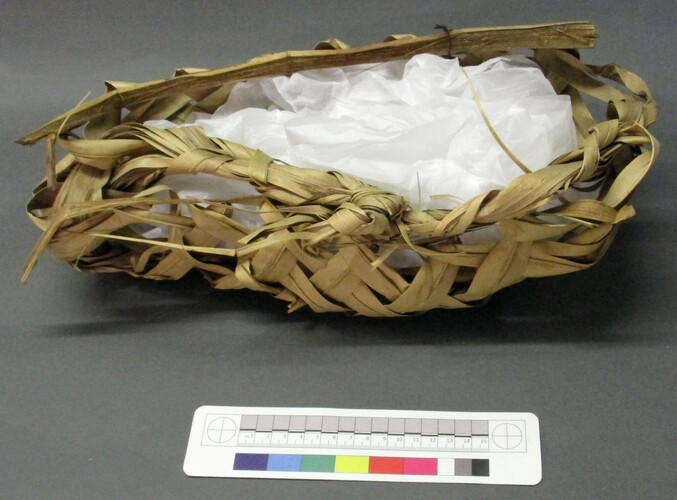 1914.56.7.7Basket for holding potter's tools made from loosely woven palm spathes and with a carrying handle made from palm spathes plaited and knotted. [JP 24/7/2003]1914.56.7.7
 1931.6.4.1Wooden cylinder roulette with oblique hatching, used for decorating pottery [.1][RTS 2/6/2004]. With modern impression [.2] [El.B 'DCF 2004-2006 What's Upstairs?' 22/11/2004]1931.6.4.1
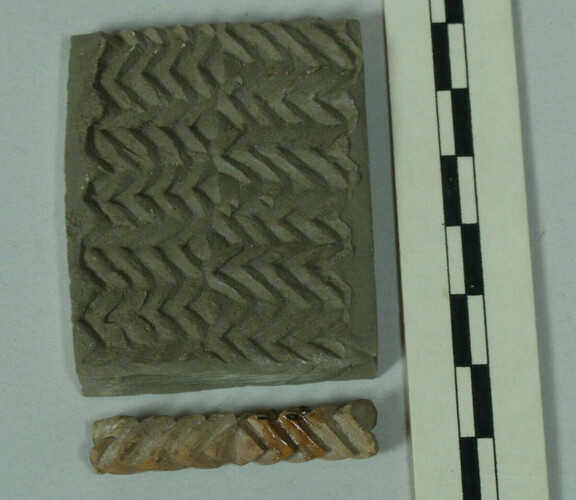 1958.10.6.1.11Carved wooden cylindrical tool for making impressions on pottery. Please see 1958.10.6 .2 .11 for impression of design.1958.10.6.1.11
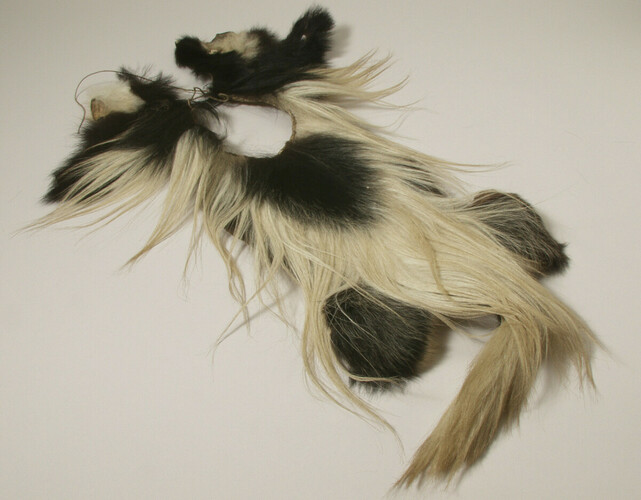 1979.20.178Dance collar made from black and white animal fur (colobus monkey?), with plant fibre ties [RTS 8/6/2004].1979.20.178
 1936.10.45Mussel shell, pointed at one end and serrated at the other, used as a spoon.1936.10.45
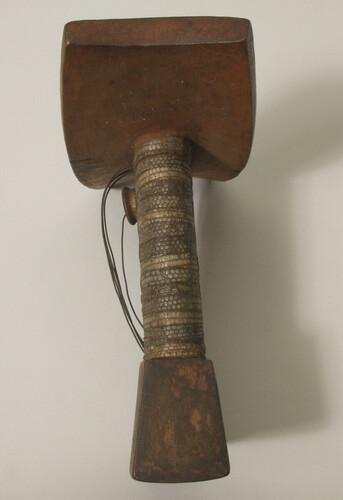 1936.10.94Two footed wooden stool or headrest with rectangular seat, hollow monitor-skin covered pedestal, brass wire carrying handle and recycled cotton reel plug [RTS 12/8/2004].1936.10.94
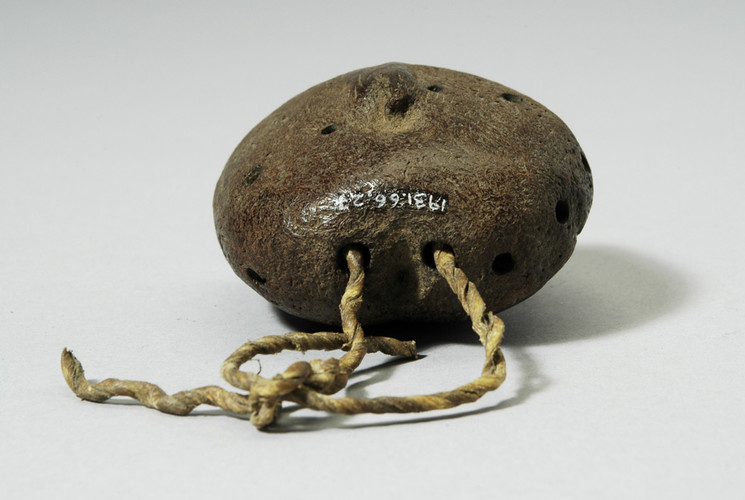 1931.66.27Clapper bell with perforated nut body, stick clapper and hide suspension cord [RTS 5/9/2005].1931.66.27