
- Collection type
- Object
- Description
- Carved wooden figure of a standing woman, wearing a bead necklace and white metal earrings.
- Long description
- Anthropomorphic figure carved from a single piece of wood in the form of a standing woman, facing forward with her arms held slightly flexed by her sides with hands in front of the thighs, legs positioned slightly apart and feet flat on the ground, facing forwards. Most of the body is a warm, orangey brown colour (Pantone 730C), with areas burnt black to show details of the hair, face, torso, hands and legs (Pantone black 7C). The figure has a rounded head, with incised arcs over the brow marking the lower edge of the hair, which curves above the ears and around the back to end well above the nape of the neck. This area has been burnt black, but has no further detailing. Additional details have been marked on the face using pyroengraved pokerwork. This includes two curving eyebrows burnt into the surface, above sunken oval eyes defined by an incised groove around their edges, and narrow slots running horizontally across the middle; the latter have been burnt in using a flat bladed tool, and are quite deep. Below these there is a long, triangular nose with two nostrils burnt into its base, and a pouting mouth with a short straight line burnt across the surface. cicatrization marks have been added as groups of three vertical lines on each cheek, and three oblique lines running down either side of the face. The ears stand out prominently from the sides of the head, each with two notches cut into their inner edge, a deep blackened interior hollow, and a small hole burnt through their lower lobe. These have been fitted with two small white metal earrings, probably made from either aluminium or tin (Pantone Cool Gray 1C). These take the form of simple loops with touching ends. Seams are visible, suggesting that they were made from folded sheet metal. The poker used to make the holes has left an elongated scorched groove in the wood below each ear. The figure has a short, cylindrical neck, around which has been hung a short necklet. This has been made from twisted cotton yarn, tied in a knot at the back. It has been strung with 6 opaque cobalt blue cylindrical beads (Pantone 2748C); the string then divides into ten strands, each of which carries a series of translucent amber cylindrical beads (Pantone 465C); the separate strands are then tied together, before splitting into 7 strands with similar beads in place on the other side; these then rejoin to form a single cord, threaded with 2 opaque yellow (Pantone 106C), 2 cobalt blue, then 3 yellow cylinder beads. All the beads are made from glass. The torso of the figure is only slightly modelled, with two nipples and a navel standing out from the surface and blackened around their bases. The shoulders and arms are modelled in the round, swelling out slightly at the elbows, then in again to the wrist; the hands are flattened on their outer face. Fingers are marked by elongated v-shaped notches cut into the upper surface of the hand; these give the figure's right hand five digits, and her left hand only four; each groove has been blackened. There is a single narrow cut burnt into the base of the torso to indicate pudenda, and another wider cut burnt part way up the buttocks on the back of the figure. The legs are short and plump, with broad hips; they taper in towards the feet, which having sloping tops and flat cut undersides. These have been burnt black all over. The figure is complete, but there is a split in the wood that runs from the back of the head to the shoulders. The surface appears to be covered with tiny flecks of what may be mica; there is also some kind of waxy surface coating preserved in patches around the lower legs and feet. It is not known if this is original. Tool marks are visible across areas of the surface, particular under the arms and between the legs; these areas also have some unintentional scorch marks from the pyroengraving tool used to colour the wood. It has a weight of 616.8 grams, is 316 mm high, and measures 78.8 mm across the width of the head, 110.4 mm across the shoulders and 85 mm across the hips; the maximum thickness of the head is 73 mm. The earrings have diameters of 12 mm, and are 2.2 mm wide and 2.5 mm thick. The larger blue and yellow beads have a typical length of 3 mm and diameter of 3 mm; the smaller amber beads are 2 mm long and 1.6 mm in diameter [RTS 17/9/2004].
- Geographical reference
- Cultural groups
- Acholi
- Person
- Maker Ajala
- Field collector Armine Charles Almroth Wright
- PRM source Armine Charles Almroth Wright
- Date / Period
- Date made: Before 1939
- Date collected
- By 1939
- Acquisition information
- Donated: 07/1939
- Materials and processes
- Material Wood Plant, Material Glass, Material Cotton Seed Fibre Yarn Plant, Material Aluminium Metal, Material Tin Metal, Process Carved, Process Perforated, Process Burnt, Process Pyroengraved Pokerwork, Process Hammered, Process Bent, Process Strung
- Dimensions
- Width 85 mm hips, Width 78.8 mm head, Width 110.4 mm shoulders, Height: max 316 mm, Height 73 mm head, Weight 616.8 g
- Object numbers
- Accession number: 1939.7.122
- Research and responses
Gulu is located in the Gulu District in the northern part of Uganda.
This figure has been carved in a similar style to 1939.7.123, and was made by the same craftsman. They wear similar earrings, and have almost identical bodies, except for the genitalia; there are differences in the cicatrization marks and the types of necklace they wear [RTS 17/9/2004].
Search terms: Figure, Bead, Ornament, Trade, Ear Ornament
Further items to explore
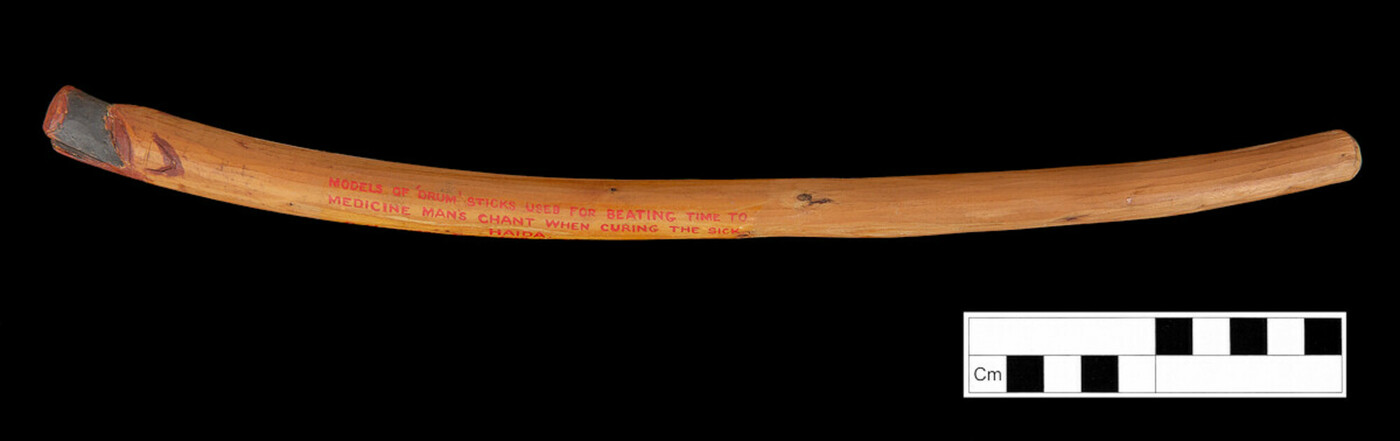 1891.49.30Model wooden stick carved and painted with animal figure at one end. [CAK 19/05/2009]1891.49.30
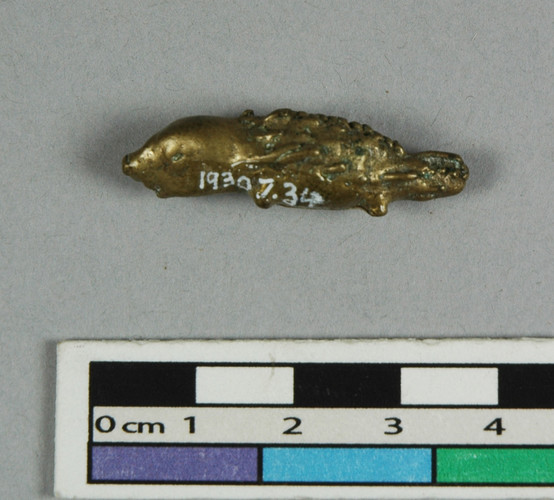 1930.7.34Copper alloy weight for weighing gold in the form of a porcupine. [MJD DDF Body Arts Project 2010/2011 04/01/2011]1930.7.34
 1985.53.706Small porcelain figure of beckoning cat, painted with black spots, red nose and ears, blue and pink collar and gold claws. [El.B 20/11/2013]1985.53.706
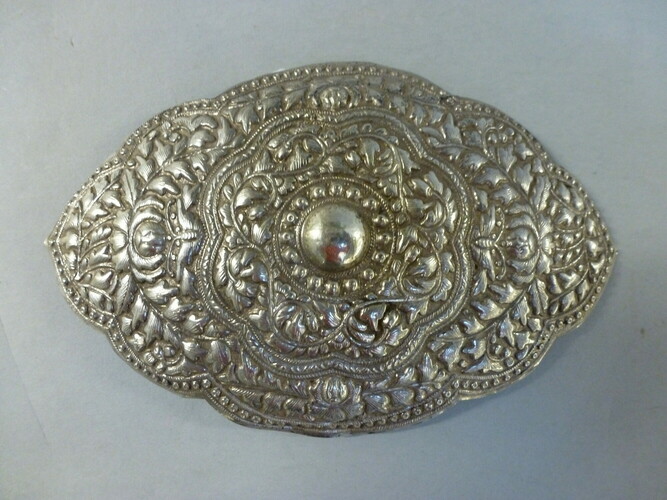 1957.12.020Silver buckle1957.12.020
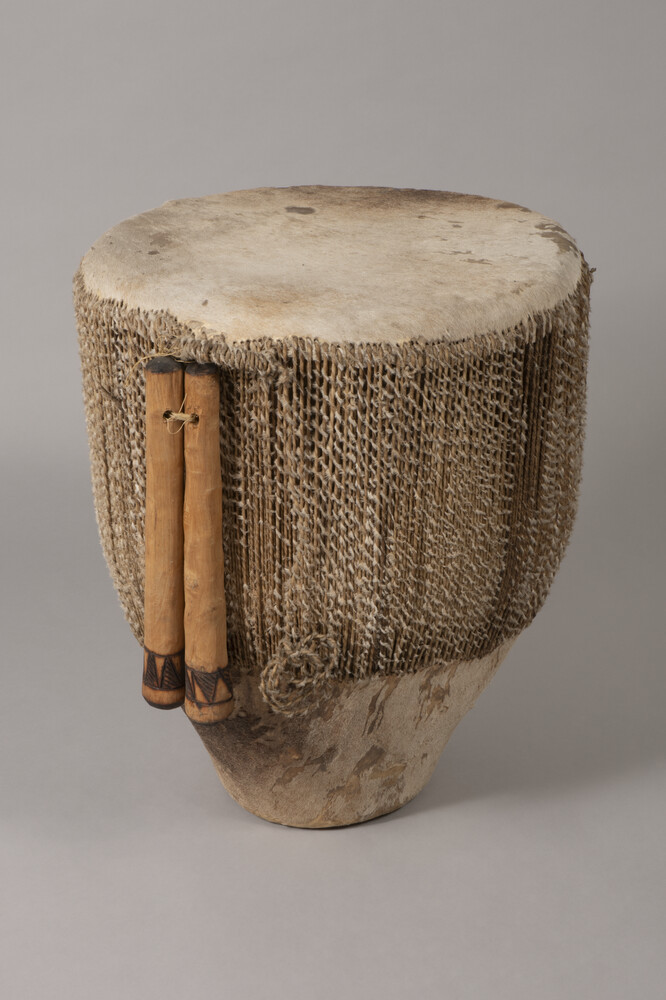 1921.9.102.1Royal drum used in Empango ceremonies. The drum [.1] is made of wood with a membrane of hide and hide strip thongs stretching to the base. Two beaters of wood [.2-.3] are attached to the drum.1921.9.102.1
 2017.255.1.2Arrow with wooden shaft and iron head. For associated quiver and arrows see [2017.255.1 .1 - .16]. [EH [OPS move] 30/10/2017]2017.255.1.2
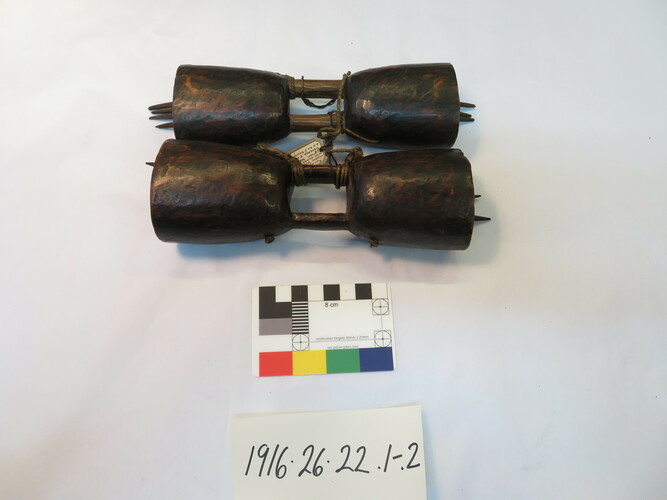 1916.26.22.1Clapper bell. Associated with sibling object .2 [PB 31/1/2020]1916.26.22.1
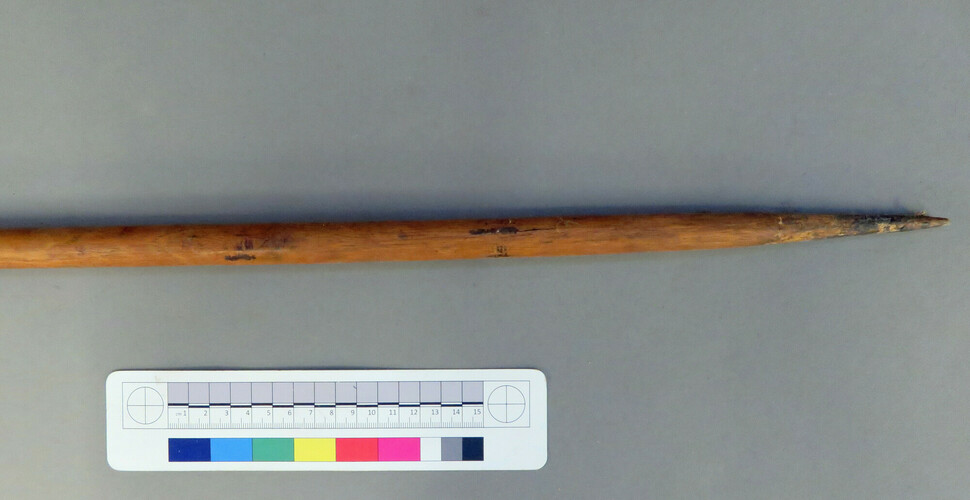 1992.19.49.1Wooden shaft of a spear carved to a point at both ends. For the blade see 1992.19.49 .3 and the butt 1992.19.49 .2 [PH [OPS move] 29/6/2018]1992.19.49.1