
- Collection type
- Object
- Description
- Painted and hair-fringed shield, with a face design painted in the centre. [BH [OPS move] 5/8/2016]
- Long description
- Painted and hair-fringed shield, with a face design painted in the centre. 6 cane bands running across the width of the shield, 3 at each side. On the reverse there are spiral designs painted in a black and red pigment. [BH [OPS move] 5/8/2016]
- Cultural groups
- Kenyah
- Date / Period
- Date made: Before 1912
- Date collected
- By 1912
- Acquisition information
- Donated: 1934
- Materials and processes
- Material Pigment, Material Hair, Material Wood Plant, Material Cane Plant, Process Painted
- Dimensions
- Width: max 469 mm, Length: max 1370 mm, Depth: max 103 mm
- Object numbers
- Accession number: 1934.25.9
- Research and responses
Most inland groups of northern Borneo made shields of this shape, which are highly refined in form to defend against both swords and spears. Each shield, including its wooden handle, is carved from a single piece of wood. The wedge shape of the shield is designed to deflect spear-thrusts, although the typical weapon of the people of Borneo was the parang or mandau. These shields were designed so that – due to their longitudinal coarse grain, and transverse rattan cane straps – the parang became embedded in the body of the shield, which the straps held fast, and prevented from splitting. This meant that the shield-bearer could pull the sword out of his opponent’s hand, and then attack safely. This shows us that shields were not simply weapons to deflect attacks, but could also become offensive weapons. Kenyah shields are among the most elaborately painted of all Sarawak shields, and are conventionally painted in three colours – white, red and black. The designs are sketched out first with the point of a knife, and then painted in with a fingertip or the chisel-trimmed point of a stick. The usual theme painted on the outside of Kenyah shields is a central tusked humanoid face, with a small and somewhat simian body beneath. These motifs have been interpreted in 2 main ways: Firstly, as a demon derived from the Javanese hindu raksasas. Secondly, as an Orang Utan. Indigenous to the parts of Borneo where the Kenyah live, orang utan were traditionally greatly feared by the Kenyah, who would never look them in the face, or laugh at them (even in their absence). In fact, it seems quite likely that the Kenyah shields represent a mixture of both of these fearful creatures – designed to confuse and terrify the enemy as he saw them. Inside the shield, usually a pair of painted friendly human figures faced the warrior as he held it, which were intended to remind him of the wife, family and deceased relatives who would benefit from his victory. Such shields were often mounted with fringes of human hair, taken from head-hunting victims. This was done partly to enhance the image of a demonic face, and partly to advertise the head-hunting skills of the shield’s owner. Several inland peoples of Borneo practiced head-hunting until the late 19th century, for a number of reasons. These motives were typically seeking revenge upon enemy groups for previous head-hunting raids, thefts and insults, as well as magically increasing agricultural fertility, and providing the necessary fresh heads for performing the rituals to lift mourning taboos. In 1901, Aban Avit, an ageing chief of the Sibop people was recorded as saying: “It is an ancient custom. A good, beneficent custom, bequeathed to us by our fathers, and our father’s fathers; it brings us blessings, plentiful harvests, and keeps off sickness and pains. Those who were once our enemies hereby become our guardians, our friends! Our benefactors”. The heads were dried and treated with great care, respect and affection, and each was known personally by name. Relevant Reading: Hose, C. & McDougall, W. (1912) The Pagan Tribes of Borneo. London: Macmillan & Co. Hose, C. (1926) Natural Man: A Record from Borneo. London: Macmillan & Co. Haddon, A.C. (1932) Head-Hunters. London: C.A. Watts & Co., Ltd. Morrison, H. (1957) Sarawak. London: MacGibbon & Kee. Roth, H.L. (1968) The Natives of Sarawak & British North Borneo, Vol.II. Kuala Lumpur: University of Malaya Press. Research Conducted for DCF Cutting Edge 2006/2007 [AM].
Further items to explore
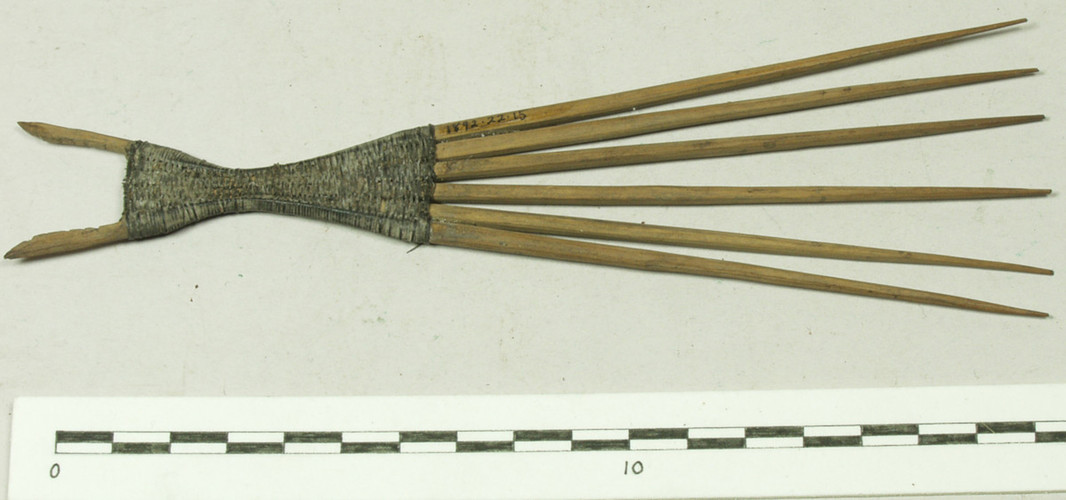 1892.22.15Comb of 6 bamboo teeth bound together with fibre to a horn-like carved top. [E.S-R 'DCF 2004-2006 What's Upstairs?' 9/12/2004]1892.22.15
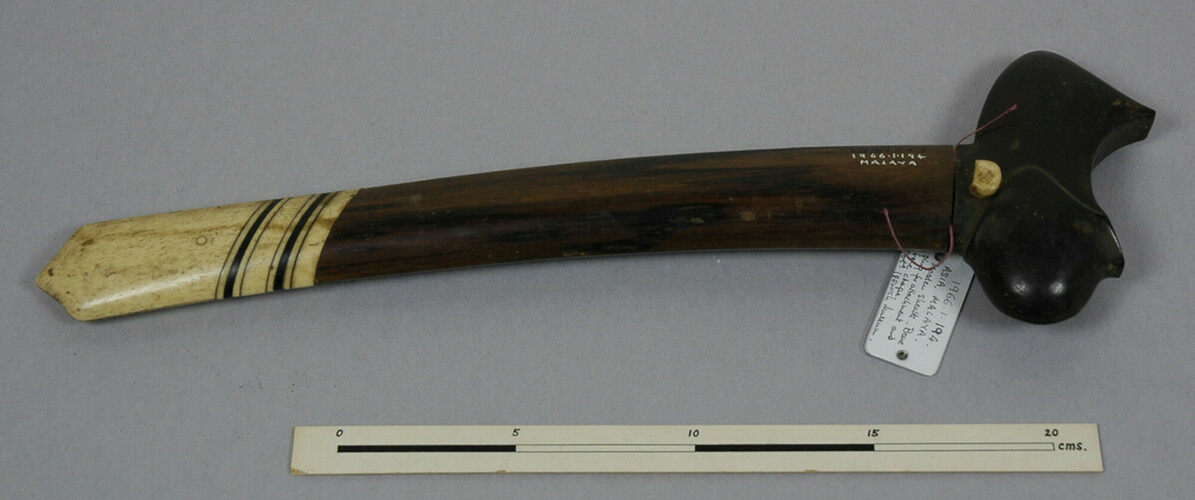 1966.1.194Wooden sheath with bone chape and a small bone plug near the top. [El.B 19/3/2007]1966.1.194
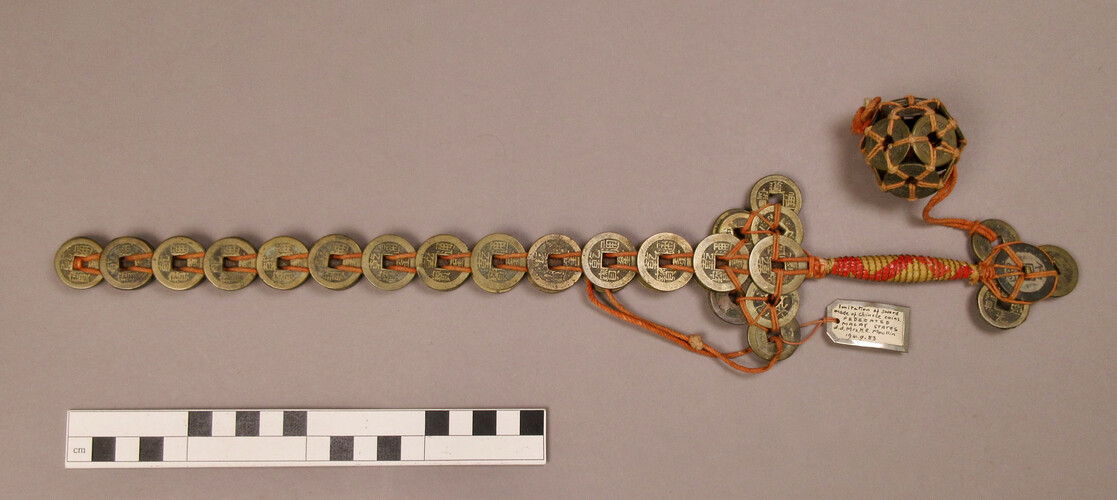 1941.9.83Reproduction of a sword made of Chinese coins and string, used as an amulet.1941.9.83
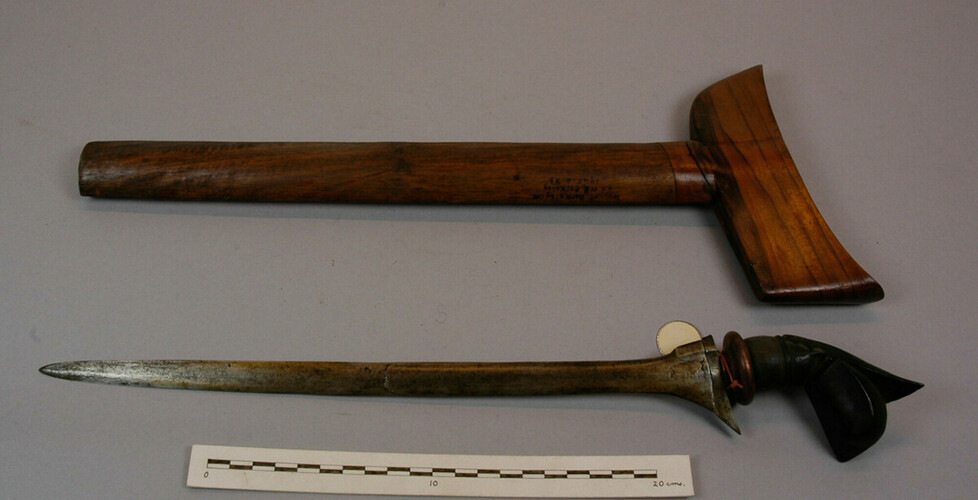 1945.6.23.1Keris [.1] with straight blade, wooden hilt and wooden sheath [.2]. [El.B 12/12/2007]1945.6.23.1