
- Collection type
- Object
- Description
- Oval piece of gourd with smoothed edges, used as potter's tool for smoothing [RTS 18/10/2004].
- Long description
- Piece of cut gourd, used as a potter's tool. This consists of an oval body with slightly irregular convex upper surface and concave underside, the edges of which have been ground smooth, possibly through use. The original reddish colour of the gourd surface is visible only in patches (Pantone 499C), as both faces are heavily smeared with a pale buff coloured mica rich clay (Pantone 7401C); this is similar in appearance to clay sample 1934.8.132.2 and to the clay residues on the other tools in this group. The sherd is complete and intact, but has a glossy patch at the centre of the upper face where it had originally been stuck to a display mount. It has a weight of 2.6 grams, is 58.2 mm long, 45.3 mm wide, and 3.6 mm thick [RTS 18/10/2004].
- Cultural groups
- Zande
- Person
- Maker Mbitim
- Field collector Percy Horace Gordon Powell-Cotton
- Field collector Hannah Powell-Cotton
- PRM source Percy Horace Gordon Powell-Cotton
- Date / Period
- Date made: Before 1933
- Date collected
- 28th April 1933
- Acquisition information
- Donated: 1934
- Materials and processes
- Material Gourd Plant, Material Clay
- Dimensions
- Width: max 45.3 mm, Length: max 58.2 mm, Depth: max 3.6 mm, Weight 2.6 g
- Object numbers
- Accession number: 1934.8.132.6 Other numbers: 978
- Research and responses
For a brief discussion of the works in the PRM’s collection associated with the Zande potter Mbitim (1930.86.42, 1930.86.43, 1930.86.44, 1931.66.2, 1931.66.3, 1934.8.132.7, 1934.8.132.8, 1934.8.133, 1934.8.134 [illustrated], 1934.8.135 [illustrated], 1950.12.117, 1950.12.118, 1996.53.1), as well as the tools associated with him (1934.8.132.1, 1934.8.132.2, 1934.8.132.3 [illustrated], 1934.8.132.4 [illustrated], 1934.8.132.5 [illustrated], 1934.8.132.6 [illustrated], 1934.8.132.7 [illustrated], 1934.8.132.8), see ‘An Artist of Exceptional Skill: The Zande Potter Mbitim’, by Rachael Sparks, in The Friends of the Pitt Rivers Museum, Oxford, Newsletter, no. 55 (March 2006), p. 10.
For further information about Mbitim and discussion of his work in museum collections (including the PRM), see ‘The Potter of Li Rangu’, by Inbal Livne, in Pieces of a Nation: South Sudanese Heritage and Museum Collections, edited by Zoe Cormack and Cherry Leonardi (Leiden: Sidestone Press, 2021), pp. 135–141, 202–203.
The coordinates that Powell-Cotton gives for Lirango suggests that this is the same as the modern town of Li Rangu, which lies immediately north of Yambio.
This object had been part of the tool kit of Mbitim, chief potter of Li Rangu, and was obtained by Percy Horace Gordon Powell-Cotton and his wife Hannah at Li Rangu on 28th April 1933 during a shooting expedition to the region. At the time they visited, Li Rangu was a centre of foreign contact for the district (N. Barley, 1994, Smashing Pots, p. 144), something that is illustrated by the type of product Mbitim was producing. Powell-Cotton filmed Mbitim at work; a commentary on that film describes him as follows: "'Mbitim', was an artist of exceptional skill and originality. His pots, jars and dishes were of varied and beautiful form, many decorated with Zande heads and figures, each one distinct, true to type and with its own definite personality. He worked swiftly with his fingers, and a split wood spatula; the only other tools were an achatina shell for the nostrils, and a fragment of gourd. The clay was very light in colour. This man's services are now pledged to the Sleeping Sickness Station at Lirangu, where he is encouraged to make book-ends and other objects of European design, but his work still remains individual" (Mrs Powell Cotton, "Village Handicrafts in the Sudan", Man 34 (112), pp 90-91). They collected several potter's tools and samples of unfired clay from Mbitim, now in the museum collection (see 1934.8.132.1-.5, .7-.8), as well as a selection of his products. For vessels in the Pitt Rivers Museum that may have been produced by Mbitim, see book-ends 1934.8.135 and 1996.53.1, anthropomorphic jars 1934.8.134, 1950.12.117-118 and bowls 1930.86.43-44, and 1931.66.2-3. Other examples of Mbitim's work may be found in the Cleveland Museum of Art (1996.301-302) and the British Museum (1934.3-8.27 and 1931.3-21.48).
Zande pottery is frequently mixed with small flecks of mica, as seen in the traces on the edge of this tool; this which naturally occurs in beds throughout the region, known as hilidiwe, meaning 'slough of the moon' (P.M. Larken, 1926, "An Account of the Zande", Sudan Notes and Records IX no. 1, p. 4). Schweinfurth noted the presence of mica in both Bongo and Zande pottery, which he suggested made their wares very brittle. He believed this mix to be naturally occurring and that potters did not know how to remove it from their fabrics: "... [Zande potters] have no idea of the method of giving their clay a proper consistency by washing out the particles of mica and by adding a small quantity of sand" (G. Schweinfurth, 1873, In the Heart of Africa Volume I, p. 292; Volume II, p. 25). This mica may well have been left in the clay deliberately, as it gives the vessels an attractive sparkle, and does not seem to have impaired the plasticity of the material, as the detailed modelling of Mbitim demonstrates.
Larken discusses Zande customs regarding the collection and working of clay. Clay is usually found on the banks of a stream, and prepared by pounding it in a mortar before shaping it by hand. Tools are limited to pieces of gourd or a rounded pebble for smoothing; decoration is applied by something simple, such as a short stick bound with cord. He describes two kinds of vessels that are made, one with a low collar around the mouth, and another with a bow-shaped neck (see 1931.66.2-3). The smaller pots are said to be used for cooking meat, the larger ones for water or making bakinde; other pots are for brewing beer, while long-necked varieties are used for washing the face and hands - this last type may have a head adorning the neck. Each type has its own Zande name. Decoration often covers the whole surface. Larken goes on to describe the firing and finishing: "When dry, pots are turned upside down and baked in the open, only certain kinds of wood being suitable for the fire. While still red-hot, they are splashed with water in which bark of the ndili tree has been soaked, in order to blacken them. A black polish is sometimes given to the smooth surfaces, by means of graphite grains, which are mixed with water and a little powdered ironstone, painted on the clay and gently but continually rubbed into it with a polishing-pebble before the pot is fired". The resulting vessel is not very strong, and only slightly porous, if at all; broad leaves may be used for a lid, if required (P.M. Larken, 1927, "Impressions of the Azande", Sudan Notes and Records X, pp 129-131). According to Evans-Pritchard, all Zande potters were male (Evans-Pritchard 1971, The Azande, p. 95) [RTS 24/8/2005].
- Associated publications
- Pieces of a Nation: South Sudanese Heritage and Museum Collections, Editor: Zoe Cormack; Editor: Cherry Leonardi, 2021
- Note that Powell-Cotton number 1042 refers to 1934.8.132.8 only; all other objects in this group are listed in the original typed list as number 978 [RTS 18/10/2004].
Search terms: Tool, Pottery, Technique, Potter's Tool, Scraper
Further items to explore
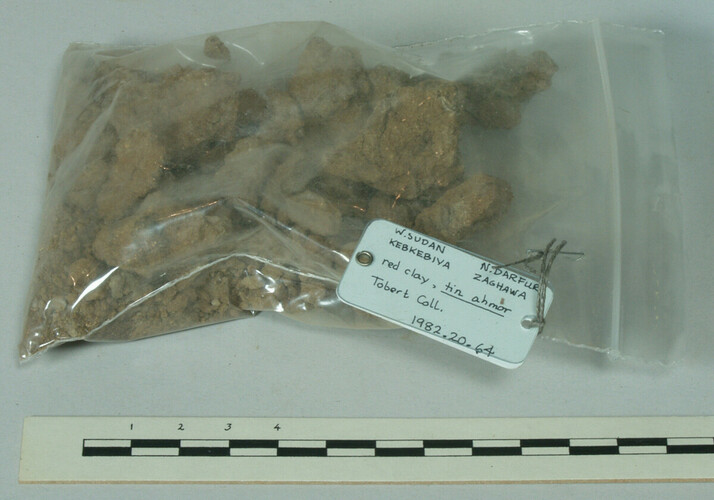 1982.20.64Clay (red) for pottery.1982.20.64
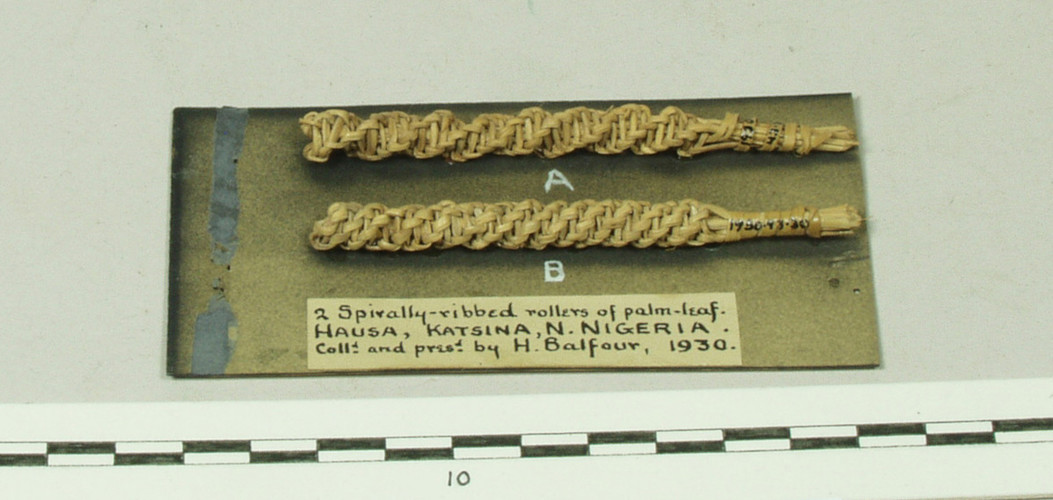 1930.43.29Roller of spirally plaited palm-leaf for impressing designs on pottery, mounted on card with 1930.43.30. [ZM 13/03/2008]1930.43.29
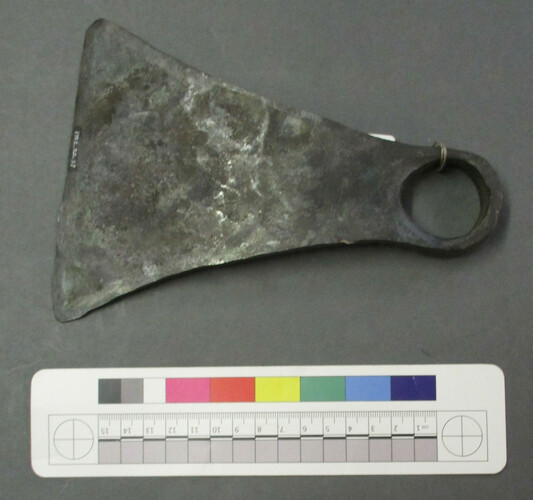 1982.20.37Adze blade of iron. [MJD 14/08/2014]1982.20.37
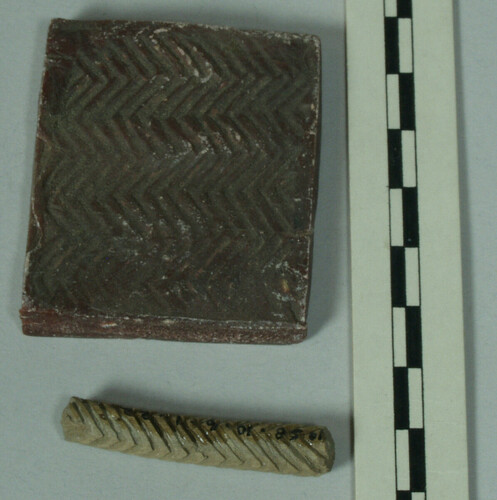 1958.10.6.1.22Carved wooden cylindrical tool for making impressions on pottery. Please see 1958.10.6 .2 .22 for impression of design.1958.10.6.1.22
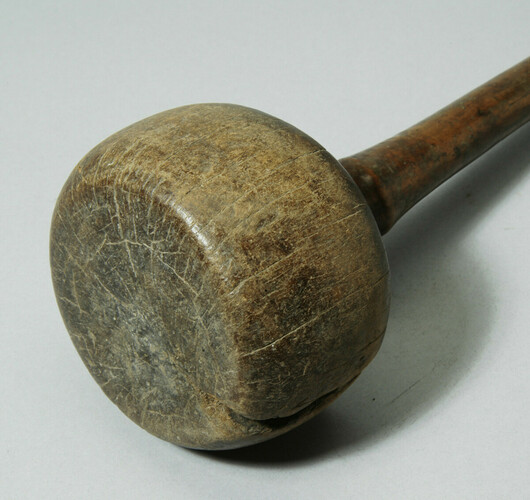 1979.20.131Wooden club or mallet, carved in a single piece with a large cylindrical head [SM 14/05/2007].1979.20.131
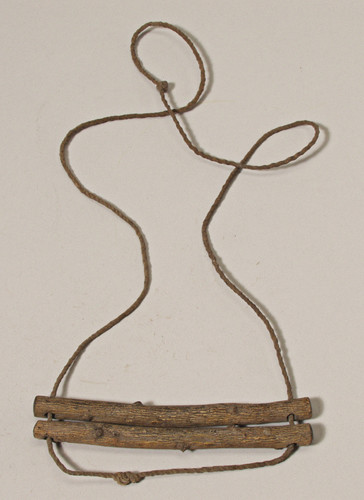 1903.16.124Necklet made of two wooden bars strung on a cord [RTS 21/5/2004].1903.16.124
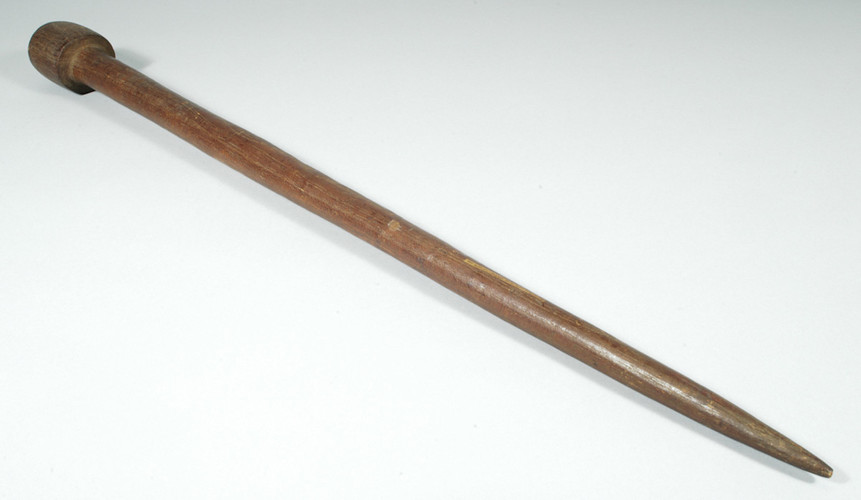 1884.12.19Club carved from a single piece of wood with short cylindrical head and narrow handle tapering to a pointed butt [RTS 9/5/2005].1884.12.19
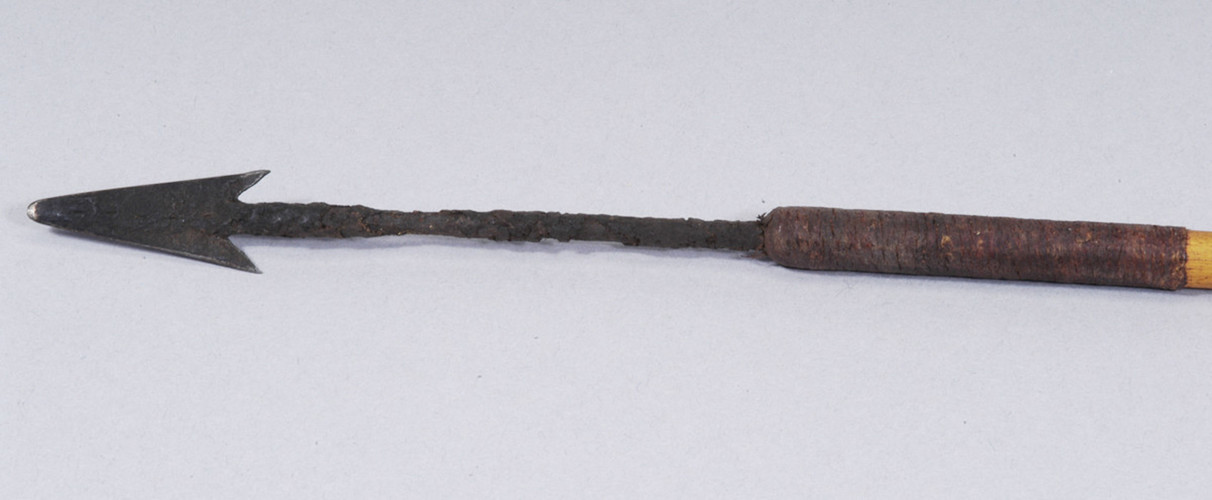 1934.8.116Poisoned arrow with triangular iron head, long circular sectioned tang and cane shaft with bound and nocked end [RTS 6/6/2005].1934.8.116