
- Collection type
- Object
- Description
- Black cow tail tassel mounted on bead string, worn on left upper arm for good luck [RTS 19/5/2004].
- Long description
- Upper arm ornament consisting of a series of 91 opaque glass beads strung onto a twisted plant fibre cord, in the following order: 3 blue (Pantone 2975C), 2 white, 2 blue, 70 white, 1 yellow (Pantone 128C), 2 white, 1 blue, 5 white and 5 blue beads. The end of the string has been doubled over, forming a circle to fit around the upper arm, and then fastened to the body with a short fibre cord loop. This fastening loop is loose, and can be moved up and down the body to widen or constrict the arm loop as required. At present, this encompasses a small diameter of 65 mm. The beads are spherical, with a broad flat section running around their circumference that is probably a mould line. The other end of the bead string has been passed through a hole at the top of a tassel and knotted at the other side to secure it. The tassel is made from a cow's tail with dark brown to black cow hair (Pantone black 4C). The object is complete, although some hair may have been lost near the top of the tassel; most beads are encrusted with dirt. The tassel is 280 mm long, and measures 14.6 by 7.8 across the top, where the bead string is attached. The bead string has a current length of 390 mm (with the arm loop), and the cord has a diameter of 1 mm. The beads themselves are very similar in size, a typical one having a diameter of 5.5 mm and a length of 5 mm; the moulded band around the sides is 1.5 mm in width. In its entirety, the object weighs 48.5 grams [RTS 8/6/2004].
- Person
- Field collector Percy Horace Gordon Powell-Cotton
- Field collector Hannah Powell-Cotton
- PRM source Percy Horace Gordon Powell-Cotton
- Date / Period
- Date made: Before 1933
- Date collected
- 6th April 1933
- Acquisition information
- Donated: 1934
- Materials and processes
- Material Animal Tail, Material Cattle Hair Animal, Material Plant Fibre, Material Glass, Process Perforated, Process Twisted, Process Tied, Process Strung, Process Moulded
- Dimensions
- Length 390 mm string, Diameter 65 mm loop, Length 280 mm tassel, Weight 48.5 g
- Object numbers
- Accession number: 1934.8.76 Other numbers: 464
- Research and responses
According to “African ethnonyms: index to art-producing peoples of Africa” by Daniel P. Biebuyck, Susan Kelliher and Linda McRae (G.K. Hall & Co.: New York, 1996), the Latuka should be known as Lotuko [CW 23/3/2000]. Lotuko appears to be an alternative name for the Otuho. Powell-Cotton made ethnographic films during his 1932-3 shooting expedition to southern Sudan; footage included a Lotuko blacksmith and his forge and a female Lotuko potter at work (see the description in Mrs Powell Cotton, "Village Handicrafts in the Sudan", Man 34 (112), pp 90-91).
For similar moulded glass beads, see 1940.7.049 (Labwor, North Uganda) and 1934.8.104 (Jur, Luklun). This type of bead also appears in Arkell's collection of trade bead sample cards (see 1971.15.195, 1971.15.196 and 1971.15.257; the cards were purchased in Omdurman and El Fasher, and the beads shown on them were made in Jablonec nad Nisou in the Czech Republic.
For other uses of these glass beads with broad moulded ribs around the centre amongst the Lotuko, using a similar range of colours, see 1934.8.62 (an apron) and 1934.8.66 (a necklet or arm ornament) [RTS 26/11/2004].
Search terms: Ornament, Bead, Religion, Arm Ornament
Further items to explore
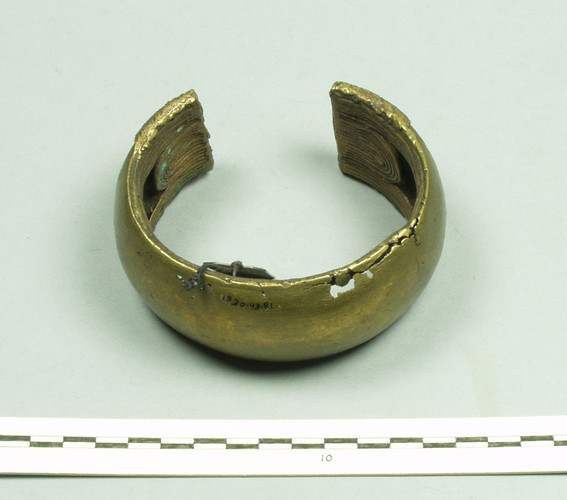 1930.43.81Armlet of cast brass, with designs in the shape of cowrie strings and plaited string. [El.B 'DCF 2004-2006 What's Upstairs?' 4/8/2005]1930.43.81
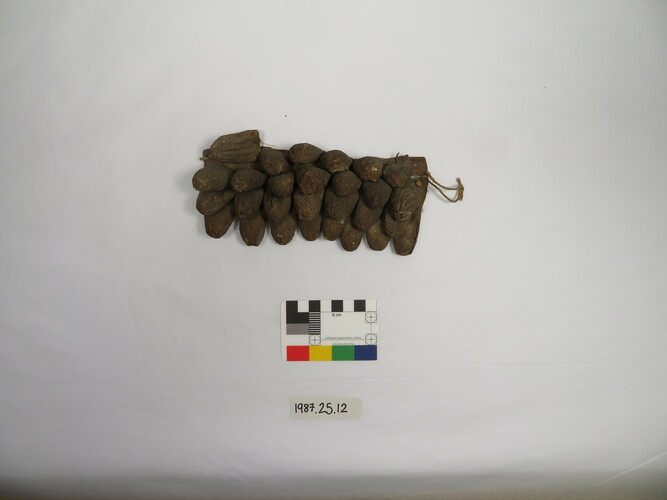 1987.25.12Armlet or anklet made of four rows of moth cases stitched with thongs to a strip of skin. The cases have been filled with seeds etc. to make a jingle.1987.25.12
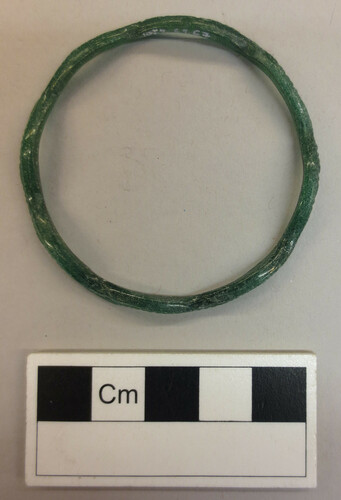 1952.6.9.67Green glass bangle; circular with wavy profile. [EC 'DCF 2004-2006 What's Upstairs?' 7/11/2005]1952.6.9.67
 1923.85.736Arm ornament of brass with ends decorated with a ?stamped or ?incised dotted pattern. [SM 11/05/2007]1923.85.736
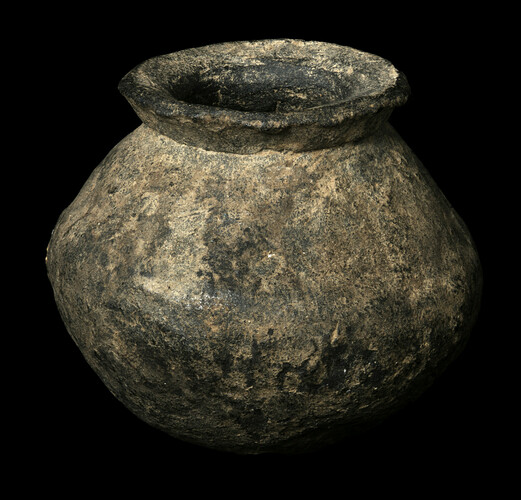 1940.12.615Miniature ceramic jar with everted rim, biconical body and convex base, used to hold rainstones [RTS 24/8/2004].1940.12.615
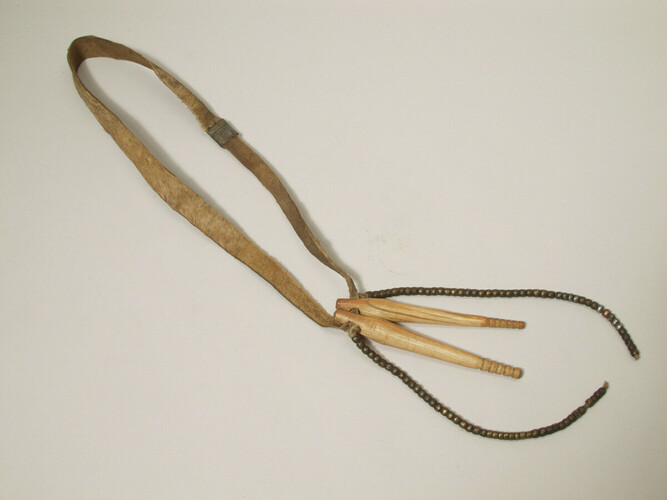 1934.8.75Hide chest band strung with two tapering ivory pendant amulets and flanked by two strings of brass, copper and iron beads [RTS 23/8/2004].1934.8.75
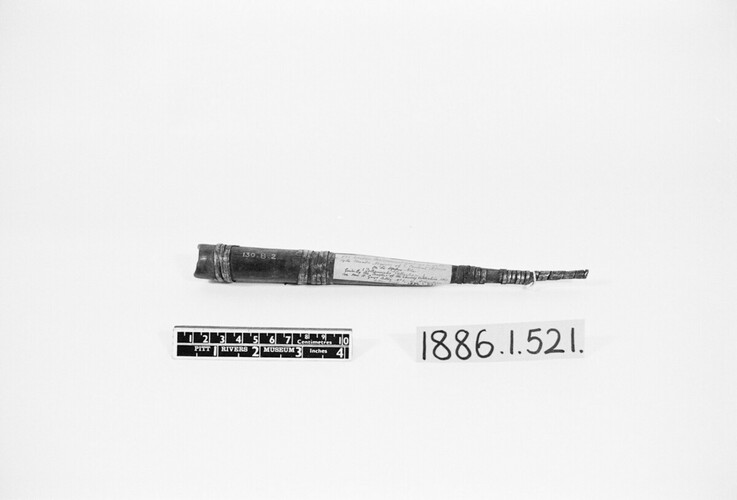 1886.1.521Wooden notched end-blown flute with tapering body and small finger-hole at base, bound in iron strips, used as a call [RTS 8/12/2004]1886.1.521
 1884.140.828Arrow with iron leaf-shaped blade with ogee-shaped section and barbed shank on a cane shaft with bound and nocked end [RTS 6/7/2005].1884.140.828