
- Collection type
- Object
- Description
- Large ivory pendant amulet, pierced near top, with a narrow body tapering to a ridged point at the other end [RTS 13/8/2004].
- Long description
- Pendant carved from a single piece of yellowish brown ivory (Pantone 7509C) and consisting of a slightly convex top on a narrow body with the sides flaring out to a carination point around 30 mm below, then tapering in to a point at the other end with a very narrow flattened tip. The lower part of the body has had 6 parallel grooves cut around the circumference, creating a series of decorative ridges. The rest of the surface is smooth and polished, with some carving marks still visible. The pendant is oval in section throughout, and has been pierced near the top with a large hole that has been bored from both sides, creating an hourglass-shaped perforation. It is complete and intact, with some small cracks running down the body and traces of red ochre in some of the decorative grooves; the surface is slightly discoloured. It has a weight of 69.9 grams, is 150 mm long, 27 mm wide and 24 mm thick at the carination, while the hole has a diameter of 10 mm [RTS 13/8/2004].
- Person
- Field collector Percy Horace Gordon Powell-Cotton
- Field collector Hannah Powell-Cotton
- PRM source Percy Horace Gordon Powell-Cotton
- Date / Period
- Date made: Before 1933
- Date collected
- 17th April 1933
- Acquisition information
- Donated: 1934
- Materials and processes
- Material Animal Ivory Tooth, Process Carved, Process Perforated, Process Polished, Process Decorated
- Dimensions
- Depth 24 mm, Width 27 mm, Length 150 mm, Weight 69.9 g
- Object numbers
- Accession number: 1934.8.74 Other numbers: 676
- Research and responses
According to “African ethnonyms: index to art-producing peoples of Africa” by Daniel P. Biebuyck, Susan Kelliher and Linda McRae (G.K. Hall & Co.: New York, 1996), the Latuka should be known as Lotuko [CW 23/3/2000]. Lotuko appears to be an alternative name for the Otuho, while the modern spelling of Laronyo is Loronyo.
Powell-Cotton made ethnographic films during his 1932-3 shooting expedition to southern Sudan; footage included a Lotuko blacksmith and his forge and a female Lotuko potter at work (see the description in Mrs Powell Cotton, "Village Handicrafts in the Sudan", Man 34 (112), pp 90-91).
For a strung example of this kind of amulet, see 12934.8.75, and for a smaller version see 1934.8.73, also attributed to the Lotuko [RTS 24/8/2004].
Further items to explore
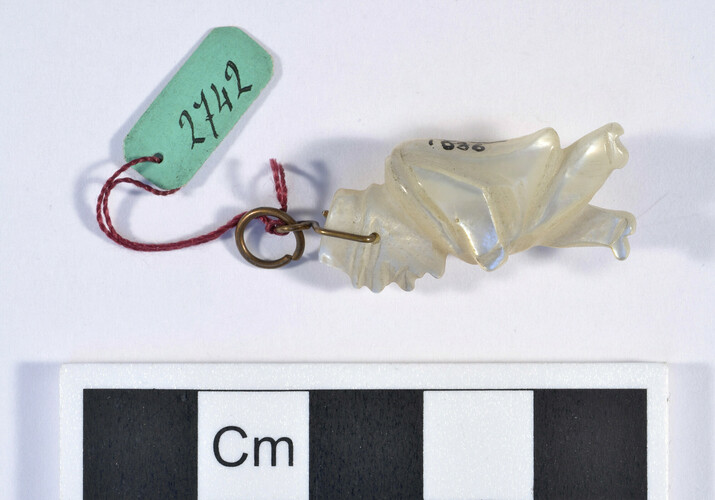 1985.52.1334Amulet, pendant in the shape of a hunchback figure, carved in mother of pearl, with a loop for suspension. [ACA 15/05/2012]1985.52.1334
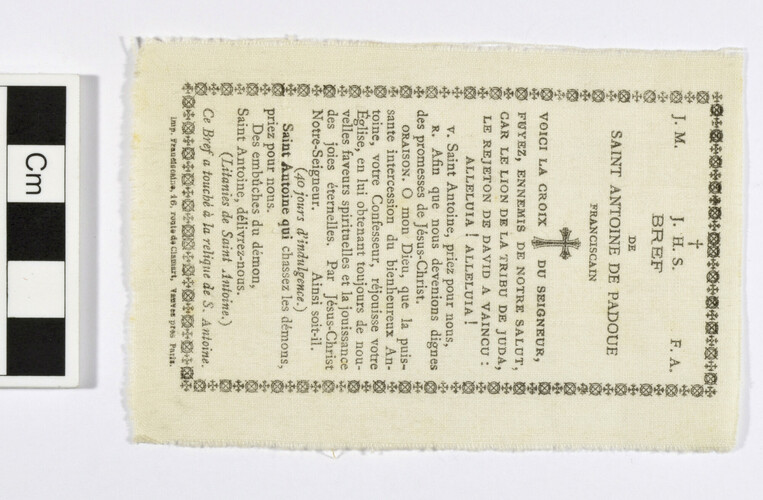 1985.52.2683Amulet, rectangular white textile printed in black ink with the "BREF DE SAINT ANTOINE DE PADOUE" [Brief of Saint Anthony of Padua]. [ACA 21/08/2012]1985.52.2683
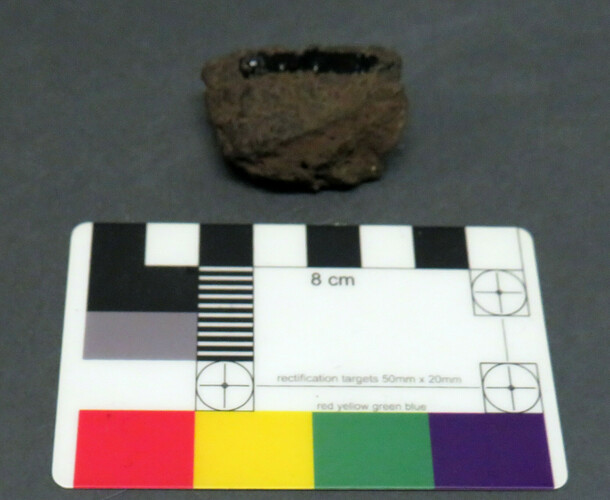 1985.54.1896Medicine; baked mud fragment, dark brown in colour. Used to cure inflammation of the eyes. [ASh [OPS move] 15/09/2017]1985.54.1896
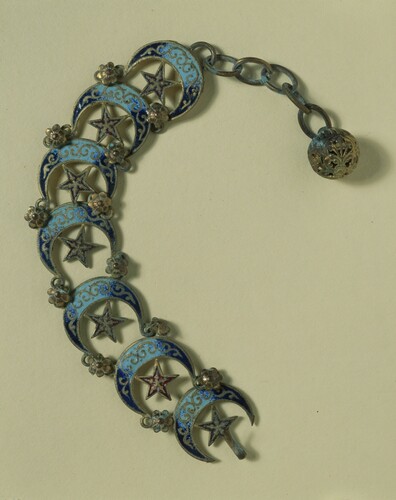 1985.50.972Amulet, bracelet of seven gilt metal links in star and crescent shape, with a hook at one end and a short chain and openwork ball at the other. [El.B 18/12/2013]1985.50.972
 1979.20.197Light yellow wooden spoon with long pierced handle and shallow bowl, tied to 1979.20.195-6 by hide thongs [RTS 21/6/2004].1979.20.197
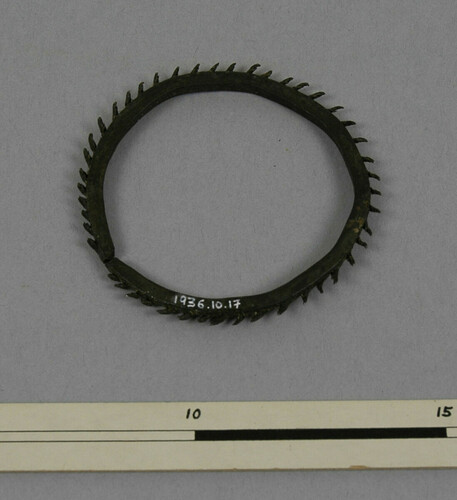 1936.10.17Iron armlet with short spikes around the edge, worn by boys during wrestling fights [RTS 4/3/2004].1936.10.17
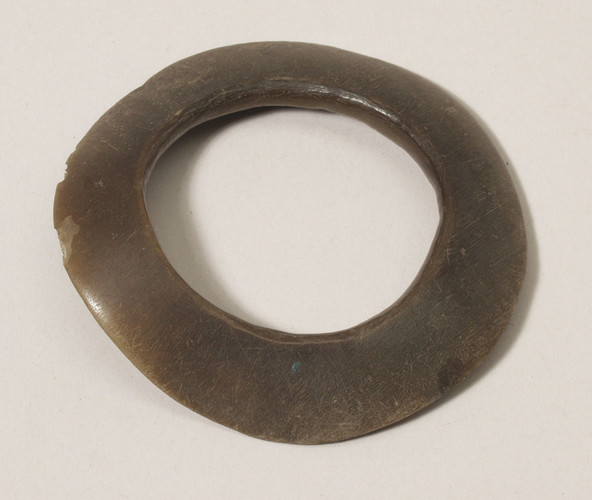 1917.25.84Annular armlet made from elephant hoof [RTS 25/3/2004].1917.25.84
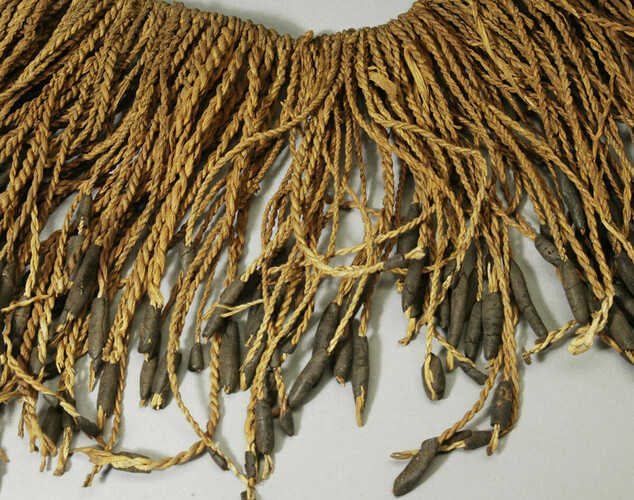 1936.10.64Fringed dance skirt made from twisted fibre cords weighted with barrel-shaped pellets of clay [RTS 16/9/2005].1936.10.64