
- Collection type
- Object
- Description
- Circular wooden spiked wheel trap, belonging with hide noose 1934.8.35.2 and used for catching giraffes [RTS 26/7/2004].
- Long description
- Wheel trap of a type used in conjunction with a noose (see 1934.8.35.2). The object has a circular body made from two wooden pieces, partially covered with their dark brown surface bark, bent into loops of similar diameters to form the framework for the wheel. These pieces appear to be semi circular to almost round in section, and may have overlapping ends. The two loops were placed together and a series of 84 large wooden spikes passed through the gap between the rings, their broader, faceted cut ends left protruding from the outside edge and their sharpened pointed tips meeting at or near the centre of the object, where they overlap one another. This forms the hub of the trap, which would break when trodden on by an animal, to leave its hoof trapped by the surviving spikes and held by the accompanying noose. Each spike varies from irregularly rectangular to ovoid in section, and is a light yellow to reddish colour (Pantone 7508C). The wheel framework was secured by winding flat strips of reddish brown plant fibre - possibly palm or banana - around the two rings. Some strips are split just bove each spike with the two ends passing on either side to secure it to the frame. There is further binding made of twisted string, probably of European origin, knotted in place at several points around the circumference; this is a light yellowish brown colour (Pantone 7508C). This may represent a local repair, as some of the plant fibre bindings are broken. Otherwise the trap is largely complete, although a couple of the spikes have damaged ends and one has broken off below the tip. The wheel has an external diameter of 530 mm; the circular frame has a diameter of 470 mm and its constituent rods are 20 mm wide, while each spike measures from 14 to 23.5 mm across its base and ranges from 230 to 310 mm in length. The fibre binding strips are between 10 and 20 mm in width. The trap weighs a total of around 2400 grams [RTS 26/7/2004].
- Cultural groups
- Moru
- Person
- Field collector Percy Horace Gordon Powell-Cotton
- Field collector Hannah Powell-Cotton
- PRM source Percy Horace Gordon Powell-Cotton
- Date / Period
- Date made: Before 1933
- Date collected
- 12th February 1933
- Acquisition information
- Donated: 1934
- Materials and processes
- Material Wood Plant, Material Plant Fibre, Material Cotton Seed Fibre Yarn Plant, Process Carved, Process Bent, Process Bound, Process Twisted, Process Knotted, Process Repaired (local), Material Banana (Abaca) Fibre Plant, Material Palm Fibre Plant
- Dimensions
- Diameter 470 mm frame, Diameter: max 530 mm, Length: max 310 mm spikes, Weight 2400 g
- Object numbers
- Accession number: 1934.8.35.1 Other numbers: 249
- Research and responses
The accession book entry implies that the object was collected from the town of Mongalla, rather than from the province of that name; this town is located in the modern administrative district of Bahr el Jebel.
Wheel traps of this type are discussed by K.G. Lindblom. They were used by a number of Sudanese groups, including the Nuer, Lango, Acholi, Bari and Baggara, for catching antelopes as well as larger animals such as giraffe and rhinoceros - with the size of the animal determining the size of the trap. This particular example is said to have been used for giraffes. The trap would be placed over a hole, dug into the ground, with a noose laid over the top and secured to either a tree or a wooden block. The trap was then covered with earth to hide it. When an animal trod on the trap, the spikes secured the wheel to the foot and allow the noose to tighten around the leg (K.G. Lindblom, 1928, The Spiked Wheel-trap and its Distribution, Statens Etnografiska Museum, Smärre Meddelanden 5).
The noose used in conjunction with this object is 1934.8.35.2.
For similar wheel traps, see 1922.25.6 (an Acholi trap used for catching giraffes), 1936.10.26 (Anuak, for catching 'Kob, Tiang, Waterbuck etc) and 1936.10.99 (Anuak) [RTS 22/9/2004].
Search terms: Hunting, Trap, Hunting accessory
Further items to explore
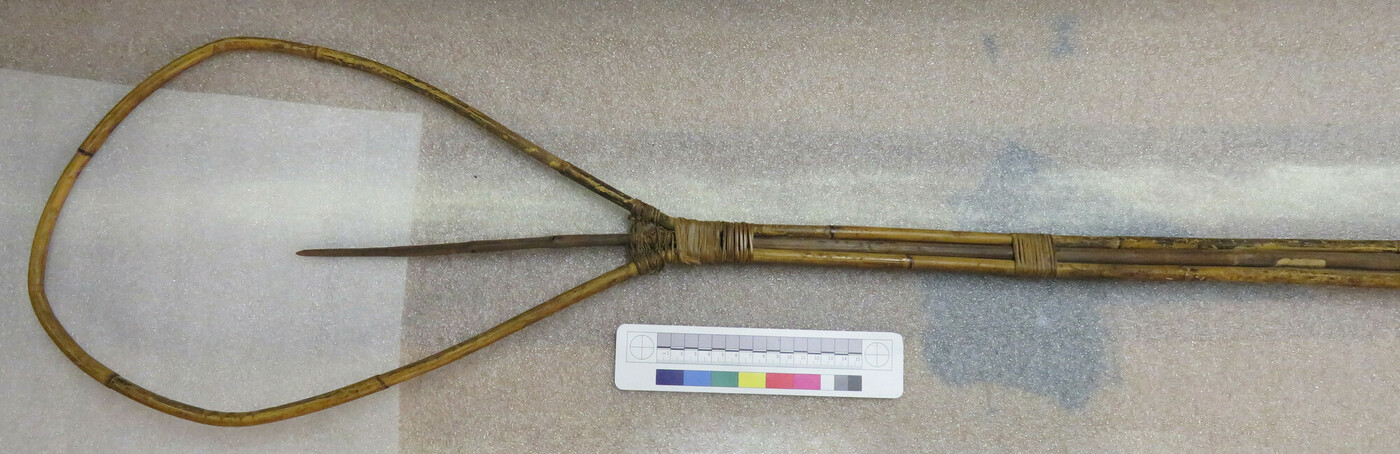 1931.1.27Wooden man catcher. Consists of a main wooden pole which terminates in a spike at both ends, and a cylindrical piece of bamboo which is tied to the wooden pole with plant fibre binding and string, and which curves round one of the spiked ends to form an oval loop. [EH [OPS Move] 18/4/2017]1931.1.27
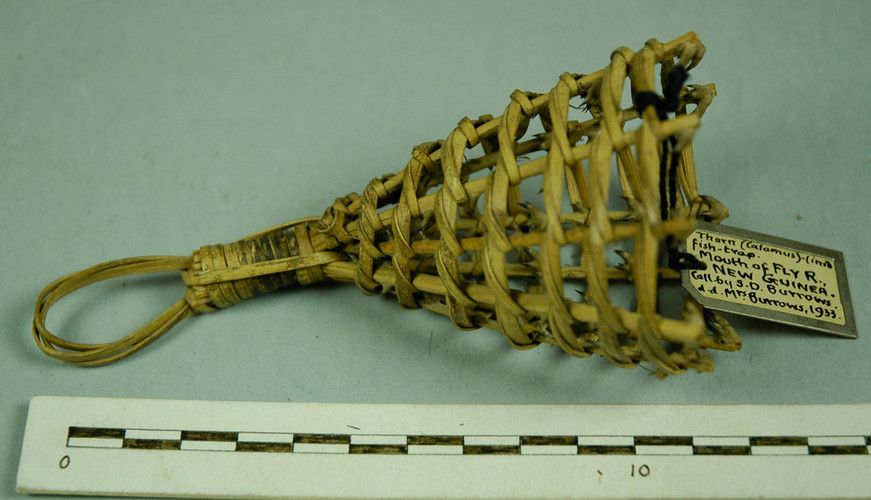 1933.18.23Small twined conical fish trap of thorny Calamus sticks. [MJD 13/11/2009]1933.18.23
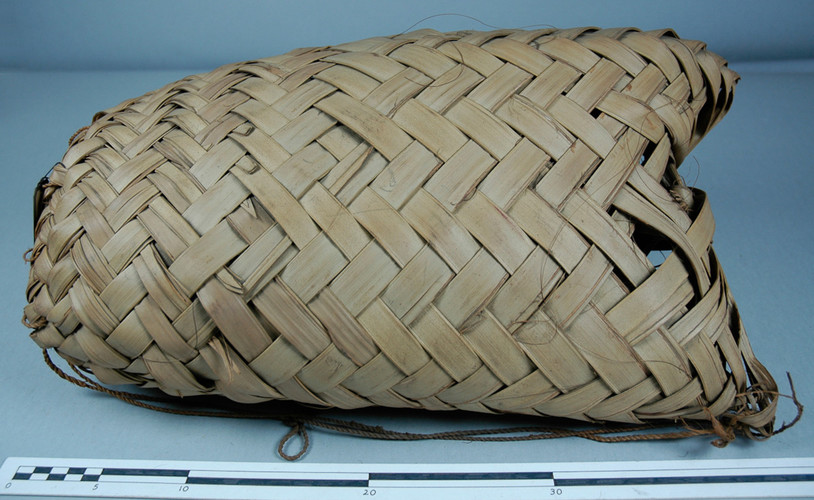 1925.45.8Sub-cylindrical fish trap of plaited palm leaves still attached to their midribs; string loops to pull the entrance tight shut. [MJD 17/11/2009]1925.45.8
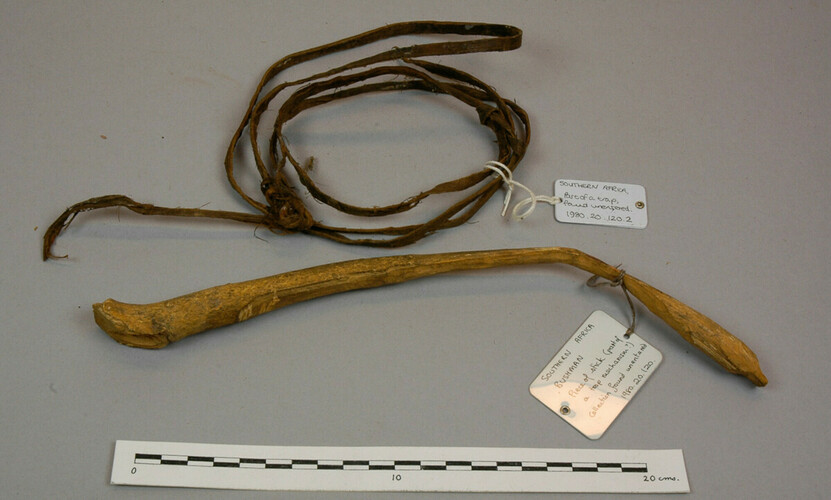 1980.20.120.1Piece of notched wood [.1] and length of partly knotted plant fibre [.2] which form part of a trap or snare for catching birds.1980.20.120.1