
- Collection type
- Object
- Description
- Ivory pendant amulet with crescent-shaped body, pierced through the centre of one side [RTS 24/8/2004].
- Long description
- Amulet carved from a single piece of yellowish cream ivory (Pantone 7506C) and consisting of a crescent-shaped body of uneven width, with one rounded end being broader than the other. The upper surface is slightly convex and the underside concave; the latter also has an uneven surface with a deep groove running alongside the upper edge, partly encrusted with dirt. A hole has been bored into the centre of this long upper edge, so that the pendant could hang with its ends pointing downwards. There is some use wear evident on the upper edge of this hole; a shallow groove next to it may represent further wear, an abortive attempt to make another hole, or traces of an earlier object from which this has been recycled. The pendant is complete, with some minor cracks developing across its surface. The outer face has been more heavily polished than the inner face; there are also traces of tool marks on the edge of the narrower end. It weighs 11.6 grams, and has a length of 92.2 mm, a maximum width of 19.6 mm, and a maximum thickness of 6.5 mm, while the hole measures 2.5 mm in diameter [RTS 24/8/2004].
- Cultural groups
- Dinka
- Person
- Field collector Percy Horace Gordon Powell-Cotton
- Field collector Hannah Powell-Cotton
- PRM source Percy Horace Gordon Powell-Cotton
- Date / Period
- Date made: Before 1933
- Date collected
- 3rd May 1933
- Acquisition information
- Donated: 1934
- Materials and processes
- Material Animal Ivory Tooth, Process Carved, Process Perforated, Process Polished
- Dimensions
- Length 92.2 mm, Width 19.6 mm, Depth 6.5 mm, Weight 11.6 g
- Object numbers
- Accession number: 1934.8.29 Other numbers: 2298A
- Research and responses
According to the Encyclopedia Britannica Online, the White Nile is the section of the Nile between Malakal and Khartoum, Sudan [CW 23/3/2000]. However the way in which this term has been used seems to have changed since this object was collected, and Fanamweir appears to be located in the administrative district of Warab in the Southern Sudan. Powell-Cotton made ethnographic films during his 1932-3 shooting expedition to southern Sudan; footage included a Dinka hunter setting a trap, a staged fight between a Dinka and Jur and a female Dinka potter at work (see the description in Mrs Powell Cotton, "Village Handicrafts in the Sudan", Man 34 (112), pp 90-91) [RTS 12/12/2003].
Further items to explore
 1934.8.132.5Short narrow wooden spatula, pointed at both ends, used as potter's tool [RTS 15/10/2004].1934.8.132.5
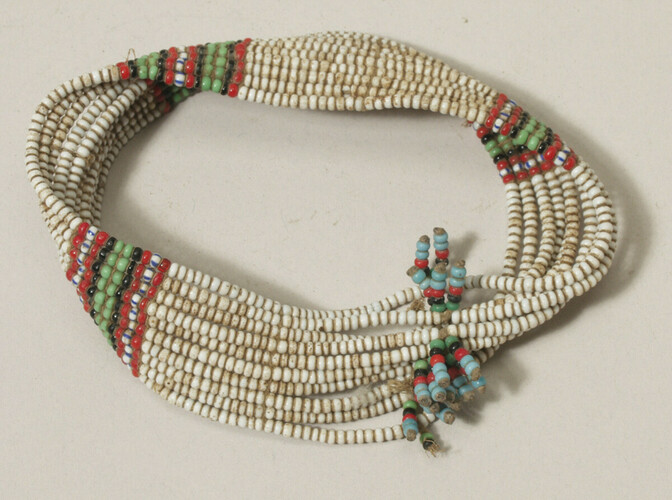 1979.20.157Multicoloured beaded ornament for the upper arm, worn by women [RTS 21/6/2004].1979.20.157
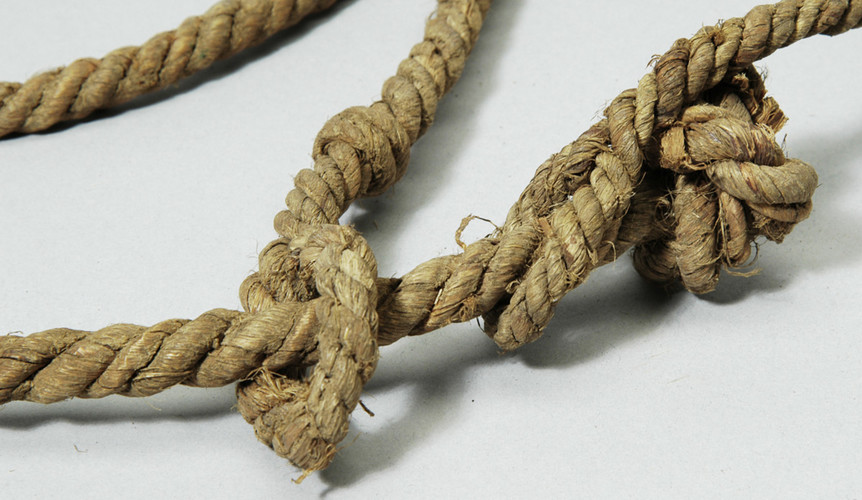 1931.66.22Thick twisted plant fibre cord with a noose at either end, used for hobbling cattle [RTS 30/11/2004].1931.66.22
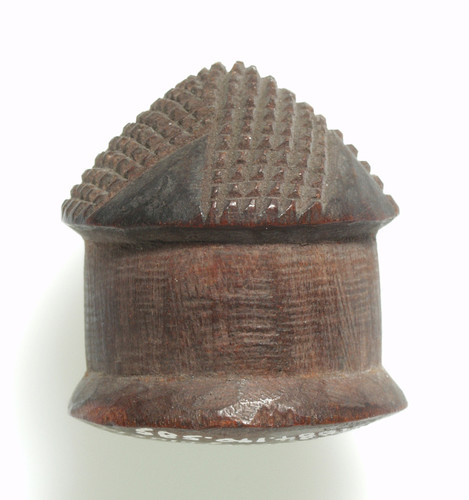 1884.140.585Cylindrical wooden lip stud with conical top bearing bands of incised crosshatching [RTS 11/5/2004].1884.140.585