
- Collection type
- Object
- Description
- Pair of earrings beaten from a sheet of tin into broad, flattened loops with narrow pins running across the top [RTS 24/11/2004].
- Long description
- A pair of almost identical earrings made from single pieces of sheet tin, hammered to shape. Each has a body is in the form of a broad flat loop or crescent with rectangular section, tapering slightly to the ends which have been cut at a slight angle. The top edge is left open, except for a narrow round-sectioned pin that runs horizontally across the opening, leaving a small gap between its tip and the other side of the earring. The metal is slightly flexible, to allow the earring to be opened up and this pin to be fitted through a hole in the owner's ear. The undersides are essentially flat, but irregular; on 1934.8.28.2 there is a slight convex curve to the surface, where the object has been pressed down onto another surface while shaping the upper face. The upper surfaces have a narrow, flattened inside edge, then the rest of the body slopes down and thins towards the curved outside edge. Both earrings are complete and intact; there is a slight surface flaw in the metal of 1934.8.28.1. Tool marks are visible on the underside, in the form of linear scratches, and the upper surface, in the form of numerous small dents made by using some kind of hammer. The metal has been polished, and shows no signs of corrosion; it is currently a metallic gray colour (Pantone 877C). 1934.8.28.1 has a weight of 3.9 grams, and is 25 mm long, 28.7 mm wide and 1.8 mm thick; the pin at the top has a diameter of 1.3 mm. 1934.8.28.2 weighs 3.7 grams and is 25.7 mm long, 29.3 mm wide and 2.1 mm thick; the pin at the top has a diameter of 1.4 mm [RTS 24/11/2004].
- Cultural groups
- Dinka
- Person
- Field collector Percy Horace Gordon Powell-Cotton
- Field collector Hannah Powell-Cotton
- PRM source Percy Horace Gordon Powell-Cotton
- Date / Period
- Date made: Before 05/1933
- Date collected
- 3rd May 1933
- Acquisition information
- Donated: 1934
- Dimensions
- Width 29.3 mm, Thick 1.8 mm, Width 28.7 mm, Depth 2.1 mm, Length 25.7 mm, Length 25 mm, Weight 3.7 g
- Object numbers
- Accession number: 1934.8.28.1 Accession number: 1934.8.28.2 Other numbers: 2036
- Research and responses
According to the Encyclopedia Britannica Online, the White Nile is the section of the Nile between Malakal and Khartoum, Sudan [CW 23/3/2000]. However the way in which this term has been used seems to have changed since this object was collected, aand Fanamweir appears to be located in the administrative district of Warab in the Southern Sudan. Powell-Cotton made ethnographic films during his 1932-3 shooting expedition to southern Sudan; footage included a Dinka hunter setting a trap, a staged fight between a Dinka and Jur and a female Dinka potter at work (see the description in Mrs Powell Cotton, "Village Handicrafts in the Sudan", Man 34 (112), pp 90-91) [RTS 12/12/2003].
Search terms: Ornament, Ear Ornament
Further items to explore
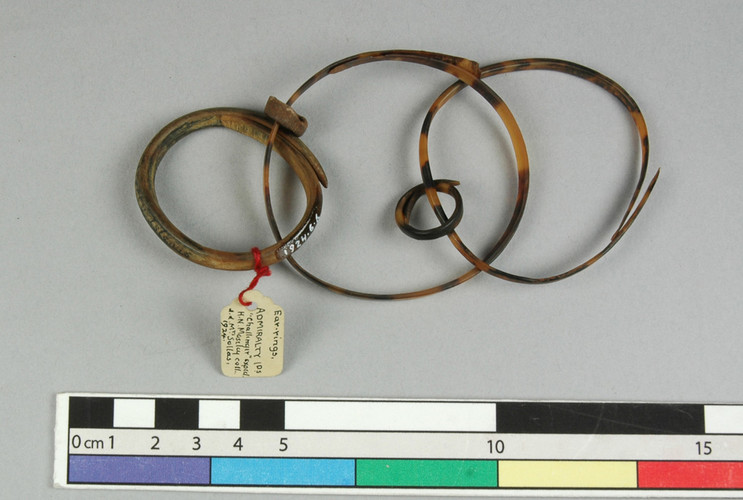 1924.6.6Ear ornament of five rings of turtleshell in different sizes, all attached to each other. [El.B DDF Body Arts Project 2010/2011 24/11/2010]1924.6.6
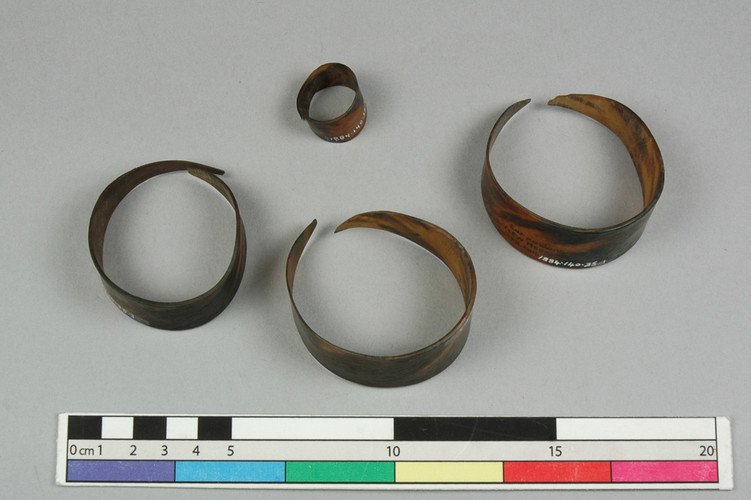 1884.140.35.1Four rings [.1-.4] of turtleshell with overlapping ends. [El.B DDF Body Arts Project 2010/2011 31/08/2010]1884.140.35.1
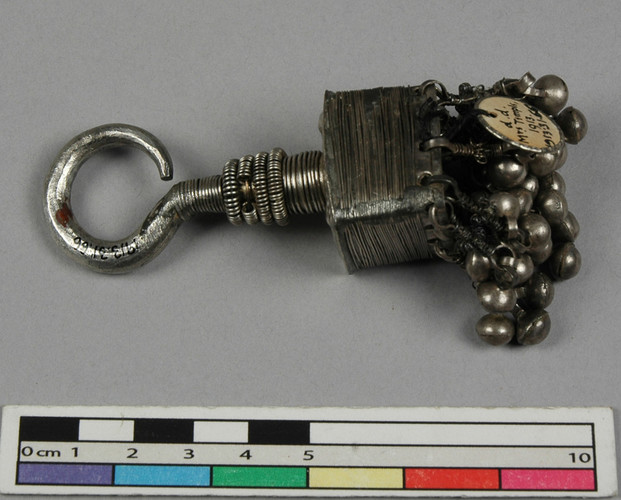 1913.31.66Silver ear ornament with hanging silver pendants. [MJD DDF Body Arts Project 2010/2011 05/11/2010]1913.31.66
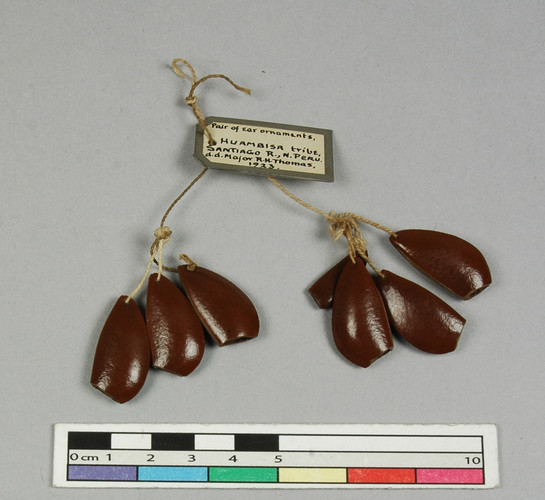 1923.88.214Ear ornament of a bunch of bean-like seeds with the ends cut off. [El.B DDF Body Arts Project 2010/2011 15/11/2010]1923.88.214
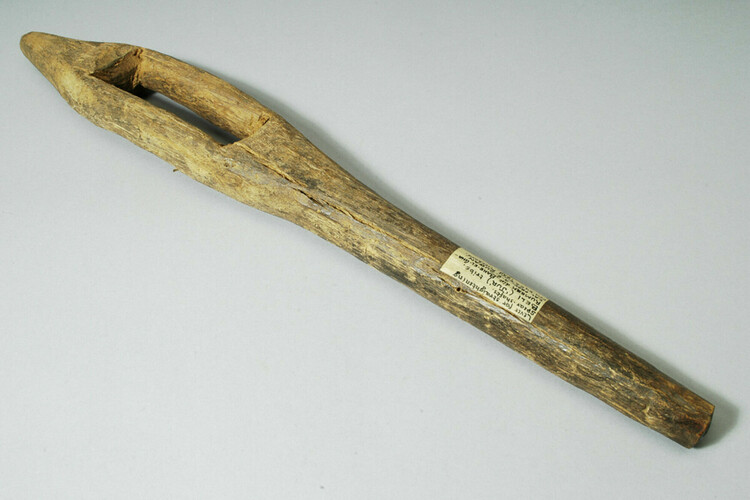 1929.47.2Wooden shaft straightener with pointed top, narrow upper body with a rectangular opening cut into the centre, and a cylindrical, tapering handle [RTS 28/6/2005].1929.47.2
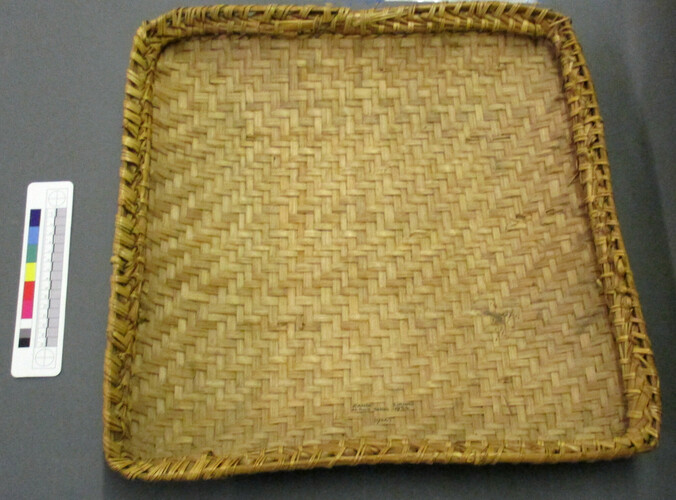 1934.8.127Square twill woven basketry winnowing-tray. The rim is reinforced by two cane bands. [CW [OPS Move] 19/12/2016]1934.8.127
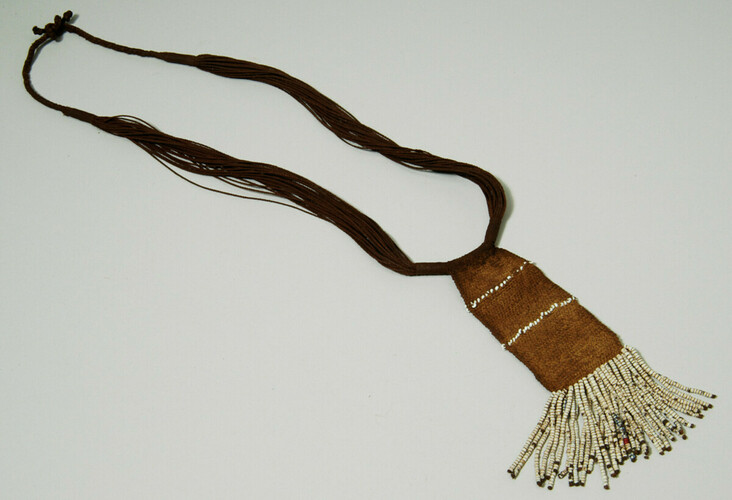 1934.8.95Multistranded carrying loop, hung with a narrow rectangular woven fibre tobacco bag with beaded base fringe [RTS 29/9/2004].1934.8.95
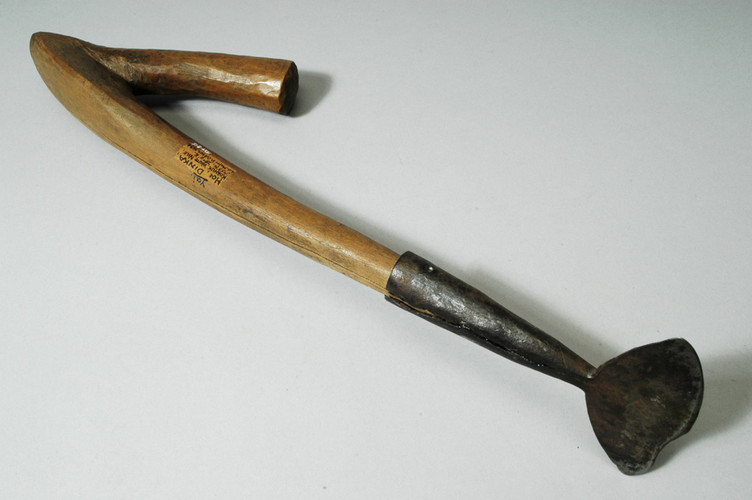 1934.8.15Hoe with iron blade with socketed base, fitted onto a wooden shaft with angled handle at the end [RTS 1/7/2005].1934.8.15