
- Collection type
- Object
- Description
- Brass weight for weighing gold, in the shape of two crocodiles crossed at the body.
- Cultural groups
- Asante
- Date / Period
- Date made: 1700-1900, uncertain
- Date collected
- By 1930
- Acquisition information
- Donated: 1930
- Materials and processes
- Material Brass Metal, Process Lost Wax Cast
- Dimensions
- Length: max 53 mm, Width: max 50 mm, Weight 39 g
- Object numbers
- Accession number: 1930.7.20
- Research and responses
According to de Kolb (1968) Ashanti Goldweights No.1, Gallery d'Hautbarr: New York, page 58 the proverb relating to the crocodile with two heads and one body is 'We have different mouths, but have the same stomach.'. [MJD DDF Body Arts Project 2010/2011 13/12/2010]
This weight was one of 97 studied by Ryan Brown, an MSc student at Cranfield University, between 2015-2016. Ryan used HH-XRF analysis to determine that the gold weights matched the composition of contemporary Portuguese brasses thus corroborating the literature that identifies Portugal as the source of Akan copper alloys. He also found that across the five centuries of gold weight production their composition did not greatly vary and it is therefore difficult to infer any datable information. The title of his Master’s thesis was “Non-Destructive Compositional Analysis of Akan Copper-Alloy Goldweights from Ghana, in the Pitt Rivers Museum, University of Oxford: Characterisation and Provenance” and a copy can be found in RDF under 1938.18.
Search terms: Measurement, Figure, Gold Weight, Animal Figure
Further items to explore
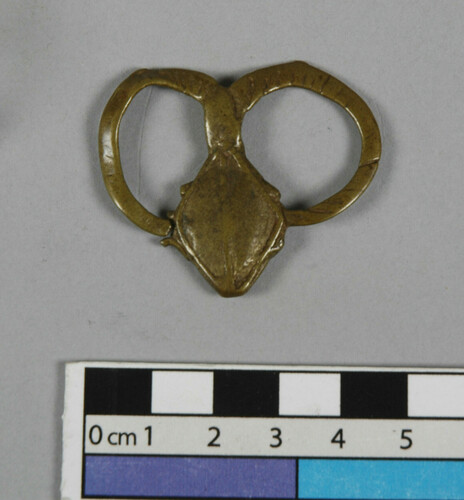 2000.6.753Brass weight used for measuring gold. A flat representational? weight of unrecognisable form. [CF 6/8/2002]2000.6.753
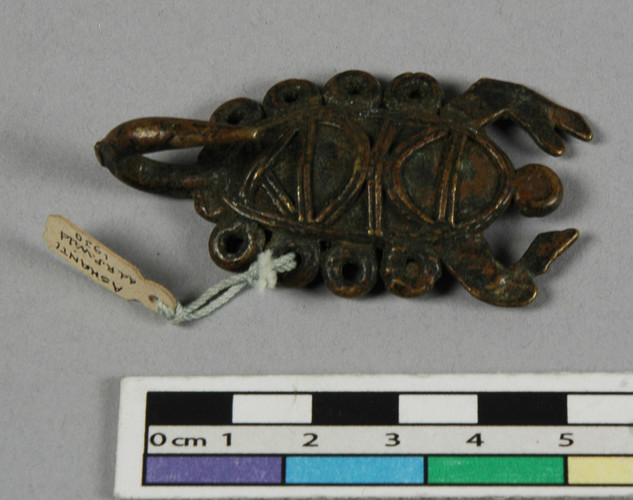 1930.7.37Copper alloy weight for weighing gold, in the form of a scorpion. [MJD DDF Body Arts Project 2010/2011 24/01/2011]1930.7.37
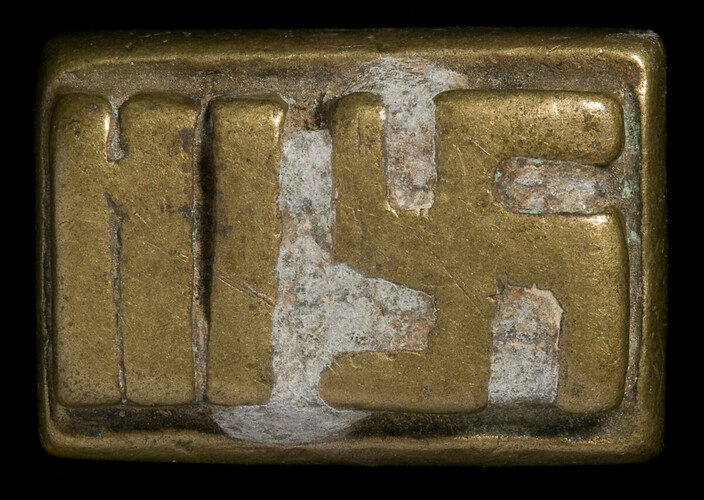 2000.6.344Brass weight used for measuring gold. The weight is rectangular in shape and has geometrical designs on the upper surface. [MdeA 19/12/2001]2000.6.344
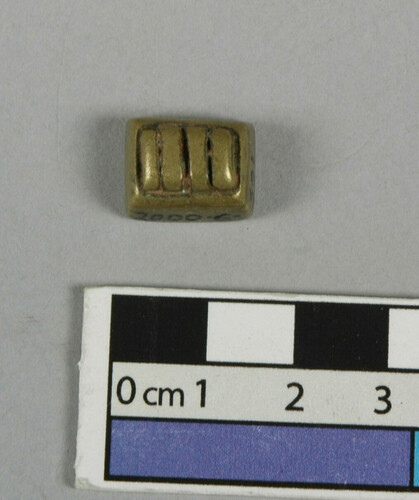 2000.6.391Brass weight used for measuring gold. The weight is roughly rectangular in shape and has geometrical designs on the upper surface. [MdeA 19/12/2001]2000.6.391