
- Collection type
- Object
- Description
- Beadwork neck ornament with 2 sets of bead strips [.1] joined at base with small circular metal mirror [.2] showing Queen Mary on front and country scene on reverse.
- Geographical reference
- Eastern Cape Tsolo [St Cuthbert's Mission]
- Date / Period
- Date made: Before 1923
- Date collected
- By 1923
- Acquisition information
- Donated: 1923
- Dimensions
- Length: max 470 mm, Width: max 100 mm, Length 690 mm fully opened
- Object numbers
- Accession number: 1923.34.32.1 Accession number: 1923.34.32.2
- Research and responses
For information on the collector, the mission for which he worked (St Cuthbert at Tsolo), and the wider context, see 'Jubilee Dandies: Collecting Beadwork in Tsolo, Eastern Cape 1897–1932', by Anitra Nettleton, in African Arts, Vol. 46, no. 1 (Spring 2013), pp. 36–49. (Printout of article in RDF for collection 1923.34.) [JC 25 11 2015]
For information on the collector, the mission for which he worked (St Cuthbert at Tsolo), and the wider context, see 'Of Severed Heads and Snuff Boxes: "Survivance" and Beaded Bodies in the Eastern Cape, 1897–1932', by Anitra Nettleton, in African Arts, Vol. 48, no. 4 (Winter 2015), pp. 22–33. (Printout of article in RDF for collection 1923.34.) [JC 25 11 2015]
- Associated publications
- Illustrated in colour as Figures 11a, 11b (detail), and 11c (detail) on page 29 of 'Of Severed Heads and Snuff Boxes: "Survivance" and Beaded Bodies in the Eastern Cape, 1897–1932', by Anitra Nettleton, in African Arts, Vol. 48, no. 4 (Winter 2015), pp. 22–33. Caption (same page) reads: '11a–c Mpondomise necklace, with painted snuff tin representing the head of Queen Alexandra, wife of Edward VII of the UNited Kingdom on one side and a landscape on the other. Collected by Mr. Frank Cornner in the vicinity of St. Cuthbert's Mission near Tsolo, Eastern Cape, before 1923. 69 cm x 10 cm | Pitt Rivers Museum, Oxford, no. 1923.34.32'. (Printout of article in RDF for collection 1923.34.) Nettleton goes on to discuss this object in detail (pages 30–32): 'The other necklace with a unique snuff tin (Fig. 11), in the Pitt Rivers Museum in Oxford, has an even more complex structure of panels of pink beads separated by blue seed beads, all strung horizontally, and crossed by rows of larger white beads to create similar sections. The snuff box has a painting of what appears to be Queen Alexandra, wife of Edward VII, on one side and a landscape on the other. Queen Alexandra is shown here, not in the profile of the medal-like snuff box portraits, but in a typical European three-quarter portrait view, with her hair piled high on her head, tiara set atop, and her neck encased in a carapace of chokers made of what appear to be pearls [note 26, p. 33; 'The Museum records identify her as Queen Mary, wife of George V, but the image in this portrait is so close to one published in The Pictorial World published to celebrate the Silve Wedding Jubilee of Edward VII and Alexandra in 1888 (British Museum no 1902.1011.10418) that I have taken it to be of the latter'], not dissimilar [pp. 30/31] to the kind of chokers made of beads and worn by isiXhosa-speakers and definitely visually similar to the large white beads in the necklace itself. Yet the queen’s beads are represented here as simple strings worn one above the other and are completely outclassed by the extraordinary technical expertise of the necklace to which the image is attached. The indigenous use of the imported materials trumps the wealth-value suggested by the queen’s baubles. / That wealth and monetary value are at play here is thus evidenced by the visual equivalence set up not only through the white beads’ relationship to pearls, but also in the relationship to coins in the embossed snuff tins and the gold and silver tones of the Vaseline tin and others with mirrors in their lids. The commodities to which these tins refer were all part of the economic exchange that happened in the trading stores of the rural Eastern Cape/Transkei, but also formed part of a chain of exchanges on a cultural and aesthetic level. That these necklaces as a whole tell tales of encounters between colonial and indigenous cultures is clear in the ways in which elements are combined and integrated into a newly significant set of objects, but perhaps none more so than in the reverse side of the Queen Alexandra snuff tin. / The landscape on the reverse of the Queen Alexandra tin, however, appears incommensurable with local African experience, except within the context of the mission station and the trading store. Its small rectangular house, somewhat dilapidated jetty on the pond in the foreground, and verdant trees in the background invoke the picturesque English countryside, not the vast open spaces and rolling hills of Mpodomise country in the late nineteenth and early twentieth century. In the large landscape, a small English-style mission settled in its midst would have been almost invisible, until it became marked by particular transformations wrought by the missionaries. Africans who visited the mission station in the year of Victoria’s Jubilee (1897) would have had less experience of such a foreign and Anglicized landscape than those who, visiting after 1907, encountered the results of the missionaries’ attempts to coax the African land to convert to Western ways by planting avenues of eucalyptus trees, cypresses in the graveyard, flower gardens, and fruit trees. Rural Africans did not emulate the rectangular buildings of the mission and the painted landscape until well into the twentieth century, and the need to grow gardens of trees and flowers is still not generally felt. In this rural, African context, which was that of the beadwork items to which the tin belonged, the Queen’s head and the picturesque view represented, not an England for which the wearer bore some kind of nostalgic affection, but an England manifested in magistrate’s offices and mission schools, houses, and hospitals. / But there may be further dimension to the attraction of the landscape painting on this snuff-box for an isiXhosa speaker. During the infamous “cattle-killing” among the Xhosa people proper (1856–1857), the prophetesses Nongqawuse and Nonkosi reported seeing the “new people,” accompanied by herds of cattle, who were to deliver the Xhosa from the domination of the British, in the sea or particular bodies of water. Nonkosi is reported to have seen recently circumcised initiates (abakweta) dancing on the surface of a pool on the Mpongo River. Nongqawuse saw the new people, who were ancestors soon to be resurrected, and the new animals in the sea and lagoon.... The new people were to bring new prosperity, happiness, and health to the Xhosa nation, largely through freeing them from the yoke of British colonial domination. The prophecies of their arrival from their lacustrine or maritime abodes appear to fit in with older traditions associating the acquisition of marvellous powers and wealth with spirits and visits to the depths in which [pp. 31/32] they lived. The Mpondomise chief Ngwanya, for example, was buried in a large pool in the Thina River, where he was given offerings of corn, maize, tobacco, and hemp and a slaughtered animal annually.... / That the image of the pond forms the reverse of the image of a white woman of great wealth bedecked with jewels may, possibly at a stretch, be paralleled to a wider phenomenon of Mami Wata worship that was manifesting itself in a number of different places at about the time that the snuff boxes were coming into use in the Eastern Cape. IsiXhosa-speaking initiates, the abakweta, are painted white when they are in their liminal phase after circumcision; isiXhosa-speaking doctors like the Mpondo igqirha are likewise painted white in the phase of their initiation and they were often said to have visited spirits under water. So the whiteness of the queen on one side of the snuff box and the image of her pool on the reverse could well have struck particular chords of resonance with indigenous belief, turning the image of the spouse of a hated dominator into an image of spiritual significance, one which signified the possibility of acquisition of wealth and prosperity.' (See full text for references, etc.) [JC 25 11 2015]
Search terms: Ornament, Bead, Trade, Toilet, Neck Ornament, Mirror, Toilet Article
Further items to explore
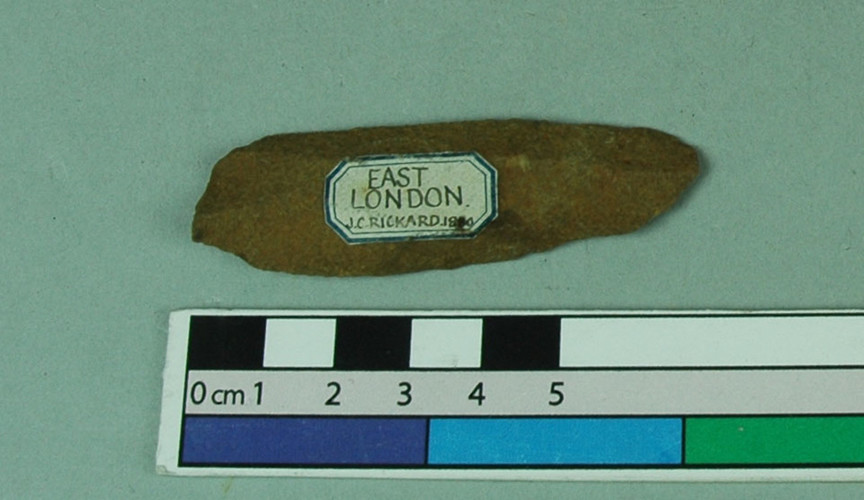 1928.68.403Flake implement made from a piece of orange brown stone, long and narrow and tapered to a point at the distal edge. [LKG 26/04/2010]1928.68.403
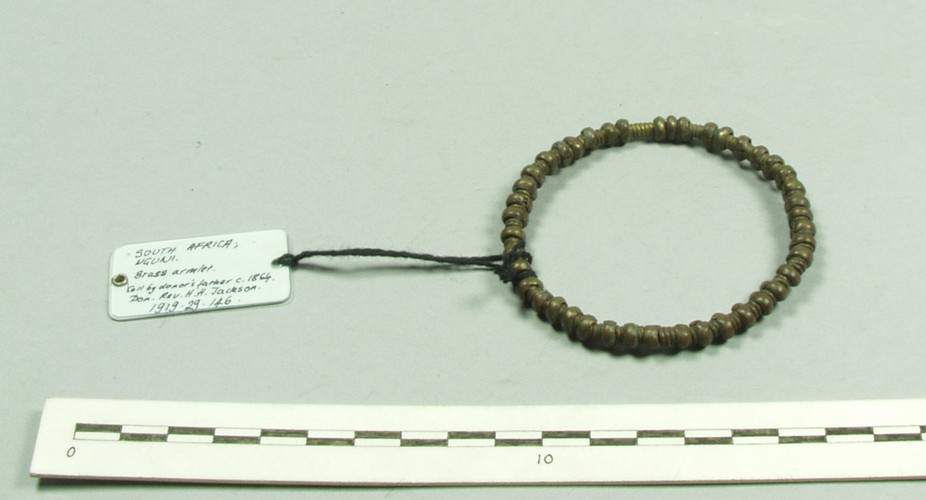 1919.29.146Arm ornament; flexible circlet of coiled brass wire with thicker brass (or copper?) wire ribbons clamped into 'beads' over the top [EC 'DCF 2004-2006 What's Upstairs?' 13/10/2005]1919.29.146
 1935.13.106.412Narrow stone flake of yellow ochre-grey colour, with a strong dorsal crest. [LKG 07/06/2010]1935.13.106.412
 1952.1.9.51Ostrich egg shell bead, disc shaped with central hole. [MJD 05/08/2010]1952.1.9.51