
- Collection type
- Object
- Description
- Neck ornament; stringwork loop strung with animals' teeth, possibly macaque.
- Date / Period
- Date made: Before 1906
- Date collected
- 1906
- Acquisition information
- Donated: 1927
- Materials and processes
- Material Monkey Tooth Animal, Material String, Material Plant Fibre, Process Perforated, Process Plaited, Process Braided
- Dimensions
- Length: max 280 mm doubled
- Object numbers
- Accession number: 1927.62.7
- Research and responses
Célia (Glicéria) Tupinambá is an artist, activist, teacher and researcher from the Serra do Padeiro village, located in the Tupinambá Indigenous Land of Olivença, in the south of the state of Bahia, Brazil. Célia and her niece Jéssica viewed this object during a research visit in June 2023 and provided the following information (a copy of which can be found in RDF under 1886.1.908):
For the Tupinambá, teeth necklaces are very powerful and should not be worn all the time. In situations of danger/high power, the necklace can take the force of the energy to avoid harm to the wearer, which explains why sometimes the teeth used in the necklace might crack or break. Teeth are a powerful material to use in objects because the force of a bite is a strong energy. The teeth can come from a variety of animals, today the teeth most commonly used to create necklaces in Célia and Jéssica’s community are cow teeth, however monkey teeth may also be used. Monkey teeth can be very powerful however, so can’t be worn by everyone.
Where the Putumayo River enters Brazil it is known as the Içá. See “Putumayo River" Encyclopædia Britannica Online. http://search.eb.com/bol/topic?eu=63572&sctn=1 [Accessed 24 February 2000] [JP 24/2/2000]
See also 1927.62.6 [JP 24/2/2000]
Search terms: Ornament, Neck Ornament
Further items to explore
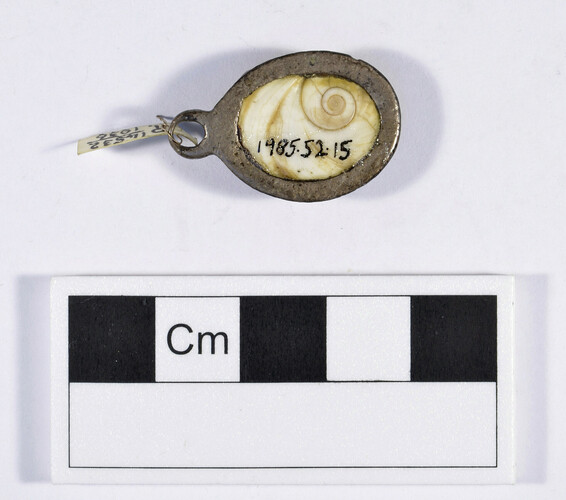 1985.52.15Amulet, operculum shell pendant. Inset in ?silver and perforated for suspension. [ACA 10/02/2012]1985.52.15
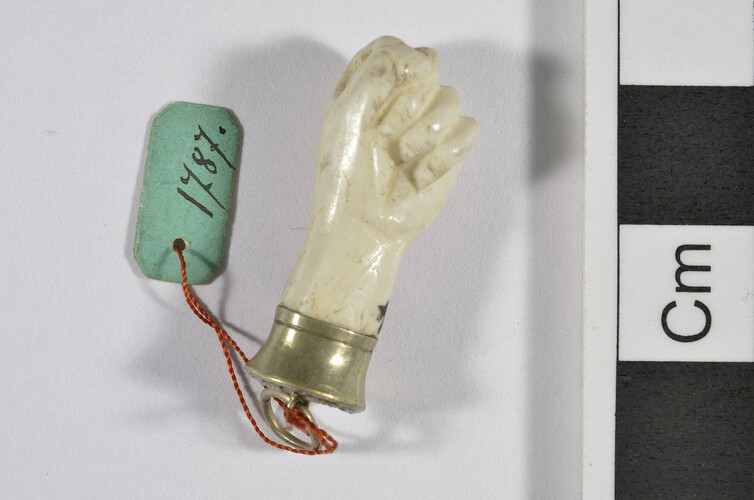 1985.52.912Amulet, pendant in the shape of a clenched hand, made of carved ?shell or ?bone, with a silver mount and loop for suspension. [ACA 18/04/2012]1985.52.912
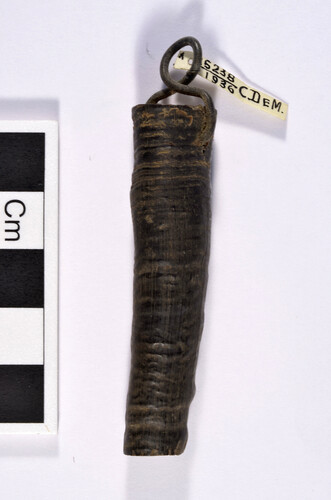 1985.52.319Amulet, gazelle horn pendant, perforated with a metal loop for suspension. [ACA 06/03/2012]1985.52.319
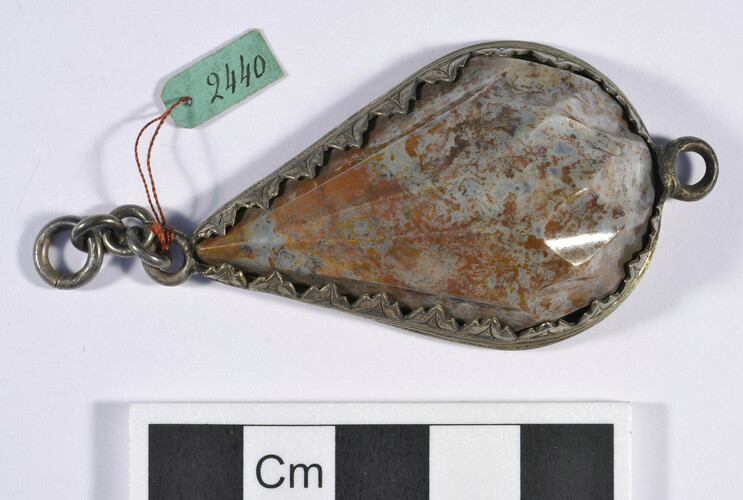 1985.52.1215Amulet, a teardrop shaped piece of red and grey Jasper stone carved to look like a crystal, in an incised silver mount, with a loop for suspension. [RB 10/05/2012]1985.52.1215