
- Collection type
- Object
- Description
- Helmet mask representing a woman with hair made up into a solid crested construction to which combs and bells have been added. [ZM 28/08/2013]
- Long description
- Mask with a human face painted white with black facial decorations on the forehead, above the eyes, cheeks and chin. Carved with an elaborate hairstyle and headdress consisting of three pink and black 'semicircles'. Openings carved at the eyes, ears and mouth. [ZM 14/05/2013]
- Geographical reference
- Southern Nigeria Anambra State Nri-Awka area Amobia village
- Cultural groups
- Nri-Awka Igbo
- Date / Period
- Date made: Before 1937
- Date collected
- 1937
- Acquisition information
- Donated: 1938
- Materials and processes
- Material Wood Plant, Material Pigment, Process Painted, Process Carved
- Dimensions
- Depth: max 340 mm, Height: max 470 mm, Width: max 205 mm
- Object numbers
- Accession number: 1938.15.4
- Research and responses
In the G.I. Jones photographic archive at Museum of Archaeology and Anthropology (MAA), Cambridge, is a black and white negative (identification number N.13332.GIJ) of this mask, which is described on the MAA photographic database as follows: 'A side view of a Mau helmet mask. The face of the mask is painted white with darker paint/pigments to accentuate the etched eyebrows, eyes, mouth. The eyes are small slits and the mouth is open and painted black with white teeth. On the temple is a circular etched and raised marking (resembling a keloid) and etched markings in the centre of the forehead. Around the face are dark swirled, circular designs representing hair (uli designs); there are two carved combs in the hair. On top of the arched crest are round circular carvings.' Also noted is that GI Jones wrote in pencil on the back of the print: 'IBO. Helmet Mask - Amobia village Nri-Awka Ibo. Now in Pitt Rivers Museum.' Under context is the following information: 'In relationship to this photograph, the masquerade Obugulu Mau, was very popular in the 1930s and consisted of a small group of female helmet-masked characters in brightly coloured harlequin-like tights (Jones, 1984, p. 60). Mau is translated as "secret society".' [The publication referred to is G.I. Jones, The art of Eastern Nigeria (Great Britain: Cambridge University Press, 1984] [ZM 08/11/2013]
John Picton examined the Igbo white-faced masks during a consultation visit on 12 November 2013 and noted the following: These white-faced masks are generally worn by middle-aged men (in their thirties and forties) performing the Agbogho mmanwu, which means maiden masquerade (see 1908.20.1, 1912.61.1, 1922.67.24, 1938.15.4 to 6, and 1972.24.67). In this masquerade the masks often appear in a series of staggered performances, for example two masqueraders may appear together one representing the mother and the other the daughter, which will be followed by another two masked performers. This style of mask depicts a female with an ornate hairstyle, which can be part of the actual carved mask or in the case of masks like 1938.15.5 and 6 attachments would be added to the costume to create this kind of hairstyle when these are used in masquerade. This particular mask does not look like it has ever been used as there are no holes carved around the edges for a masquerade costume to be attached and the inner surface of the mask is not smooth. [ZM 19/11/2013]
In March 2014 Herbert M. Cole identified this from a photograph as maiden mask and noted the following: Pretty female masks, often called maidens, are usually worn with bright multi-coloured, closely-fitting appliqued costumes. Common traits are white faces with small, delicate symmetrical features and elaborate crested hairstyles, carved as part of the mask or worn as a separate attachment, Usually men between eighteen and twenty-five years old wear these masks. Maiden masqueraders often appear in a group, for instance representing a mother spirit with her daughters. Performances are light-hearted and entertaining, combining exaggerated gestures of femininity with skilful dancing displays. [ZM 13/03/2014]
- Associated publications
- Published as a colour photograph on the cover of Ibo Art, by G. I. Jones (Buckinghamshire: Shire Publications Ltd., 1989). The caption (page two) reads: 'Helmet mask. Amobia village, Nri-Awka Ibo, representing a beautiful woman with hair made up into a solid crested construction to which combs and bells have been added.' [Note: the Museum accession number is not included but this is almost certainly this mask] [ZM 28/08/2013]
Search terms: Mask
Further items to explore
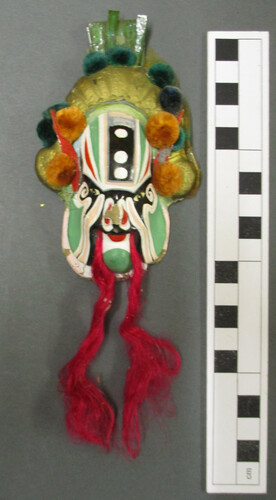 1970.24.16Plaster painted model of a mask. Painted and decorated with tufts of green and yellow silk thread. 2 red silk streamers represent a beard. [ASh [OPS move] 15/3/2017]1970.24.16
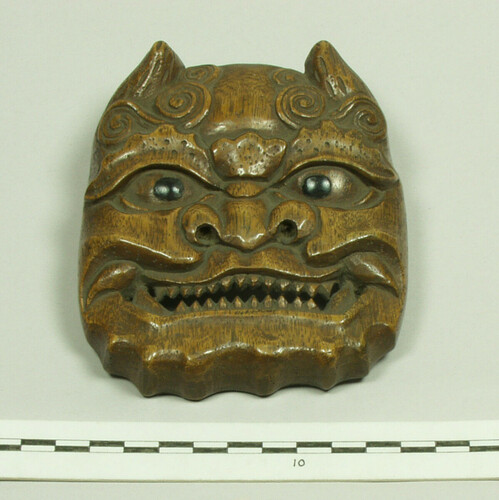 1980.34.2526A large wood toggle representing a mask with inlaid ebony eyes.1980.34.2526
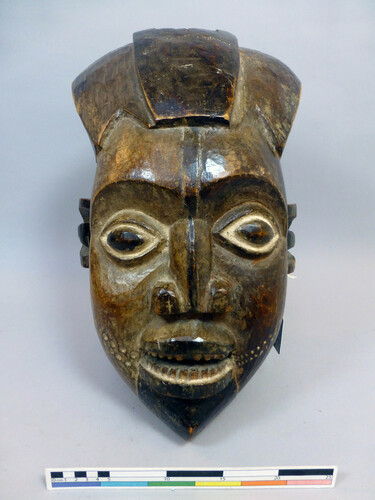 1987.23.3Helmet mask [ZM 23/04/2013]1987.23.3
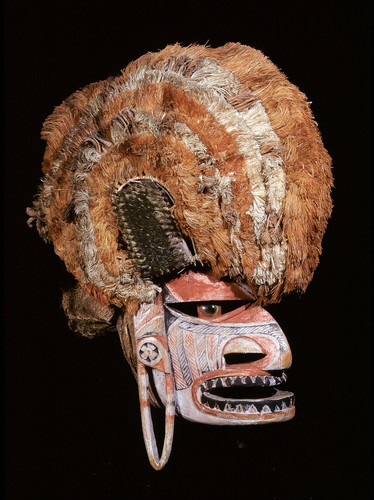 1899.62.405Mask covered in fibrous material, with a brush attached to one side. [CM]1899.62.405
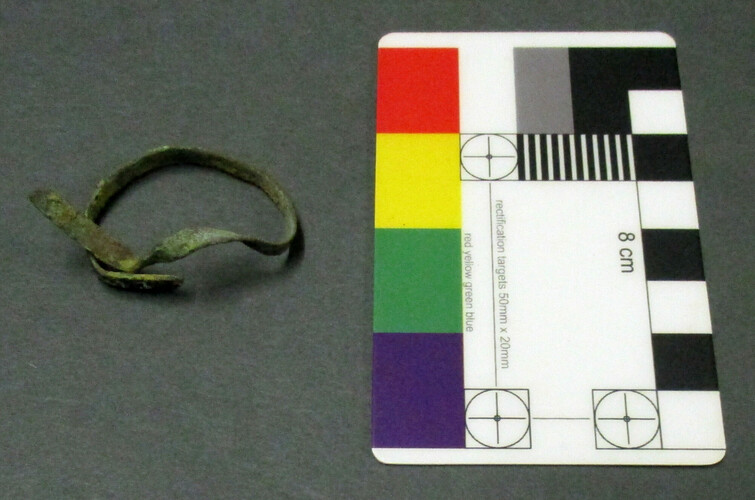 1942.13.1142.3Copper alloy wire. Flattened initially, then bent into almost a full circle that overlaps and twists at one end. [ASh [OPS move] 2/11/2016]1942.13.1142.3
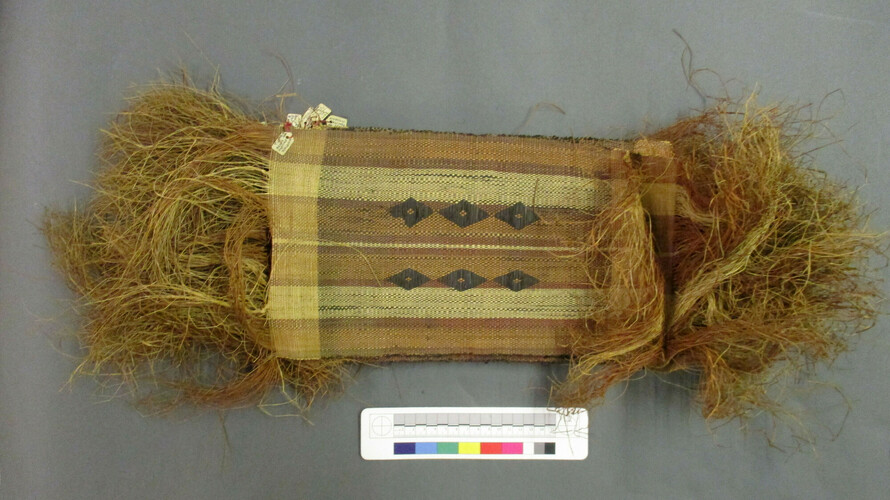 1938.35.1504Rectangular woven raffia mat, with two fringed shorter edges. The mat is inwoven with a pattern of stripes in varying shades of brown, and six dark brown diamonds. [EH [OPS Move] 26/6/2017]1938.35.1504
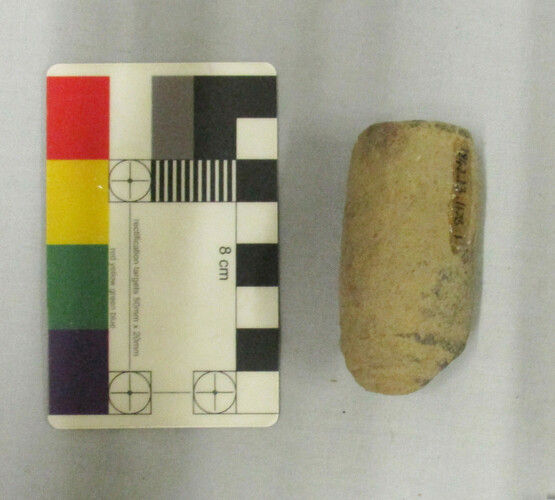 1942.13.1176.1Largest fragment belonging to a pipe bowl broken into eleven fragments. The fragment is made of pottery. It has a jagged edge revealing black coloured pottery underneath. The fragment is cylindrical with one side missing and curved short end decorated with two incised concentric lines. For the second largest, triangular shaped fragment see 1942.13.1176 .2 and for the other fragments too small to physically number see 1942.13.1176 [.3 - .11]. [CW [OPS Move] 27/9/2016]1942.13.1176.1
 1975.3.7.2Decorated calabash used as storage container. [This is a lid for 1975.3.7 .1]1975.3.7.2