
- Collection type
- Object
- Description
- 184 beads nephrite beads strung on flying fox wool, including plaited tassels.
- Geographical reference
- Person
- Field collector Emma Hadfield
- Field collector London Missionary Society
- PRM source Emma Hadfield
- Date / Period
- Date made: Before 1923
- Date collected
- 1886 to 1920
- Acquisition information
- Donated: 1923
- Materials and processes
- Material Nephrite Stone, Material Pteropus Hair Yarn Animal, Process Carved, Process Plaited, Process Perforated, Process Strung
- Dimensions
- Length: max 730 mm
- Object numbers
- Accession number: 1923.14.1
- Research and responses
Nephrite is not found in the Loyalty Islands, but is obtained by trade. Both the nephrite and the pteropus hair string are precious items. Pteropus hair string is often associated with an exchange (not straightforward trade, more exchange of gift between important persons). Pteropus hair string is made by taking other string (e.g. of coconut fibre) and rolling it over the pteropus fur until the outside of the string is covered with it. Information from Francois Wadra, visiting researcher from Mare, Loyalty Islands, September 2009. [El.B 23/09/2009]
For more information about the collector and donor see 'Emma Hadfield Among the natives of the Loyalty Group', by Hannah Ivory, pages 313 to 317 in Melanesia Art and encounter, edited by Lissant Bolton, Nicholas Thomas, Elizabeth Bonshek, Julie Adams, and Ben Burt (London: British Museum Press, 2013). On page 313 Ivory notes Emma, along with James Hadfield were London Missionary Society evangelists 'who resided on the islands of Ouvea and Lifou for nearly forty years, from 1886-1920...Recent research into the Hadfields' time in the Loyalties and their collecting activity indicates that it was principally Emma who collected the objects while in 'the field''. On page 314 the author mentions similar necklaces in the British Museum collected by Emma Hadfield and notes the following: 'Among the Hadfield Collection in the British Museum are thus a number of strings of jade beads that she [Hadfield] correctly predicted would 'soon become rare'. Emma observed in a letter to Read [Assistant Keeper at the British Museum] that she rarely saw them on the neck of her 'own women', and noted that their manufacture had ceased. Their rarity meant that the acquisition of such necklaces by Europeans was increasingly difficult. She noted, for example, that a French missionary, living 'in the midst of the tribes' had recently tried in vain to buy a string of such beads.' [ZM 5/5/2016]
For the donor's own description of this type of necklace see Emma Hadfield, 1920, Among the Natives of the Loyalty Group (MacMillan: London). On page 135 Hadfield writes: 'The men sat together chatting and talking under the shady trees, or by their firesides, making clubs, axe-handles, and rude archimedean drills, the "bit" of which was an uncut fragment of rough, hard stone. These drills were for piercing holes in jade stone, brought from New Caledonia. The green stone was made into beads, by rolling fragments of it between two stones and afterwards piercing them with the drill. These bead necklaces were worn and greatly prized by the women. They certainly represented a great deal of patience and labour, and are no longer made, consequently they are becoming very rare.' Talking about women on pages 140 to 142 she writes: 'They were not, however, quite without ornamentations. They wore beautiful long strings of jade beads (of which I have already spoken), and these were often threaded on the wool (dela) made from the fur of the flying fox, which they value so much; also they had bracelets (ija) made from large cone-shells, and these they wore, not on the wrists, but above the elbow.' [ZM 5/5/2016]
Search terms: Bead, Ornament, Status, Status Object, Neckgear, Neck Ornament
Further items to explore
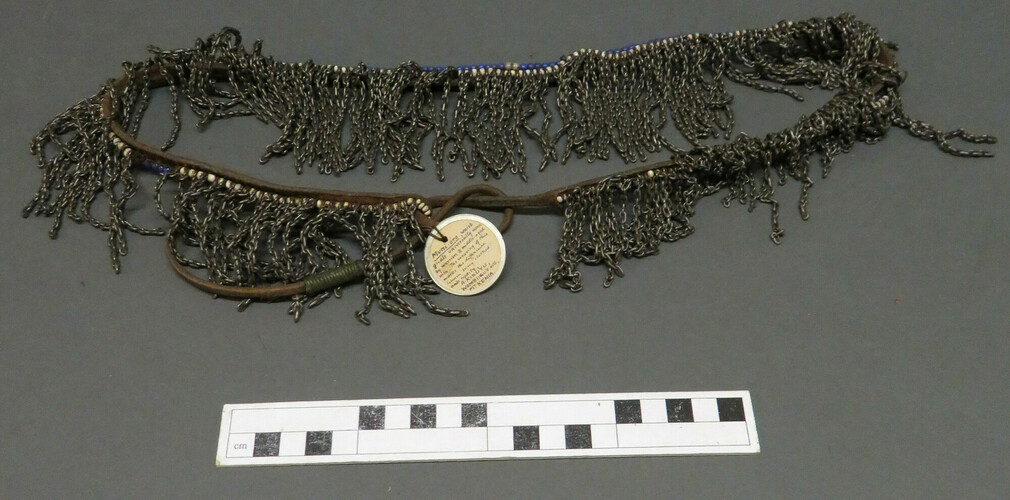 1911.11.2Ornamental waist girdle, worn by warriors and middle aged men. [FB 23/04/2015]1911.11.2
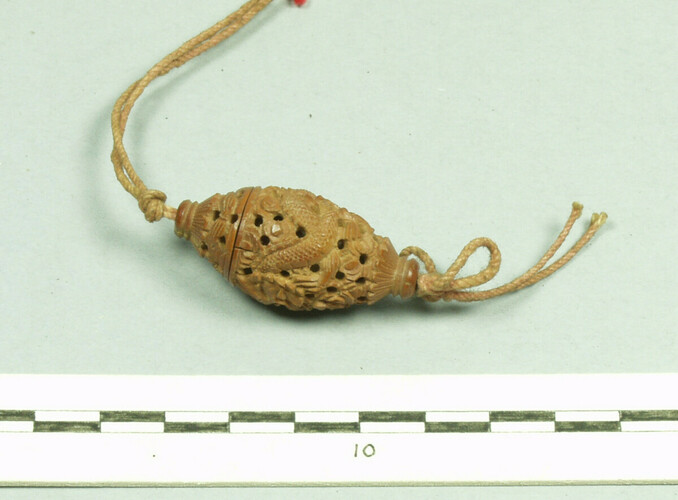 1944.7.64Long openwork bead carved out of wood or seed, with imperial dragon and Phoenix designs, on a brown string; the top of the bead comes off so that the bead doubles as a box. [N.B. 'DCF 2004-2006 What's Upstairs?' 20/7/2005]1944.7.64
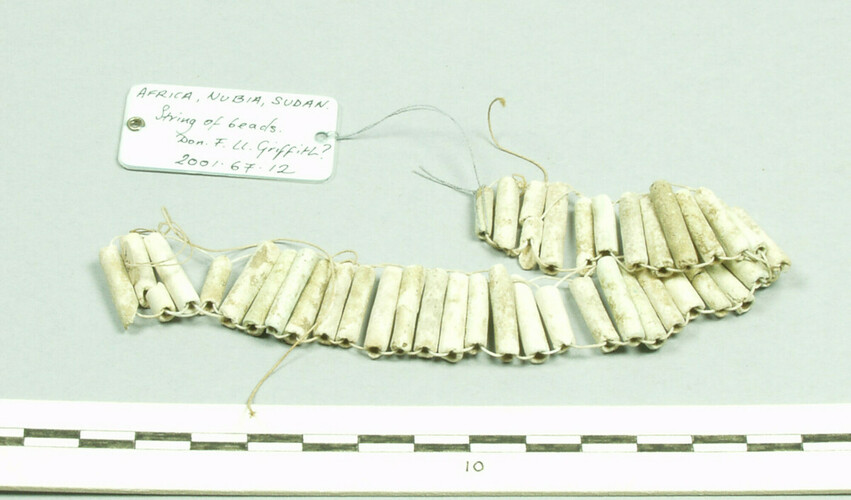 2001.67.12String of faience tubular beads. [El.B 'DCF 2004-2006 What's Upstairs?' 29/6/2005]2001.67.12
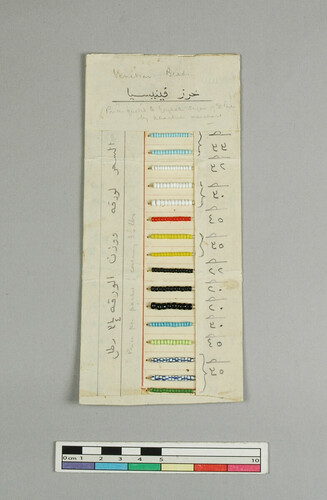 1971.15.163Specimen card with 15 rows of various coloured glass beads; marked with prices per pack of 3 1/4 pounds in Arabic [RTS 22/4/2004].1971.15.163
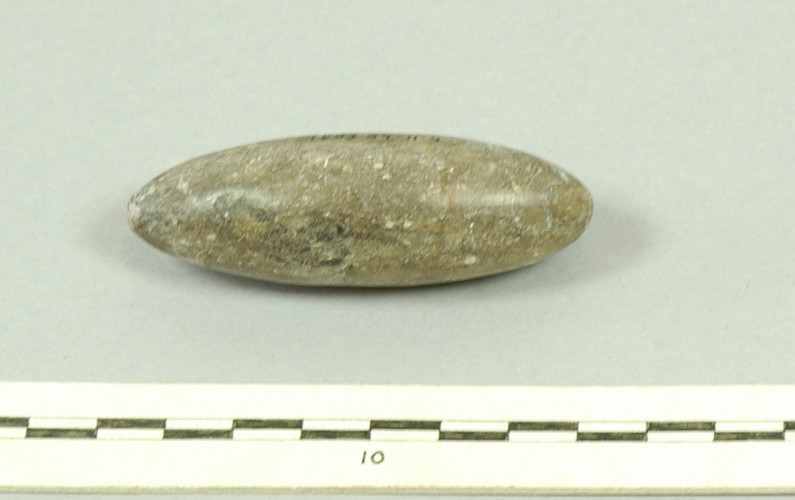 1903.54.11.41 of 4 sling stones carried in 1903.54.11 .1 [El.B 9/2/2007]1903.54.11.4
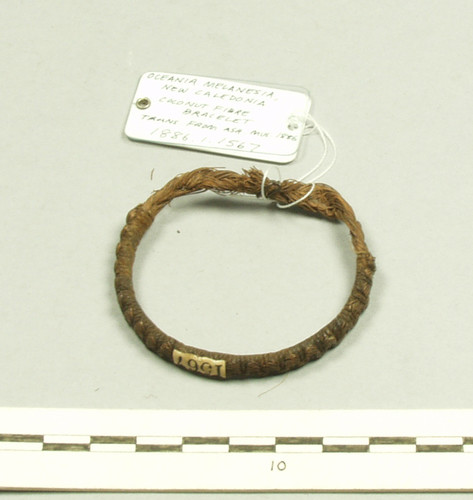 1886.1.1567Small bracelet of woven and plaited coconut fibre. [El.B 'DCF 2004-2006 What's Upstairs?' 21/11/2005]1886.1.1567
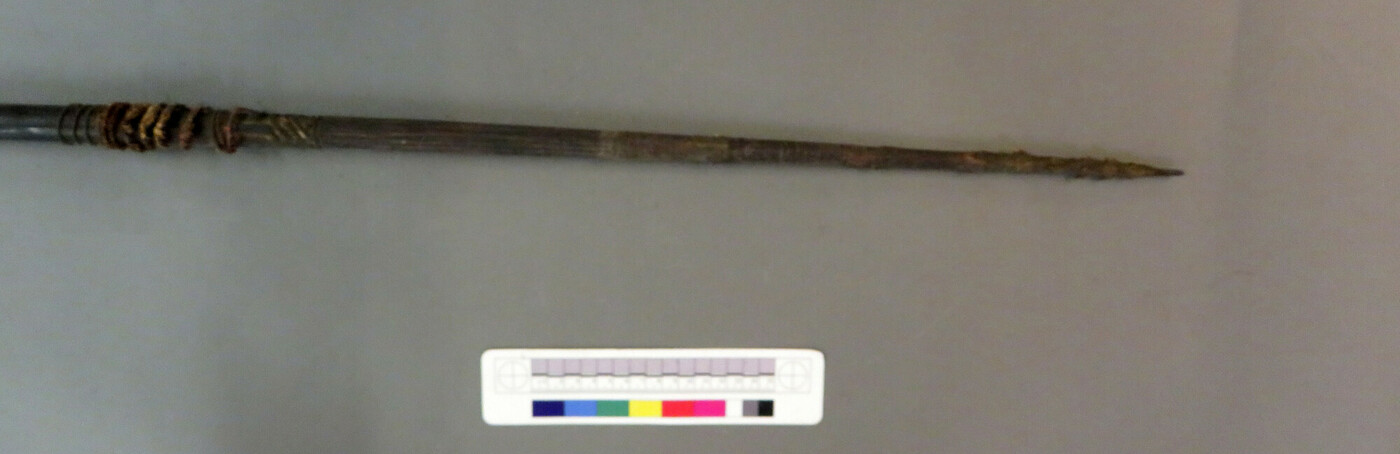 2018.150.1Spear with wooden shaft stained dark. The spear head has bone barbs bound with plant fibre and coated in resin. [FB 21/8/2018]2018.150.1
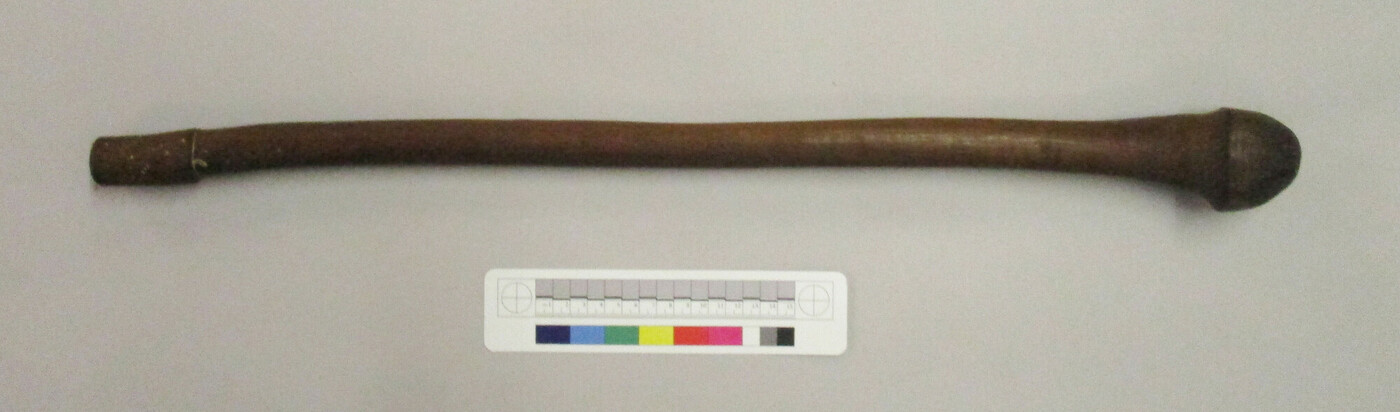 1884.12.186Wood club with globular mushroom-head, handle expanded in cylindrical form. [BS [OPS Move] 28/07/2016]1884.12.186