
- Collection type
- Object
- Description
- Headrest (kali ni bitu) made from a length of bamboo with two wooden feet attached to the bamboo with clumps of resin. [FB 27/11/2012]
- Long description
- Headrest made from a length of bamboo with two wooden feet attached to the bamboo with clumps of resin. The bamboo crossbar is inscribed with a dotted pattern with the letters SAMU.. and NOGO as well as other incised shapes and patterns. The feet are single flat pieces, solid but u-shaped in outline. [FB 27/11/2012]
- Date / Period
- Date made: Before 1888
- Date collected
- July 1888
- Acquisition information
- Donated: 1922
- Materials and processes
- Material Bamboo Plant, Material Wood Plant, Material Resin Plant, Process Carved, Process Incised
- Dimensions
- Height: max 135 mm approx, Width: max 150 mm, Length: max 380 mm
- Object numbers
- Accession number: 1922.43.5
- Research and responses
See R. Ewins, Fijian Artefacts: Tasmanian Museum and Art Gallery collection' Australia 1982: p.63: "Virtually every early visitor who wrote of thier experiences in Fiji mentions the curious headrest (Kali) of wood and/or bamboo. The general comment is that these were employed to preserve the often incredibly complicated hairstyles which were affected, and and this may well be true. Certainly without kali the hours spent preparing such coiffures would have been futile, and in this sense they could be considered to have engendered the mode. However, they were used in other parts of the pacific where such a 'hair fetish' does not seem to have been in vogue, and to this day in many vale levu (meeting houses) one will find improvised forms of the kali. I have very recently seen not only old people but quite young men in remote villages choose these wooden forms in preference to pillows, and pass the night on them. They were fairly standard in design - a cross bar of wood (either flat, curved or cylindrical) or of bamboo with either two flat (triangulate, or curved sided) legs, one at each end, or more commonly four short legs, square or cylindrical, generally tapered and often with small square or circular 'feet'. These feet were basically an inverted U-shaped piece of timber, recessed or flattened on the curve to accommodate the cross-piece (which was bound to it with sennit), and often presenting, in the end result, a very comical 'bow-legged' appearance. The kali were sometimes delicately inlaid with whale ivory (probably by Tongan craftsmen) and a chief's kali, like his hair or any other part of his head, might not be touched other than with special dispensation. If legs were omitted, the low form was called i lokoloko, and used by sick people - this word has been used for European stuffed pillows.
Roth indicates that the kali was reserved for chiefly use, and this could relate to more ornate coiffure affected by chiefs, or it could relate to the mana (spiritual power) which I have been told was believed by Polynesians to surround the head of chiefly people like an 'aura'. This was given as the reason the head was tabu, and if it is true could be a deeper reason for keeping the head of the ground.
The kali is placed under the neck, rather than the head, at the base of the skull or, if sleeping on the side, just above the angle of the jaw. Today a node of bamboo or block of wood (as high as 20cm, on occasion!) is generally all that is used (even Sunshine milk tins have enjoyed a recent vogue!), though I saw one in Nadroumai, Nadroga Province, made of packing-case wood and with large nails under it. The beautifully carved vesi items are apparently not made except as replicas for sale." [FB 27/11/2012]
Search terms: Furniture Dwelling, Headrest
Further items to explore
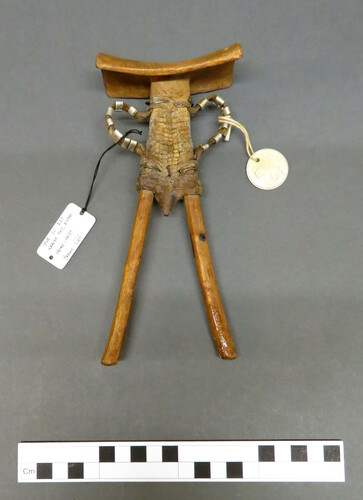 1968.20.221Wooden headrest with curved rectangular seat and two splayed legs both bound with leather and with two leather loops decorated with strips of aluminium. [JC [OPS Move] 22/3/2017]1968.20.221
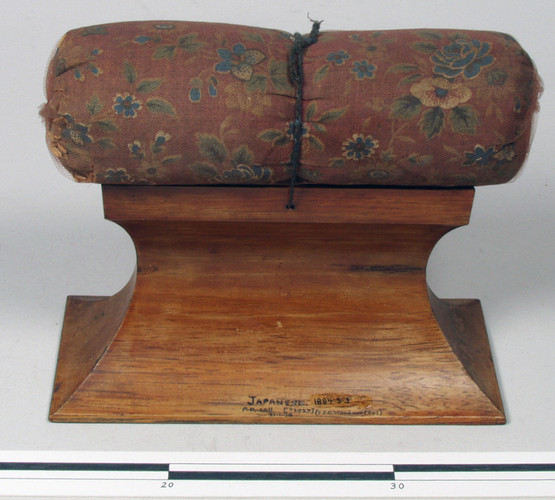 1884.3.3Wooden headrest with cylindrical red floral printed textile cushion. The cushion is covered with red netting and stuffed with ?plant seeds. It is tied to the wooden stand with blue yarn that has been threaded through a hole in the stand. The top and the base of the stand are rectangular, and the stand narrows in the middle. [EH [OPS Move] 24/3/2017]1884.3.3
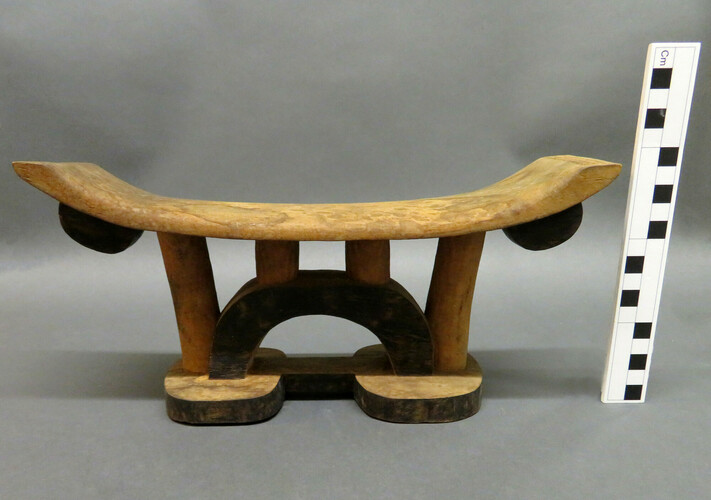 1911.19.1Wooden headrest. The seat is concavely curved and rectangular in shape, with bands of incised line decoration at both ends and two semi-spherical pieces carved from the underside. The seat is supported by four carved pillars and an arch, which attach it to the base. [EH [OPS move] 20/3/2017]1911.19.1
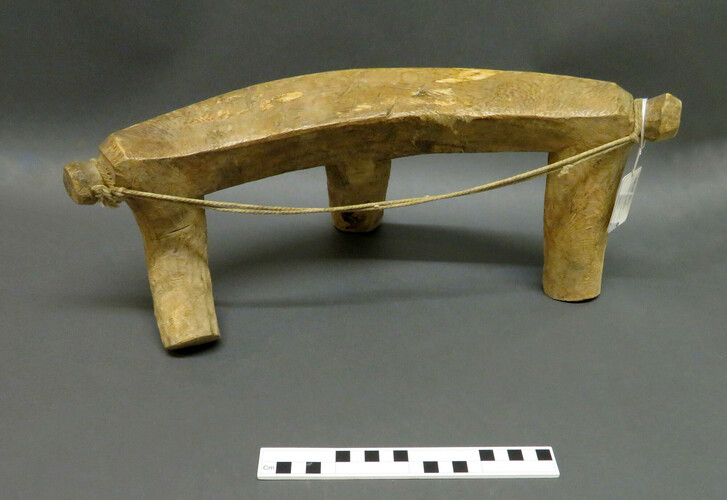 1979.20.87Wooden 3-legged headrest with twisted cord handle [RTS 22/3/2005].1979.20.87
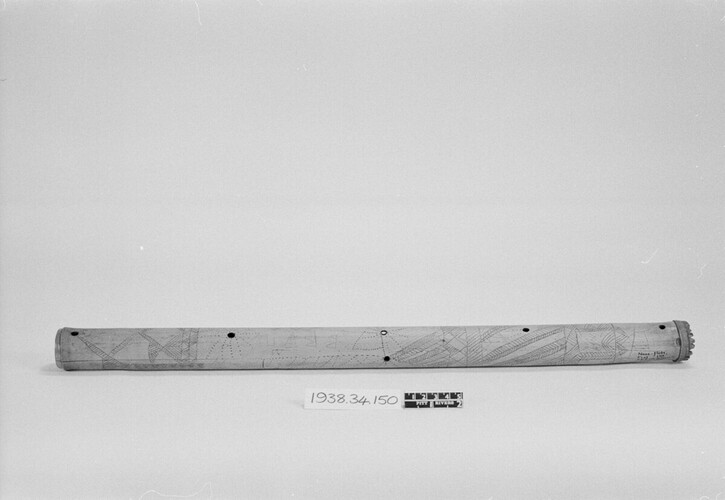 1938.34.150Nose flute made from bamboo. The surface of the flute has been decorated with incised designs and burnt decoration. [FC 25/07/2011]1938.34.150
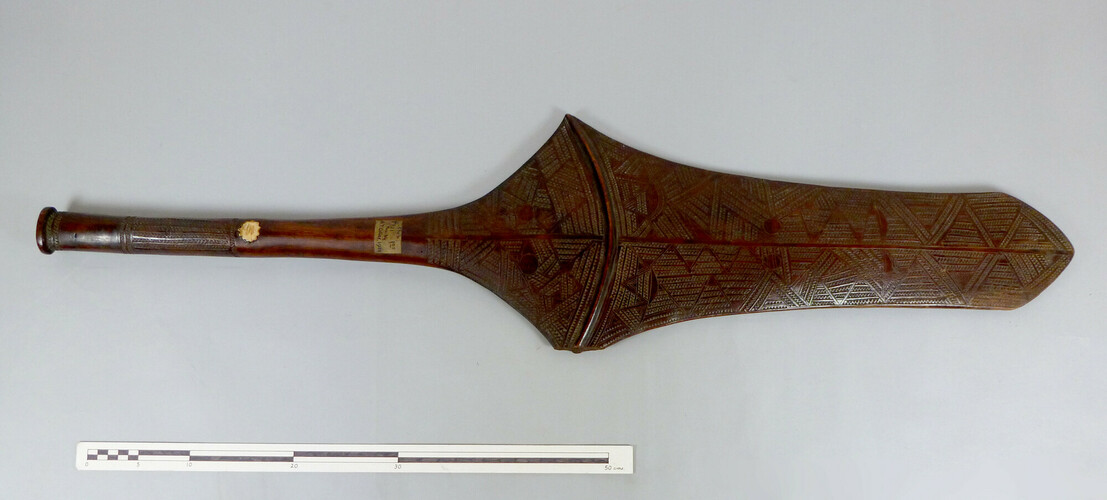 1933.32.4Carved paddle club, known as a kiniknini, with inlaid whale bone on the handle. [ZM 2/6/2016]1933.32.4
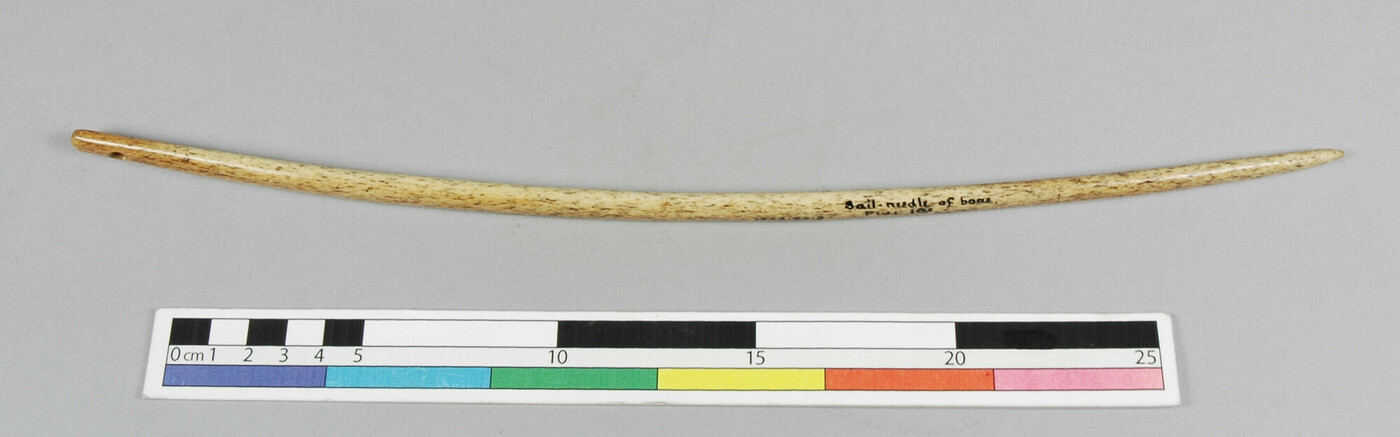 1923.50.3Bone needle for stitching canoe sails.1923.50.3
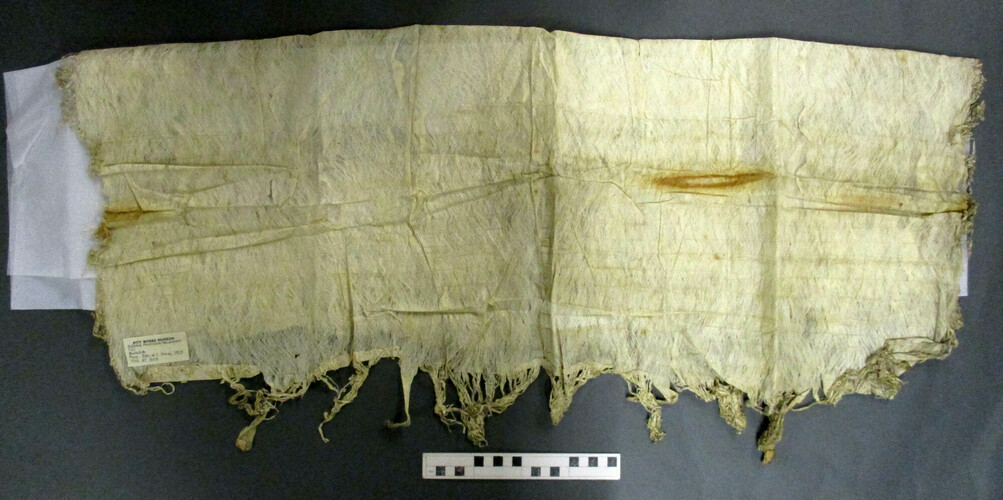 1923.87.303Barkcloth. It is cream in colour, the edges are fringed. There are some brown coloured stains on the barkcloth. It has been folded. [AB [OPS Move] 18/7/2017]1923.87.303